Ads for Electricians: A Playbook for Profitable Jobs
Stop wasting money on ads for electricians that don't convert. This playbook covers channels, budgets, and landing pages to get you more booked jobs in 2026.

Most advice on ads for electricians is backwards.
It tells you to chase more clicks, broaden your keywords, and “build awareness” everywhere at once. That’s how you burn cash. Electricians don’t need more traffic. They need the right calls, from the right jobs, in the right areas, with a response system that books fast.
The fix is simpler. Split your ad budget by job type and urgency. Put emergency work on high-intent channels. Put planned upgrades on channels that can sell trust and quality. Then tighten everything after the click, because a weak landing page or slow callback will wreck even a good campaign.
Table of Contents
- Why Your Current Ads Are Costing You Money
- Choosing Your Advertising Battlegrounds
- Building Your Emergency Response Campaigns
- Winning High-Value Planned Projects
- The Landing Page That Actually Converts
- The Post-Click Playbook for Booked Jobs
Why Your Current Ads Are Costing You Money
Most electrician ad accounts fail for one reason. They optimize for activity, not profit.
A lot of owners look at clicks, impressions, and click-through rate and think the campaign is healthy. It isn’t. If the calls are weak, the form leads are junk, or the jobs booked are small and out of area, none of that dashboard noise matters.
Clicks aren’t the goal
The math got tougher. The average cost-per-lead for electrical contractors using search advertising is $93.69, and the average cost-per-click is $12.18. Electricians need a 9.08% conversion rate just to maintain profitability, according to these electrical marketing benchmarks.
That means lazy campaign structure gets expensive fast.
If you’re paying premium click prices, a sloppy setup hurts twice. First, you pay too much for the visit. Then you pay again when the visitor lands on a generic page and leaves without calling.
Practical rule: Stop asking, “How do I get cheaper clicks?” Start asking, “Which campaign gave me booked jobs I actually want more of?”
The same problem is starting to show up in newer channels too. Early ad inventory can look cheap, but cheap attention still fails if intent is weak or routing is messy. That’s also why smart contractors are watching channels like ChatGPT Ads while the market is still early, instead of assuming old Google playbooks solve everything.
What to track instead
Your real scoreboard is short:
- Booked job cost: What did it cost to produce an actual scheduled job, not just a lead.
- Job type: Did the campaign bring emergency repairs, panel work, EV charger installs, or junk.
- Service area fit: Did the call come from places you want to serve.
- Answer and follow-up quality: Did your team pick up, text back, and lock the appointment.
A campaign can have expensive clicks and still work if it produces strong jobs. Another can brag about “low CPL” and still lose money if the callers are price shoppers, DIYers, or outside your map.
That’s why broad advice fails electricians. Electrical demand isn’t one thing. Emergency calls, planned upgrades, and commercial work behave differently. If you lump them together, the account hides what’s happening.
Here’s the blunt version. If your ads for electricians send every service to one campaign, one page, and one phone line, you don’t have a strategy. You have a leak.
Choosing Your Advertising Battlegrounds
Not every channel deserves your money.
Some channels capture demand that already exists. Others create demand and warm people up over time. If you mix those jobs up, your budget gets dragged down by the wrong traffic.
The first decision is simple. Are you trying to catch urgent buyers, or are you trying to sell a higher-value planned service?
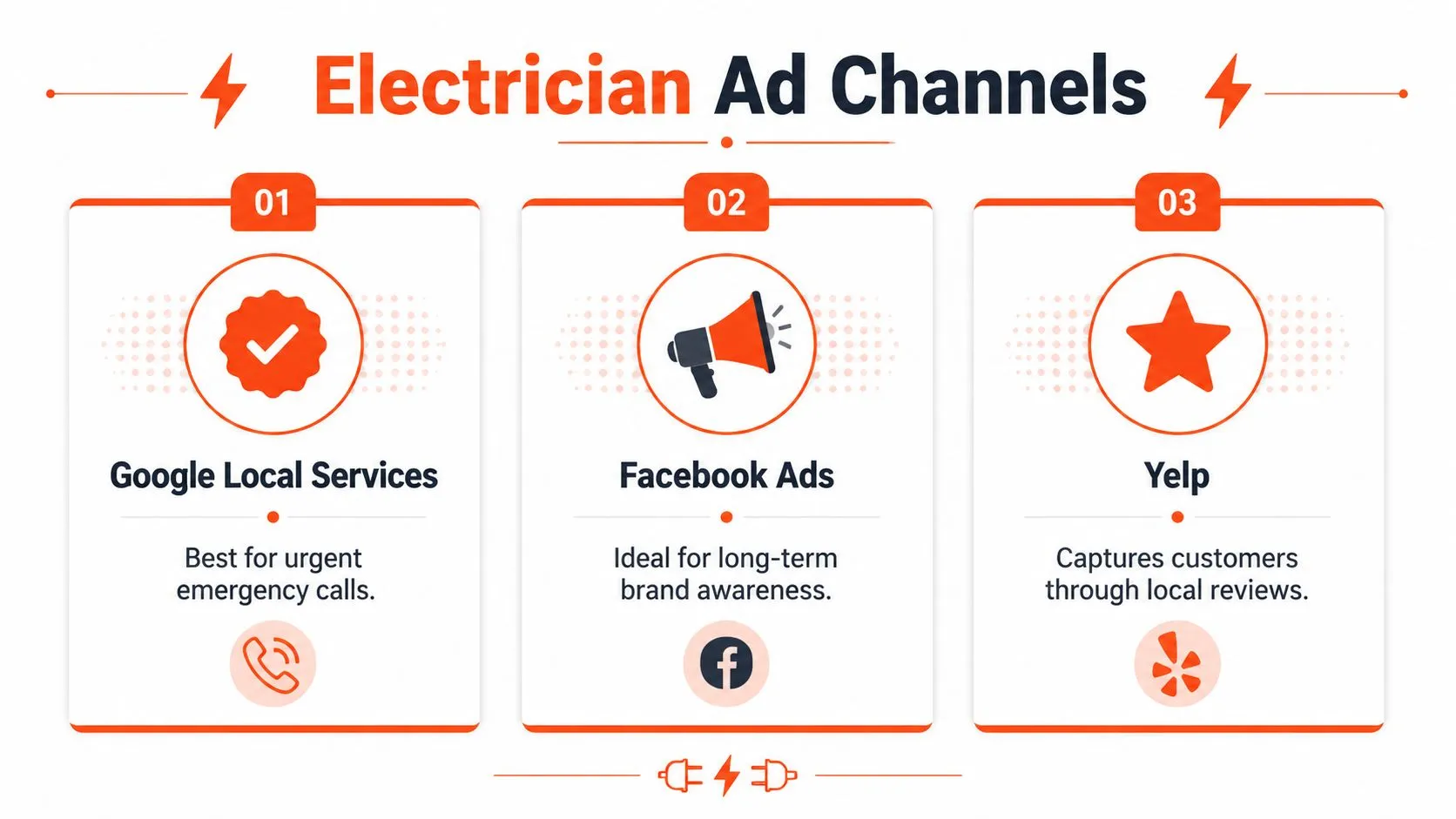
Ad Channel Quick Comparison for Electricians
Google Ads clicks for electricians often run $10 to $30 each, and with a 10% conversion rate, a lead can cost over $100. By contrast, Google Local Services Ads are paid per contact, with reported electrician lead costs around $15 to $23 per lead, based on this electrician lead cost breakdown.
That doesn’t mean Google Ads are bad. It means you need to know what each channel is for.
| Channel | Typical Cost Model | User Intent | Best For |
|---|---|---|---|
| Google Local Services Ads | Pay per contact | Very high intent | Emergency calls, “near me” demand, fast phone leads |
| Google Search Ads | Pay per click | High intent if tightly managed | Emergency terms, specific service keywords, overflow volume |
| Meta Ads | Paid social | Lower immediate intent, stronger for demand creation | Panel upgrades, EV chargers, generators, rewires, remarketing |
Where to start if you’re spending your first real ad dollars
If you’re new to paid ads, start with LSA first for emergency and service demand. It lines up better with how electricians get booked. The person searching usually wants help now, and the pay-per-contact model is easier to control than open-ended click spend.
Then add Google Search Ads, but keep them narrow:
- Use exact and phrase match: Don’t let broad match wander into junk.
- Target only serviceable areas: Skip the fringe zones that kill windshield time.
- Schedule around real answer coverage: If nobody answers, don’t buy the click.
- Break out service lines: Separate emergency terms from estimate-driven installs.
Meta comes later for most shops. It’s not the first place to hunt a homeowner whose power just went out. It is a strong place to sell planned work people don’t search for until the need gets urgent.
Run emergency and planned campaigns on different channels, with different offers, and different landing pages. Anything else muddies the results.
One more thing. Local targeting has to match your actual dispatch map. Don’t use a big radius because it feels safer. Tight service area strategy beats vanity reach every time. If you need to sharpen that side of the setup, this geo strategy guide for local campaigns is worth reviewing before you scale.
A lot of contractors also spread money across too many platforms because they’re afraid to miss something. That’s the wrong instinct. It’s better to own one channel for emergency demand and one channel for planned work than to run five half-baked campaigns.
If I were advising a typical residential electrician, the order would be simple:
- LSA for immediate service calls
- Google Search Ads for tightly controlled urgent and high-intent service terms
- Meta for upgrades, installs, and remarketing
That’s your base. Everything else is optional.
Building Your Emergency Response Campaigns
Emergency electrical ads should feel like dispatch, not branding.
When someone smells burning, loses power, or sees a breaker trip over and over, they aren’t browsing. They want a licensed pro who answers now. That’s why most electricians waste money when they run emergency and non-emergency terms inside the same campaign.
Emergency repair terms should be targeted on high-intent search and LSA, while planned upgrades perform better on visual social ads and remarketing, as explained in this guide on electrician advertising strategy.
Build the campaign around panic searches
Your emergency keyword list should sound like the customer’s problem, not your company brochure.
Use terms such as:
- Urgent service terms: “emergency electrician,” “24 hour electrician,” “electrician near me now”
- Problem-based searches: “power out in house,” “breaker keeps tripping,” “burning outlet,” “sparking socket,” “electrical burning smell”
- Local intent terms: “licensed electrician [city],” “same day electrician [city]”
Keep these in their own campaign. Don’t bury them under broad service lists like lighting installs, fan wiring, or remodel work.
A better structure is:
- One campaign for 24/7 emergency
- One for same-day repair
- Separate ad groups for core pain points like panel, outlet, breaker, outage
That setup makes ad copy tighter and landing pages easier to match.
Write ads that sound available right now
Emergency ad copy should answer three questions fast. Are you local? Are you licensed? Can you come now?
Good examples:
- 24/7 Emergency Electrician in [City]
- Licensed and Insured. Fast Response
- Power Out or Breaker Tripping. Call Now
- Local Electrician Available Today
- Emergency Repairs. Real Techs. Real Answers
Bad examples are vague lines like “Trusted electrical solutions” or “Quality service for all your needs.” Nobody in a live electrical problem cares.
Say what you do, where you do it, and how fast someone can reach you.
Use call extensions. Send clicks to an emergency-specific page. Put the phone number in the headline area and again in the body copy.
Block junk traffic hard
Negative keywords save emergency budgets.
At a minimum, filter out traffic tied to:
- Employment intent: jobs, hiring, apprentice, salary, career
- DIY intent: how to, fix yourself, diagram, wiring guide
- Education intent: class, course, training, school
- Irrelevant shoppers: free, cheap parts, wholesale
A lot of ad accounts lose money through waste. The clicks look legit in the dashboard, but the callers never intended to hire an electrician.
Also watch your schedule. If you run emergency ads overnight but calls hit voicemail, you’re buying expensive misses. If you can’t answer after hours, either route calls to an on-call person or shut those hours off. Don’t pretend to be available.
The best emergency ads for electricians feel obvious when the customer sees them. The offer is speed. The promise is credibility. The path is one tap to call.
Winning High-Value Planned Projects
Planned work needs a different sales job.
Nobody wakes up and panic-searches for a panel upgrade because their home is outdated. EV charger installs, service upgrades, generators, and rewires usually come after research, comparison, and a trust check. If you market these like emergency repair, you’ll get weak leads or no leads.
Sell the upgrade, not the appointment
For planned projects, the ad has to make the homeowner care before they click.
That means your message should focus on outcomes:
- safer power
- cleaner installs
- future-ready home upgrades
- code-conscious work
- expertise with the exact service
Photos matter for these ads. Use real panel replacements, EV charger installs, generator setups, and clean finished work. Skip stock images. Homeowners can spot fake creative fast, and it hurts trust.
Good angles for ad copy:
- Panel upgrade for older homes
- EV charger installation by a licensed electrician
- Ready for backup power before the next outage
- Clean, code-ready electrical upgrades
- Get an estimate for a home electrical upgrade
Use Meta to create demand you won’t catch on search
Meta works better for this category because people often aren’t actively searching yet. They need to see the service, understand why it matters, and decide your company looks credible enough to contact.
A strong planned-project campaign usually includes:
- Simple visual creative: before-and-after photos, short install clips, truck and tech photos
- A narrow offer: panel upgrade estimate, EV charger consultation, generator install quote
- Service-specific landing pages: don’t dump all traffic on a homepage
- Remarketing: stay in front of people who visited but didn’t book
The creative should look like proof, not promotion.
For example, an EV charger ad should show the charger, the finished setup, and the type of home it fits. A panel upgrade ad should show a clean panel, neat labeling, and a short line about safety or capacity.
Planned jobs close on confidence. Your ad should make the homeowner think, “These people do this all the time.”
One mistake I see a lot is sending planned-project traffic into a “Call now for emergency service” page. That kills momentum. Someone considering a panel replacement wants details, photos, service areas, and a clear next step to request an estimate.
This side of the account also benefits from patience. Planned-job campaigns usually need follow-up, retargeting, and better creative testing than emergency search. That’s normal. Don’t judge them by the same standards you use for outage calls.
The Landing Page That Actually Converts
A lot of electricians lose the sale after they win the click.
The ad was fine. The keyword was fine. The user was local and ready. Then they hit a cluttered website with generic copy, no clear phone number, and a form that asks too much. That’s how ad spend disappears.
Your landing page has one job. Help the visitor call or request service without friction.
What the page needs above the fold
The top of the page should answer the basics in seconds.
Include these elements right away:
- A strong service headline: “Emergency Electrician in [City]” or “EV Charger Installation in [City]”
- A visible phone number: click-to-call on mobile
- A direct CTA: “Call Now” or “Request an Estimate”
- Trust markers: licensed and insured language, service area, real customer review snippets
- Real images: your techs, trucks, jobs, panels, installs
If you serve multiple service lines, build separate landing pages. Emergency traffic should not land on the same page as generator installs. Search intent needs a matching page.
A clean layout works best:
- Headline and call button
- Short proof section with credentials and local trust
- Service details in plain English
- Real photos
- Short form
- Repeated phone CTA
What to remove from the page
Most contractor pages have too much junk.
Cut these first:
- Long company history blurbs: nobody in a rush cares
- Huge service menus: they distract from the action you want
- Stock photos: they make the company feel generic
- Overbuilt forms: name, phone, address, service need is enough
- Weak CTAs: “Learn more” doesn’t help book a job
If the page is for emergency traffic, act like it. Use short copy. Put the call button high. Repeat your response promise. Show local coverage.
For planned projects, give more depth. Add project photos, short explanations, and a simple estimate form.
The page should match the mindset of the click. Urgent clicks need speed. Planned clicks need reassurance.
You also need the page to be readable by both people and machines. Clear service labels, structured local details, and consistent business information help more than just paid traffic. That matters as local discovery shifts toward AI-assisted recommendations, and this local SEO for AI discovery guide gets into the practical side of that transition.
One last point. Don’t send paid traffic to your homepage unless your homepage is built like a landing page for that exact service. Most aren’t. Build pages for the campaign you’re paying for.
The Post-Click Playbook for Booked Jobs
Most campaigns are won or lost at this stage.
You can run solid ads, send traffic to the right page, and still lose the job because nobody answered the phone, the callback was late, or the dispatcher sounded half asleep. Electrician advertising is tied to operations. If the handoff is weak, the campaign looks worse than it is.
Your speed wins or loses the lead
The response window is brutally short. Calling a lead back within 1 minute can increase conversion rates by 391%, and 54% of consumers choose a home-services provider in under four hours, based on home-services response benchmarks.
That changes how your ad system should be built.
You need:
- Call tracking: know which campaign drove the lead
- Immediate routing: calls go to a human who can book
- Missed-call text-back: if you miss it, the system texts fast
- Automated SMS follow-up: especially for form fills
- Clear dispatch ownership: somebody is responsible for response, every time
If your team can’t respond fast, don’t scale spend yet. Fix the routing first.
Fast follow-up isn’t a nice extra. It’s part of the ad campaign.
A missed call is not just a service issue. It’s paid media waste.
A simple phone script that books more jobs
The person answering the phone doesn’t need to sound polished. They need to sound calm, local, and ready to help.
Use a script like this:
“Thanks for calling [Company Name], this is [Name]. What’s going on?”
Then:
- confirm the problem
- confirm the location
- confirm whether it’s urgent
- offer the next step clearly
Example:
“Got it. You’re in [area], and the breaker keeps tripping. We handle that. Let me get your name, number, and address so we can get this booked.”
For planned projects:
“We do those installs regularly. I can set you up for an estimate. What type of project is it?”
What not to do:
- ask too many questions before giving confidence
- sound unsure about service areas
- tell people to fill out a form if they already called
- leave pricing debates to the first minute of the call
The call handler’s first job is to reduce uncertainty. The second job is to secure the appointment.
Weekly checks that keep campaigns profitable
Don’t manage ads by staring at platform dashboards alone. Review the account with dispatch and booking data next to it.
Each week, check:
- Which campaign produced booked jobs
- Which job types came from each campaign
- Which ZIPs or areas produced the best calls
- Which keywords brought weak leads
- How many calls were missed
- How long it took to respond to form leads
- Which landing page had the best booking quality
Then make cuts quickly.
Pause vague keywords. Narrow maps. Fix ad schedules. Replace weak landing pages. If one service line is pulling junk, split it into its own campaign or shut it down.
This is also where channel selection becomes obvious. Some electricians keep feeding Google Ads because the click volume looks healthy, even when LSA is delivering better contacts. Others dump money into social without enough proof that planned-job follow-up is working. Booked-job review fixes that fast.
Get ready for AI-driven local discovery
Search isn’t the only place people ask who to hire anymore.
Homeowners and property managers are starting to use AI tools to ask what the issue means, who they should call, and which local provider looks trustworthy. Most electricians aren’t prepared for that shift. They still treat trust as a few reviews and a decent homepage.
That’s too thin.
Your business information needs to be easy to verify and easy to understand across the web:
- Consistent service descriptions
- Clear service area coverage
- Licensing and insurance details stated plainly
- Real reviews and real project photos
- Fast lead capture once someone decides to contact you
The goal is simple. When a person or an AI system looks for a credible local electrician, your company should be easy to surface and easy to trust.
Ads for electricians won’t stay limited to Google and Meta forever. The operators who win next will be the ones who already have strong service pages, clean local data, and a response system that doesn’t waste intent.
If you run an emergency service business and want help getting in front of people earlier in AI-driven local discovery, FirstMention is worth a look. They focus on helping local service companies show up when homeowners and property managers ask AI who to call, then connect that visibility to real lead routing and booked jobs.
Enhanced by Outrank tool