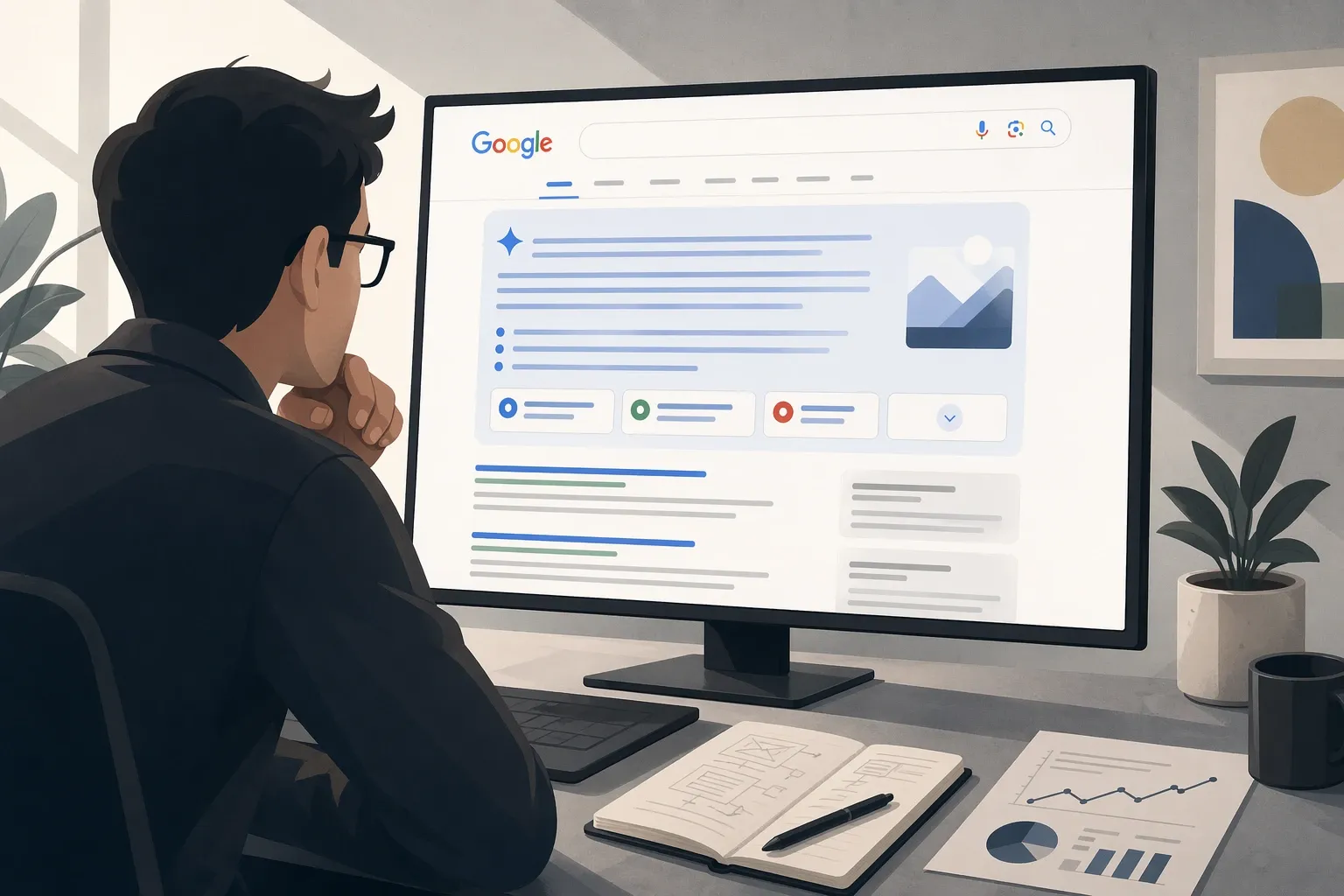
AI Overviews and Organic Clicks: What SMBs Should Measure
If AI summaries reduce click-through rate, the answer isn't panic. It's a tighter measurement model that follows influence all the way to pipeline.


Most search reporting still assumes a simple chain: rank, click, lead, customer.
That chain is breaking. Google treats AI features in Search as a distinct visibility layer, and third-party CTR analysis has shown that AI Overview citations do not behave like top organic placements.
A buyer now searches Google, reads an AI Overview, asks ChatGPT a follow-up, checks a review profile, and only then decides whether your site is worth visiting. In plenty of cases, your page influences the decision without getting the click it used to earn.
That doesn’t mean search stopped working. It means the measurement model got stale.
Stop treating click-through rate like the whole story
CTR still matters. If rankings hold and clicks collapse, something changed and you should investigate it.
But if your only conclusion is “AI Overviews are stealing our traffic,” you miss the more useful question:
Which queries still deserve click-focused optimization, and which ones now demand citation, brand recall, and downstream conversion tracking?
Those are different jobs.
For high-intent searches, you still want the click. For research queries, list-based comparisons, and “best” searches, AI surfaces may now sit between the search and your site. If your content is shaping the answer, your brand can gain consideration before the session ever becomes an analytics event.
The new reporting stack
For SMB teams, the goal isn’t to build an enterprise measurement program. The goal is to make search reporting honest again.
Track these five layers:
- Visibility layer: rankings, local pack presence, AI Overview inclusion, and answer-engine mentions.
- Engagement layer: organic clicks, branded search lift, direct traffic trends, and returning sessions.
- Conversion layer: form fills, calls, demos, booked meetings, and qualified leads.
- Pipeline layer: sourced pipeline, influenced pipeline, and opportunity creation by landing page cluster.
- Sales signal layer: what prospects actually reference in calls, replies, and inbound forms.
If you only report layer two, you will undercount the contribution of the other four.

Pages should be grouped by job, not just by topic
One of the cleanest fixes is to group content by function:
- Demand capture pages for bottom-funnel terms where the click still matters.
- Authority pages built to structure a category clearly enough that AI systems reuse the framing.
- Comparison pages that shape shortlist logic before the prospect lands anywhere.
- Local proof pages that reinforce geography, case studies, and service specificity.
When you report by page type, you stop asking every page to behave the same way.
An authority page may lose raw clicks while still increasing branded search, demo intent, and assisted conversions. A bottom-funnel service page should usually be held to a stricter click and conversion standard.
What to look for in Google Search Console
Search Console still matters, but the interpretation changes.
Look for patterns like:
- Impressions up, clicks down, conversions flat or up.
- Non-brand informational queries flattening while brand queries rise.
- Category-defining pages holding position but losing CTR.
- Service pages improving after internal links and commercial clarity are tightened.
That first pattern is the one teams misread most often. If impressions are rising and conversions are stable or improving, the page may be doing more influence work than the old click model can see.
Add a “how did you hear about us?” field and actually read it
This isn’t glamorous, but it’s one of the highest-leverage fixes.
If prospects are writing things like:
- “Saw your company in ChatGPT”
- “You kept coming up in AI search”
- “Found you through Google then checked a few AI summaries”
you now have qualitative evidence that your search surface area is broader than session data alone suggests.
Those answers should be reviewed monthly and tagged. Over time, they become a directional dataset that helps explain why pure organic-click reporting feels disconnected from the revenue conversation.

Build a simple influenced-pipeline view
For most SMB teams, a lightweight version is enough.
Take closed-won opportunities from the last 90 days and ask:
- Which landing pages did they visit before becoming an opportunity?
- Which blog posts appeared in those journeys?
- Which themes repeated across winning paths?
You’re not trying to solve attribution forever. You’re trying to avoid treating earlier-stage content as useless just because it was not the last click.
That distinction matters more now because AI-driven discovery compresses the visible part of the journey.
What this means operationally
If you run search for a service business, an agency, or a software company selling into SMBs, your reporting cadence should change in three ways:
- Review traffic and revenue together, not in separate decks.
- Separate pages that capture demand from pages that shape demand.
- Track evidence of AI-answer visibility alongside rankings and clicks.
That gets you out of the false binary where every traffic drop means search is broken or every impression increase means performance is healthy. For a practical live example of how discovery is changing, see Local SEO After ChatGPT for Service Businesses.
Search is still compounding. It’s just compounding across more surfaces than your legacy dashboard was built for.
The practical takeaway
The winning teams won’t be the ones obsessing over whether AI Overviews are “good” or “bad.”
They will be the ones that adapt reporting fast enough to see where influence moved, then build more of the assets that create it. For the rest of the current live archive, use the FirstMention blog.
That’s the real job now: measure the path buyers actually take, not the path that analytics made easiest to count.