Roofing Facebook Ads: A Playbook for Booked Jobs in 2026
Stop wasting money on roofing Facebook ads. This practical playbook covers targeting, creative, and lead routing to drive more booked jobs, not just clicks.

Most advice on roofing Facebook ads is backwards. It tells you to chase cheaper leads, wider reach, and more form fills.
That’s how roofers burn money.
A roofing ad campaign should not be judged by how many names hit your inbox. It should be judged by how many booked jobs come out the other side. Cheap leads that ghost your calls are not a win. A slightly more expensive lead that turns into a real inspection, a real estimate, and a real contract is.
Facebook can absolutely work for roofers. In fact, roofing leads from Facebook Ads come in at a 30% lower cost than Google Ads, with Google roofing leads averaging $60 to $150 and Facebook bringing that down to roughly $42 to $105 according to roofing marketing statistics compiled by WiFiTalents. That’s useful. But lower lead cost only matters if your sales process can turn those leads into revenue.
Most roofers don’t need more leads. They need a better system.
Table of Contents
- Why Most Roofing Facebook Ads Fail
- Nailing Your Audience and Offer
- Designing Ad Creative That Stops the Scroll
- Capturing and Qualifying Leads Instantly
- Optimizing and Scaling Your Ad Campaigns
- The Missing Piece Advanced Tracking and Optimization
Why Most Roofing Facebook Ads Fail
Most roofing Facebook ads fail because the owner starts with the wrong target.
Not the audience target. The business target.
They say, “I want more leads.” Then the agency, freelancer, or in-house marketer builds a campaign that gets exactly that. More leads. More names. More phone numbers. More low-intent people who tapped a form because it was easy and forgot about you five minutes later.

Cheap leads can still be expensive
A low cost per lead looks good in a report. It doesn’t mean the campaign is healthy.
If your office calls ten people and eight don’t answer, one rents, and one says they were “just checking prices,” your ad account didn’t produce ten leads. It produced noise.
Practical rule: Judge roofing Facebook ads by booked inspections, sold jobs, and profit. Everything before that is only a signal.
This is why I push roofers to stop talking about lead volume first. Start with the last step and work backward.
Ask better questions:
- Booked or not: Did the lead turn into an appointment?
- Qualified or not: Was it the homeowner, in your service area, with a real roofing issue?
- Profitable or not: Was this the kind of job your company wants?
That shift changes everything. It changes the offer. It changes the form. It changes how your team follows up. It changes what you track inside Meta Ads Manager.
Facebook works when you use it for the right job
Facebook is not Google. Google captures demand after the homeowner starts searching. Facebook helps you create demand earlier.
That matters in roofing.
The global roofing market was valued at about $277.42 billion in 2024 and is projected to grow at a 3.7% CAGR, according to roofing marketing trend reporting from Welcome Wagon. That’s a huge market, and it’s crowded. If you wait until every homeowner searches “roof repair near me,” you’re stepping into the most obvious fight.
Facebook gives roofers another lane. You can get in front of homeowners before they call three competitors.
Still, the ad platform isn’t magic. It’s just distribution.
The campaign fails when:
| Problem | What it causes |
|---|---|
| You optimize for lead count | Sales teams drown in junk |
| You use weak offers | Homeowners keep scrolling |
| You send traffic to a generic page | People bounce or get distracted |
| You don’t qualify leads | Your reps waste time |
| You respond slowly | Good leads cool off |
The winning mindset is simple. You are not buying leads. You are building a booked-job machine.
Nailing Your Audience and Offer
Bad targeting wastes money. Bad offers waste the clicks you paid for.
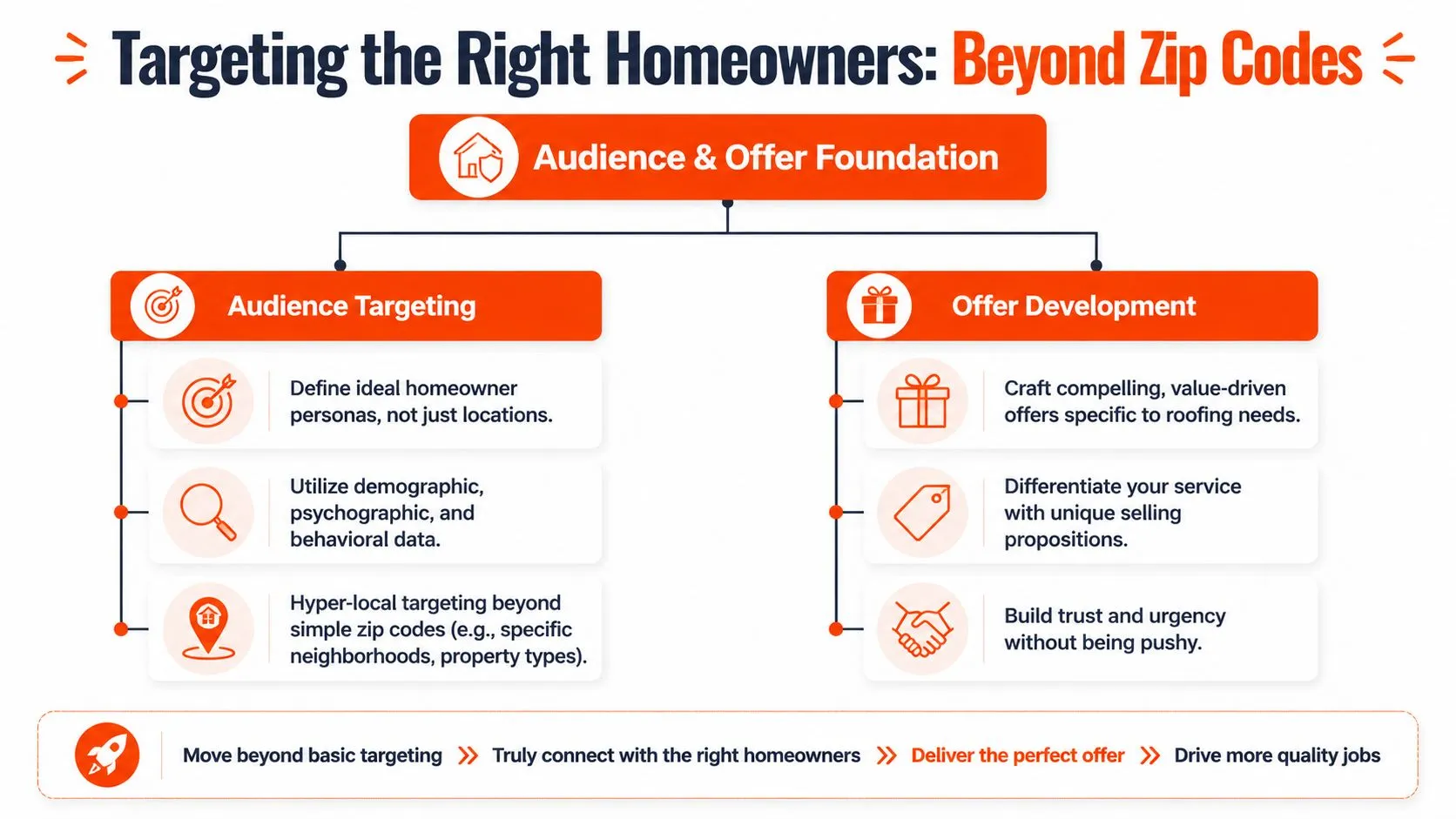
A roofing Facebook campaign should start with one question. Which homeowners are most likely to turn into profitable jobs for your team, in the neighborhoods you want to serve? If you skip that and let Meta spray your ads across a broad area with generic interests, you get what many roofers get. Cheap leads, low contact rates, and sales reps chasing people who were never a fit.
Build your audience around job quality
Start with geography, but do it with discipline. Use the towns, zip codes, or radius pockets where your crews can move fast, where your average ticket stays healthy, and where you already know how to close. A broad service area looks ambitious in Ads Manager. It usually turns into longer drive times, weaker close rates, and more jobs you should not have quoted in the first place.
Then narrow the audience with signals that line up with home ownership and roof problems. Home improvement interests can help. Real estate signals can help. Storm relevance matters even more in the right season. The point is not to stack random targeting options and hope for magic. The point is to give Meta a cleaner starting point so the algorithm can find homeowners who look more like buyers.
Use this filter:
-
Best service areas
Pick locations based on margin, crew capacity, and close rate. -
Likely homeowners
Focus on people more likely to own and maintain a home. -
Current need
Adjust targeting and message around storm activity, older housing stock, or visible wear issues common in that area. -
Sales reality
Exclude places where you rarely win, where permit issues slow jobs down, or where the average project is too small to matter.
That last point gets ignored too often. Your audience should match what your sales team can close.
Stop using weak offers
Roofing companies lose good prospects with boring offers. “Free quote” is weak. “Call today” is weaker. Homeowners are not excited to talk to a roofer. They are trying to avoid a bad decision, a high bill, and a messy insurance fight.
Your offer needs to lower the risk of taking the first step.
These offers usually work:
- Free roof inspection for homeowners who suspect damage but are not ready to commit
- Storm damage inspection right after hail, wind, or heavy rain
- Roof condition assessment in older neighborhoods where replacement demand is building
- Insurance claim documentation help for homeowners who are confused about what to do next
- Financing consultation with estimate in markets where payment friction slows deals
A good offer gets the click. A strong system turns that click into a booked appointment and then a sold job. That means your offer should set up the next step clearly. If you promise an inspection, your form, landing page, and follow-up need to continue that same promise without adding confusion.
Match the offer to the sales conversation
The right offer depends on what the homeowner is worried about right now. Pick the one that fits the moment.
| Situation | Better offer |
|---|---|
| Recent storm activity | Free storm damage inspection |
| Older homes with aging roofs | Roof condition assessment |
| Cost objections are common | Estimate plus financing conversation |
| Insurance claims drive demand | Inspection and insurance documentation help |
This is also where trust starts doing real work. If you have reviews, project photos, or customer language that proves you show up and do clean work, use it. A short quote from a real customer often beats polished brand copy. If you need better customer proof, use a testimonial request template for home service businesses and start collecting job-specific reviews your ads and landing pages can use.
Write for the homeowner, not for your crew
Roofers love technical language. Homeowners do not.
Your ad should speak to the problem in plain English. Leaks. Missing shingles. Storm damage. Insurance confusion. Old roof, not sure what to do next. Clear beats clever every time.
Good targeting and a useful offer do more than improve click-through rate. They improve lead quality before the form is even filled out. That makes the rest of the system work better, from response time to booking rate to closed revenue.
Designing Ad Creative That Stops the Scroll
Cheap clicks do not build a roofing company. Creative that attracts the right homeowner does.
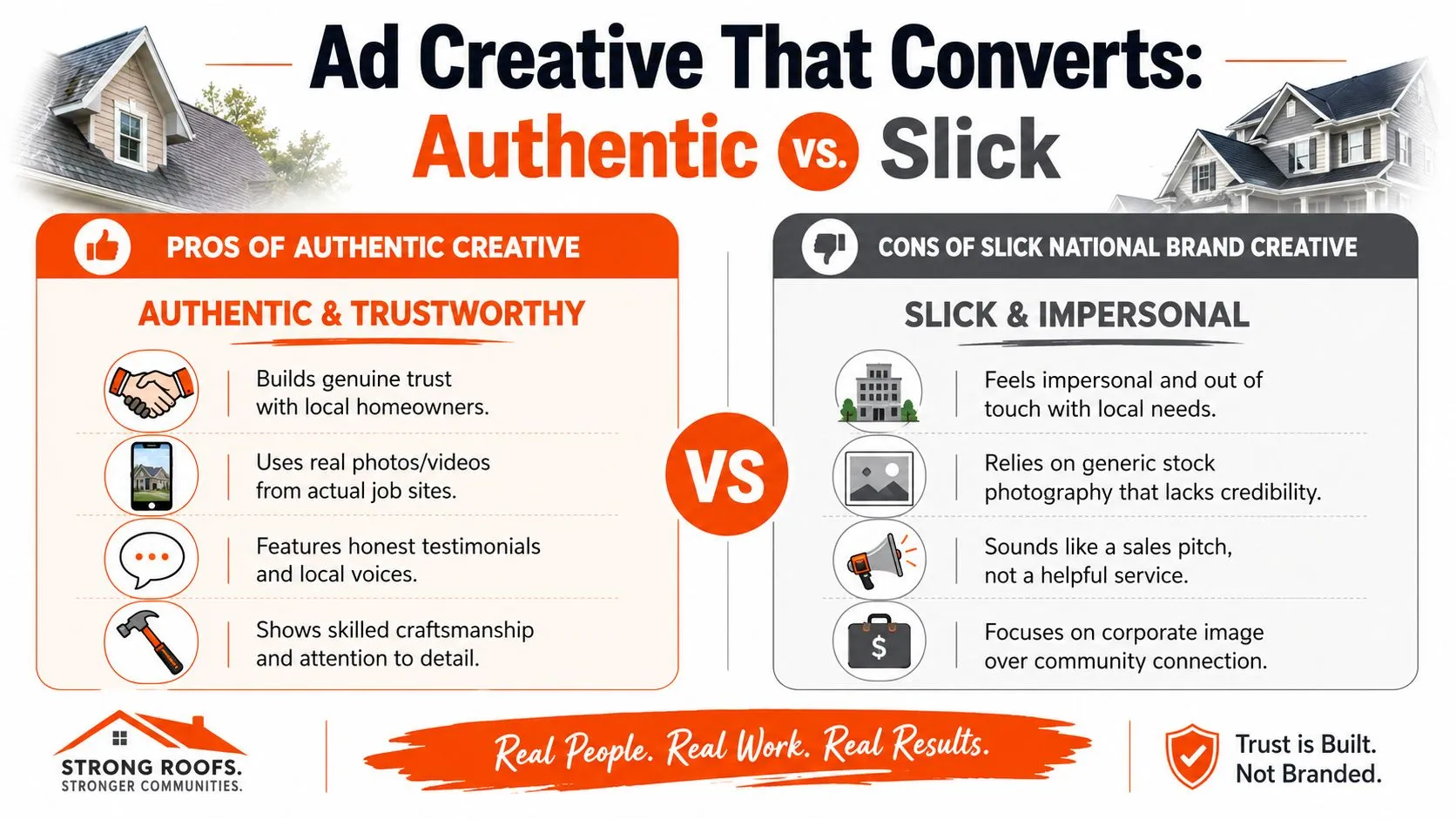
A lot of roofers treat Facebook ads like a flyer. They slap a logo on a stock photo, write “Free Estimate,” and hope volume fixes everything. It does not. Bad creative attracts price shoppers, low-intent form fills, and people who never answer the phone. Good creative pre-sells the job. It filters for homeowners who trust what they see and are ready to talk.
Use job-site creative, not brand-deck creative
The ads that stop the scroll usually look familiar, local, and specific.
Use real photos and video from actual jobs:
- Before and after shots with the same angle and the same house
- Short owner videos filmed on a phone, speaking plainly about what you found
- Crew footage that shows setup, protection, cleanup, and finished work
- Storm-related visuals that show the kind of damage homeowners should check for in your market
This works for one reason. Homeowners trust what looks real.
If the house looks like one in their neighborhood, if the person in the video looks like the one who will show up, and if the problem in the ad matches what they are worried about, you have a shot. If the creative looks like a generic franchise campaign, you lose them before the first line of copy does its job.
Write ads that pre-qualify the lead
Your copy should do more than get a click. It should help the homeowner decide whether to raise their hand.
Use a simple structure:
| Part | What to say |
|---|---|
| Hook | Name the problem or local trigger |
| Stakes | Explain what gets missed or delayed |
| Offer | Give the clear next step |
| Filter | Say who this is for |
| CTA | Tell them what to do now |
Example:
“Recent hail can leave damage you cannot spot from the ground. If your roof is over 10 years old or your street was hit in the last storm, book a free inspection. We’ll check for visible damage, document what we find, and explain whether you need repairs, a claim, or nothing at all.”
That last line matters. Homeowners trust ads that feel honest. They also convert better into booked appointments because the sales conversation starts before the form ever opens.
Show the roof. Show the issue. Show who shows up.
Put proof inside the ad
Do not make people click away just to figure out if you are credible.
Build proof into the creative itself. Add a customer quote to an image. Use a short testimonial clip. Turn a five-star review into a simple graphic with the town name and service type. If you need better raw material, use this testimonial template for service businesses and start collecting reviews that mention cleanup, communication, insurance help, and finished results.
Generic praise does not move roofing jobs forward. Specific proof does.
Test the visual first
Roofing campaigns usually burn out because the same image keeps showing up to the same audience. The fix is simple. Refresh the creative before you rebuild the whole campaign.
Start with 3 to 5 visual angles:
- before and after
- owner on-site video
- storm damage close-up
- finished roof with house-wide shot
- testimonial-style image
Keep the offer and audience steady long enough to learn which visual brings in better conversations, not just more leads. Judge creative by what happens after the click. Which ad brings people who answer the phone, book the inspection, and move toward a job?
That is the standard.
Your ad creative should also match how you plan to handle leads once they come in. If the ad promises fast answers, your intake process needs to qualify and respond fast. fonea’s AI lead qualification insights are useful here because they show how lead screening and response quality affect what happens after the form submission.
Creative is not decoration. It is the front end of your sales system. If it attracts the wrong click, the rest of the funnel has to work twice as hard.
Capturing and Qualifying Leads Instantly
Cheap roofing leads are overrated.
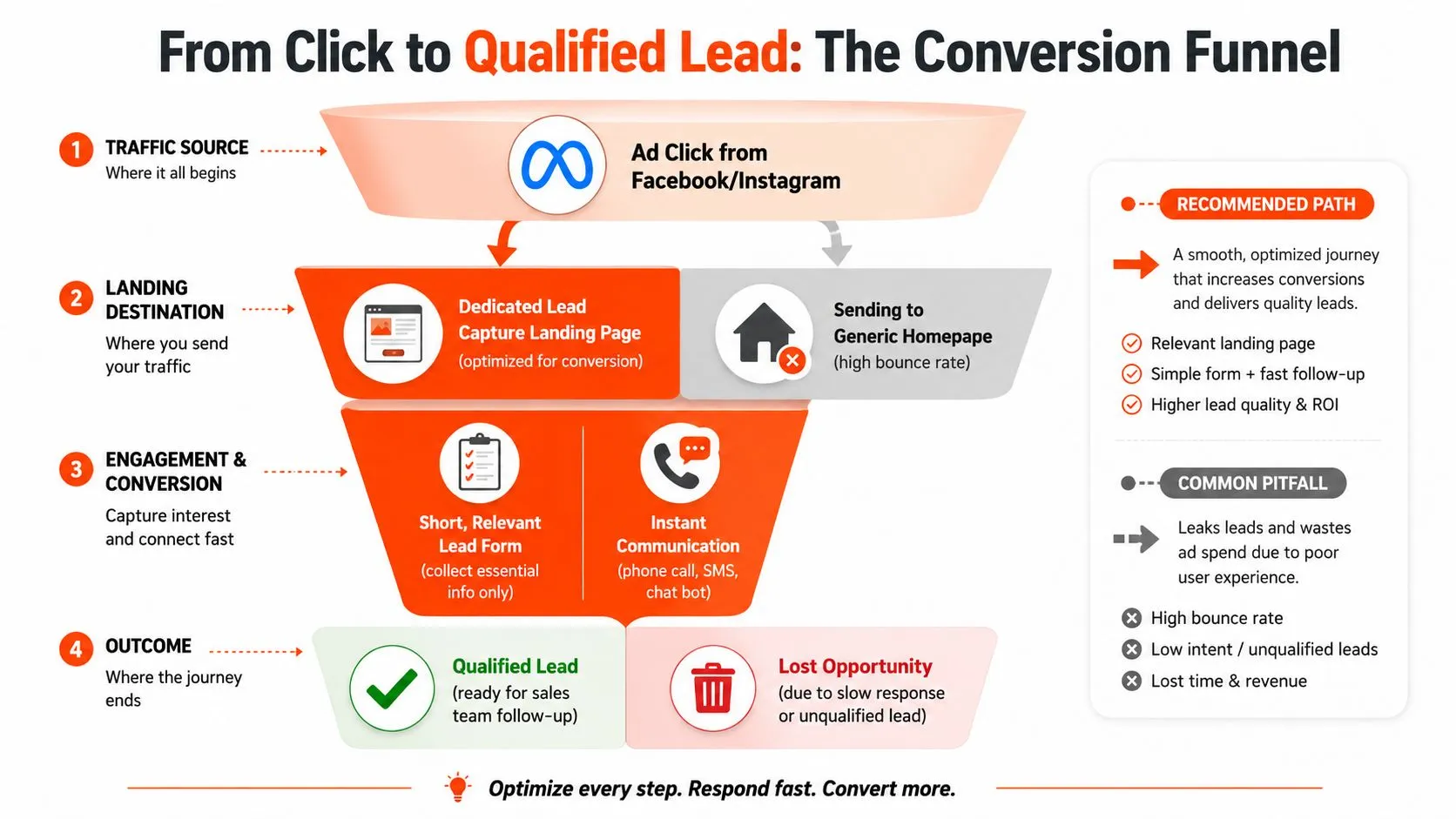
If the homeowner never answers the phone, lives outside your service area, rents the property, or just wanted a ballpark number for later, the ad did not help your business. A roofing Facebook ad only works if it feeds a sales process that turns clicks into inspections and inspections into jobs.
A better path looks like this.
Stop sending ad traffic to your homepage
Your homepage is built for browsing. Paid traffic needs a decision page.
Send roofing ad clicks to one of two destinations:
- A dedicated landing page if the homeowner needs proof, explanation, insurance context, or service-area reassurance before booking
- A Meta Instant Form if speed matters most and the offer is simple enough to convert on mobile without extra education
Built Right Digital notes that roofers usually get stronger conversion performance when they match the destination to the ad instead of sending paid traffic to a general homepage. They also point out that higher-intent form questions can improve lead quality and booked-job rates in competitive markets, especially when the questions screen for homeowner status and actual storm or roof issues in their roofing Meta ads guide.
The rule is simple. Every click should land on a page built to get one action.
Add friction on purpose
More form fills do not mean better marketing.
Roofing companies waste money when they optimize for volume and force the office to sort through junk. You want enough friction to screen out bad prospects before your team starts calling, texting, and chasing people who were never going to buy.
Use qualifying questions like:
- Ownership: Are you the homeowner?
- Location: What ZIP code is the property in?
- Problem fit: What issue are you dealing with?
- Situation: Was there recent storm damage?
- Timing: How soon do you want an inspection?
- Project type: Repair, full replacement, or insurance claim help?
That small layer of friction protects your calendar. It also protects your sales team from wasting prime follow-up time on weak leads.
Choose the form based on the sale
Instant Forms work best when speed wins. Storm response campaigns, free inspections, and simple offers usually fit here.
Landing pages work better when trust has to be built before contact. Full replacements, premium materials, financing, and insurance-heavy jobs usually need more proof. Reviews, before-and-after photos, warranty details, and a tight service-area message belong on the page.
Use the tool that matches the sales conversation you need next. If you want a broader framework for building a reliable lead generation system for roofing companies, study the full pipeline, not just the ad.
Lead handling starts the second the form is submitted
Fast follow-up changes lead quality in practice.
A decent lead turns into a dead lead when nobody calls for two hours, the office misses the first call back, or the rep reaches out with zero context. Speed matters, but routing matters too. The person who submitted the form should get contacted fast, tagged correctly, and handed to someone who knows whether the lead is a storm claim, retail replacement, repair, or bad fit.
That is why intake needs rules. Who gets called first. Which leads go to sales. Which ones get texted. Which ones get filtered out.
fonea’s AI lead qualification insights are useful here because they show how immediate screening and routing can clean up the handoff between ad lead and sales follow-up.
The companies that win with roofing Facebook ads do not stop at lead capture. They build the full system, ad, form, response, qualification, booking, and sales follow-up, so the campaign produces revenue instead of a spreadsheet full of names.
Optimizing and Scaling Your Ad Campaigns
Scaling does not fix a weak campaign. It exposes it.
A roofing ad set that brings in cheap leads but weak appointments will usually get worse when you add budget. More spend just buys more of the same problem. Scale only after the campaign is producing qualified leads, booked inspections, and real sales conversations your team wants.
Watch the numbers that affect revenue
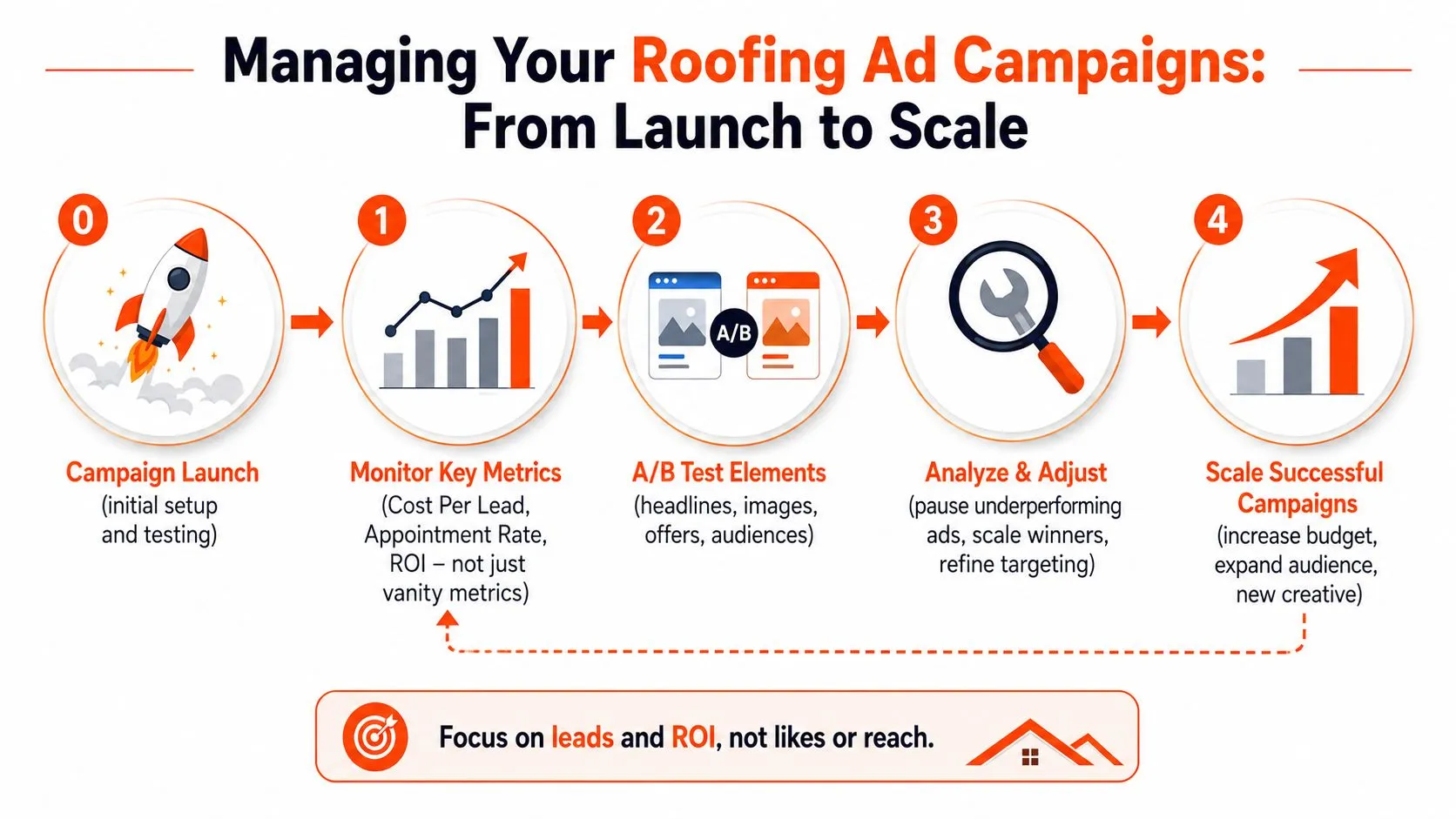
Facebook gives you plenty of numbers to stare at. A roofing owner should care about the ones that show whether the ad produced a job, not just a form fill.
Track these first:
- Qualified lead rate: How many incoming leads match your service area, job type, and budget range?
- Appointment rate: How many of those qualified leads book?
- Show rate: How many appointments hold instead of canceling or ghosting?
- Close rate: How many inspections turn into signed work?
Cost per lead still matters. It just belongs lower on the list.
If your cost per lead drops while your close rate falls, the campaign is getting worse, not better. That is the cheap lead trap. A useful framework for optimizing Facebook ads for ROI should tie ad metrics to sales outcomes, not stop at platform reporting.
Refresh creative before performance slips
Roofing campaigns fatigue fast because homeowners see the same roof photo, the same storm headline, and the same offer over and over. You do not need a brand overhaul every week. You need a steady pipeline of new angles built around the same proven offer.
Rotate one meaningful variable at a time:
| What to test | Example |
|---|---|
| Image | Before-and-after roof replacement vs adjuster meeting photo |
| Video | Owner talking to camera vs short jobsite walkthrough |
| Hook | Hail damage inspection vs aging roof replacement |
| Offer framing | Free inspection vs insurance claim documentation help |
Keep the audience and offer stable while you test creative. That gives you a clean read on what improved response.
Raise budget like an operator, not a gambler
Big budget jumps are how roofers wreck good campaigns.
If a campaign is producing qualified appointments, increase budget in small steps and let results settle before making another change. Protect the ad set that is already working. Do not stack multiple edits on the same day. If you change budget, creative, audience, and form all at once, you lose any clear read on what helped or hurt.
Use a simple rule. One major change at a time.
A better scaling plan looks like this:
- Keep one control campaign running with your current winner.
- Raise budget gradually on that winner.
- Test new creatives in a separate campaign or ad set.
- Compare results using qualified leads, booked appointments, and sales outcomes.
That structure keeps your lead flow stable while you search for the next winner.
Know when to get help
A roofing owner should not spend half the week inside Ads Manager trying to rescue results after every fluctuation. Once ad management starts pulling attention away from estimates, follow-up, hiring, and production, you need support from someone who understands both media buying and lead quality. This guide on hiring pay per click experts is a good filter if you want outside help without handing your account to a smooth-talking agency that reports clicks and calls it success.
The goal is not bigger ad spend. The goal is a stable system that turns clicks into booked jobs and booked jobs into revenue.
The Missing Piece Advanced Tracking and Optimization
Most roofing ad accounts optimize for the wrong event.
They optimize for leads because leads are easy to track. Meta sees a form fill, counts a conversion, and starts looking for more people likely to submit another form. That sounds fine until you realize many of those leads never book, never buy, and never turn into real revenue.
That’s why advanced tracking matters.
Feed sales outcomes back into Meta
A significant upgrade is to tell Meta what happened after the lead came in.
Not just “someone filled out a form.” Tell it:
- this lead booked an appointment
- this lead became a sold job
- this lead was a bad fit
- this lead produced meaningful revenue
That feedback loop is the difference between amateur ad management and a system that gets smarter over time.
The emerging 2026 trend is Offline Conversion API optimization. When roofing companies feed real sales data back into Meta, including outcomes tied to revenue, the platform can reset optimization around revenue instead of clicks. The reported result is that ad costs drop by 25% while lead quality rises, according to the MyMinyona video on why Facebook ads failed for roofing companies.
That matters because Meta can finally learn what your good leads look like.
This fixes the cheap lead trap
Without offline conversion feedback, Meta keeps chasing the easiest conversion.
That usually means low-friction, low-commitment people. They submit. Your team calls. Nothing happens. The platform thinks it’s winning because the reported conversion count keeps rising.
Once you send booked-job data back, the ad account has a better target.
A simple way to consider it is:
| Without better tracking | With better tracking |
|---|---|
| Optimize for form fills | Optimize for real outcomes |
| More junk lead risk | Better fit lead profile |
| Sales team does all filtering | Platform starts helping |
| Reporting stops at the click | Reporting ties back to revenue |
Keep the stack simple
You do not need to turn this into a science project.
At minimum, you want your website tracking clean, your CRM status changes consistent, and your closed-loop data feeding back into Meta. If you need a technical walkthrough, this guide on setting up Meta Conversions API is a practical resource.
The key is consistency. If one salesperson marks leads one way and another rep uses different labels, your feedback loop gets muddy fast.
This is the part most owner-led roofers skip because it feels too technical. That’s a mistake. It’s the piece that connects ad spend to actual sales truth.
You can run roofing Facebook ads without advanced tracking. Plenty of contractors do.
But if you want Meta to stop finding cheap noise and start finding homeowners who look like your real customers, this is the move that changes the whole system.
If you’re tired of disconnected marketing, weak lead follow-up, and reports that never tie back to booked jobs, FirstMention helps home service companies build the full system. That includes visibility, offers, tracking, AI intake, follow-up, and plain-English reporting that shows what’s driving revenue.