7 Best Fire Damage Restoration Companies of 2026
Find the best fire damage restoration companies for your home. Our 2026 guide reviews 7 top providers on services, response times, and insurance claims.
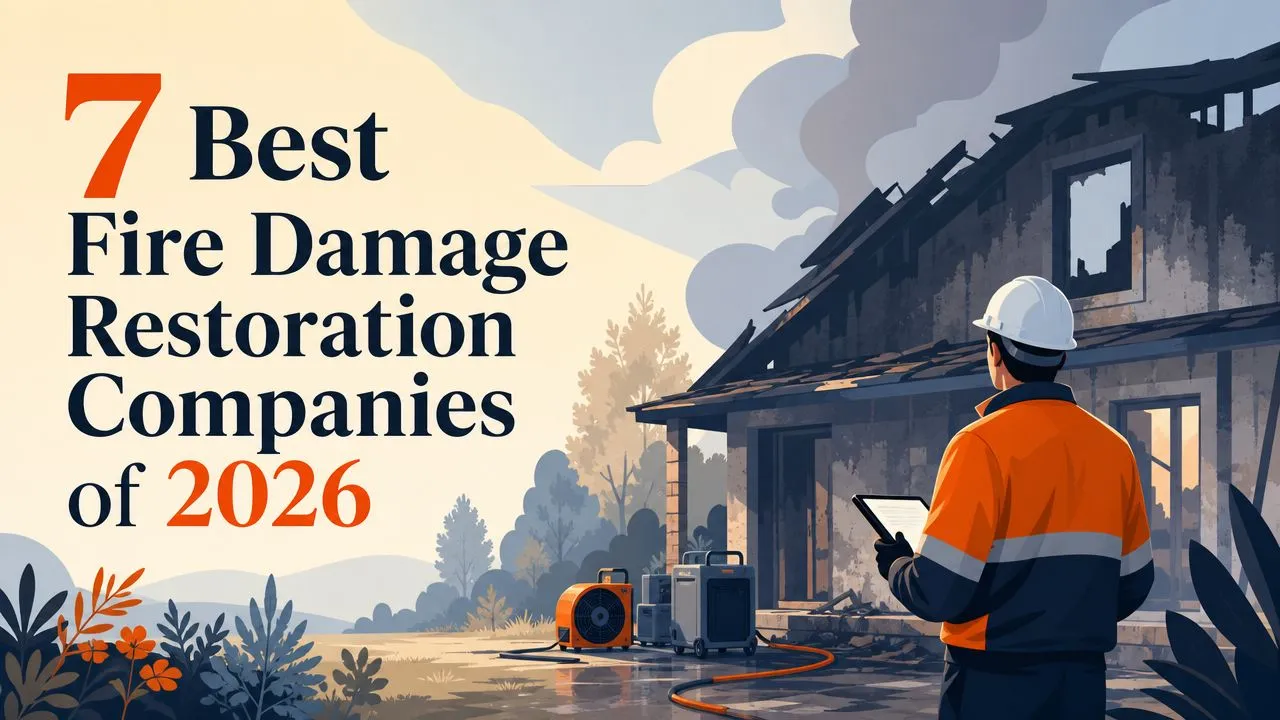

You walk back onto the property after the fire crew clears out. The house smells like smoke. Parts of it are soaked from suppression. Someone needs to secure the structure, start drying, document damage, and tell you what can be saved. Your first call sets the tone for everything that follows.
Choose a company that can do four things right away. Answer now. Dispatch now. Document thoroughly for the insurance file. Explain, in plain English, how they will handle soot, odor, water, contents, and reconstruction. Fire restoration is not a basic cleaning job. It is an emergency project with health, safety, and claim consequences.
That is why this guide focuses on the first 24 hours, not generic marketing promises. The national brands below are not interchangeable. Some win on local response speed. Some are better at process and insurance paperwork. Some make more sense for large losses, specialty contents, or full rebuilds.
If the fire happened during a storm event or the property also took weather-related damage, this storm damage restoration guide for homeowners will help you avoid the usual early mistakes.
If you’re trying to maximize your fire insurance claim, start by hiring the restoration company that matches the job in front of you. Pick wrong, and you get delays, weak documentation, lingering odor, and a longer road back into your home.
Table of Contents
- 1. SERVPRO
- 2. ServiceMaster Restore
- 3. Paul Davis
- 4. BELFOR Property Restoration
- 5. PuroClean
- 6. Rainbow Restoration a Neighborly company
- 7. ATI Restoration
- Top 7 Fire Damage Restoration Companies Comparison
- How to Choose A Homeowner’s Checklist
1. SERVPRO
SERVPRO is the safest first call if speed is your top priority. Its network is huge, with 2,380+ locations across the U.S. and Canada listed on the company site. In a fire loss, that matters. Dense coverage usually means somebody can get to the property faster for board-up, damage documentation, soot control, and drying after firefighting water.
It also helps that SERVPRO is built for the full chain, not just the dirty part. They handle smoke and soot cleanup, deodorization, contents pack-out, duct and HVAC cleaning, and reconstruction. If you want one vendor from emergency response through rebuild, SERVPRO is set up for that.
Where SERVPRO wins
SERVPRO works best when you need movement, not theory. If your home is exposed to weather, your insurer needs fast documentation, or you’re trying to stop secondary damage, this brand is usually near the top of the list.
- Fast local dispatch: The franchise footprint gives SERVPRO an edge when every hour counts.
- Broad scope: Fire, smoke, odor, contents, and rebuild can stay under one roof.
- Commercial strength: If the fire hit a mixed-use property or business, SERVPRO has programs for that too.
Practical rule: Ask the local office one question first. “Will you inspect, mitigate, pack out, and rebuild with your team, or hand parts off to others?”
The downside is franchise variation. Some SERVPRO operators are excellent. Some are average. That’s the tradeoff with any large franchise system. During major regional events, response can also slow down because everybody is chasing the same crews.
If you’re a restoration owner studying how national brands stay visible, the answer isn’t magic. It’s market coverage, call handling, and relentless lead flow. The same issue shows up in this breakdown of best lead companies for home-service businesses.
Go to SERVPRO’s website.
2. ServiceMaster Restore
ServiceMaster Restore is a strong pick if you want a more structured, playbook-driven experience. Some homeowners want a company that says, “Here’s the process, here’s what happens next, here’s how we handle smoke, soot, water, and rebuild.” That’s where ServiceMaster Restore tends to feel steady.
They offer round-the-clock emergency response for residential and commercial losses. They also cover the parts people forget after a fire, like water extraction from suppression efforts and corrosion risk from soot residue. That’s not a side issue. Smoke and soot spread farther than is often realized, and delay makes cleanup harder.
Best fit for process-heavy recoveries
ServiceMaster Restore makes sense if your loss needs coordination and you don’t want to manage the moving parts yourself. Multi-room damage, partial business interruption, and jobs with both mitigation and repairs fit this brand well.
A few strengths stand out:
- Documented process: Their recovery steps are usually easier for stressed homeowners to follow.
- Good smoke and soot experience: That matters when odor and residue are the primary challenge.
- National footprint: Helpful for owners with more than one property.
If the company can’t explain, in plain words, how they’ll separate salvageable contents from total-loss items, keep shopping.
The weakness is the same one you’ll see with other franchise-based fire damage restoration companies. The brand can be strong, while the local operator may be uneven. During wildfires or major regional events, scheduling gets tight fast.
ServiceMaster Restore is a good example of why storm and fire response often overlap in practice. The same property owner who needs soot cleanup today may need emergency board-up, roof protection, or water removal at the same time. If you want a broader look at that overlap, this guide to storm damage restoration is worth reading.
Go to ServiceMaster Restore’s website.
3. Paul Davis
You wake up after a house fire to a wet, smoky mess, a carrier asking for documentation, and a contractor voicemail that explains nothing. That is the moment Paul Davis tends to fit best. They are a practical choice for homeowners who want one company to take the job from emergency response through repairs without forcing the owner to coordinate every step.
Paul Davis offers emergency board-up, tarping, smoke and soot cleanup, water removal and drying, contents restoration, and reconstruction. Their scale matters, but the bigger point is structure. If your first priority is getting a clear plan in the first 24 hours, Paul Davis is usually stronger than companies that only handle cleanup and then hand you off for the rebuild.
Best fit for homeowners who need one chain of command
Paul Davis stands out when the fire claim is headed toward a longer insurance and repair process. If cabinets, drywall, flooring, contents, and moisture control all need attention, you want one team accountable for scope, timeline, and handoffs.
Here’s where they can be the right call:
- Single-vendor continuity: Mitigation, contents work, reconstruction, and insurance communication under one roof.
- Clearer job staging: Homeowners usually get a better sense of what happens first, what can wait, and what approval is needed.
- Useful for complicated home losses: Stronger fit when fire damage overlaps with suppression water, odor treatment, and rebuild decisions.
That last point matters. A lot of fire losses stop being “just fire” within hours. Wet insulation, damp framing, and lingering humidity can create a second problem fast, which is why many owners also start reading up on mold remediation companies near them while the fire cleanup is still being scoped.
The downside is the same one that follows most franchise-based fire damage restoration companies. The brand can be solid, while the local office determines how good the actual job feels on site. Ask who will write the scope, who manages reconstruction, and whether the same project lead stays involved after the emergency crew leaves. If the answers are vague, move on.
Go to Paul Davis’s website.
4. BELFOR Property Restoration
BELFOR is the heavy hitter on this list. If the job is large, technical, or ugly, BELFOR deserves a hard look. This is the company I’d consider first for a major commercial fire, industrial site damage, a large residential estate, or a loss involving documents, machinery, or electronics that need specialist handling.
They do the standard fire work, but they also go deeper. Think site containment, contents restoration, electronics restoration, environmental services, document recovery, and rebuilds. That breadth cuts down on the number of vendors you have to coordinate.
When BELFOR is the right call
BELFOR is strongest when the fire loss isn’t simple. If you need one company to handle specialty services that smaller operators would outsource, BELFOR has the bench for it.
- Complex-loss capability: Good for industrial, institutional, and large commercial properties.
- Specialty restoration: Electronics and document recovery can be critical after fire and suppression damage.
- Catastrophe depth: Useful during wildfire and wide-area events.
The market context backs that up. The global fire damage restoration services market is valued at $5.97 billion in 2026 and projected to reach $8.97 billion by 2032. That growth is tied in part to tools like drones and advanced drying equipment, and BELFOR is the type of operator that tends to deploy specialized methods on larger losses.
BELFOR can be too much company for a small house fire. If your job is modest, ask who will actually run it and how soon they can start.
That’s the caution. On smaller residential jobs, BELFOR may feel oversized. And when a region gets hit hard, priority often goes to the biggest losses first.
Go to BELFOR Property Restoration’s website.
5. PuroClean
Your kitchen fire is out. The smell is everywhere, the insurance carrier wants documentation, and you need a crew that will answer the phone, show up fast, and keep the job from turning into a mess of missed steps and finger-pointing. This is the lane where PuroClean often makes sense.
PuroClean works best for homeowners who want a company with a national system behind it, but still want to deal with a local operator who knows the market and can make decisions quickly. That middle ground matters in the first 24 hours after a fire. You need someone who can start mitigation, explain the scope in plain English, and keep contents, odor treatment, and repairs from drifting into separate problems.
The company offers fire and smoke cleanup, soot removal, odor control, contents cleaning, and reconstruction support. The practical advantage is process. If the local franchise is well-run, you usually get better communication than you would from a huge corporate machine, without giving up basic standards and training.
What makes PuroClean useful
PuroClean is a strong candidate for straightforward residential losses and smaller mixed-scope jobs that still need coordination. A one-room fire can turn into demolition, pack-out, smoke cleaning, and partial rebuild fast.
- National system, local operator: A good fit if you want accountability close to home without hiring a tiny outfit with no backup.
- Clearer homeowner communication: Helpful when you need fast answers on scope, salvage, and what insurance is likely to question.
- Flexible estimating: Useful if you are filing a claim, paying directly, or still deciding.
The risk is inconsistency between franchise locations. Some offices are tight and disciplined. Some are thinner on staffing or rely on outside partners for parts of the job. That is not an automatic deal breaker, but you need to screen them hard before you sign anything.
Ask three questions right away. Who is writing and updating the contents inventory? Who is responsible for odor clearance and how do they confirm it? Is the rebuild handled by the same company or referred out to another contractor? If the answers are vague, keep calling.
Go to PuroClean’s website.
6. Rainbow Restoration a Neighborly company
Rainbow Restoration is a smart pick when contents handling is a big part of the problem. A lot of homeowners focus on walls, ceilings, and structure. Then they realize the harder job is dealing with smoke-loaded clothing, furniture, electronics, and personal items. Rainbow tends to talk more clearly about that side of the work than many competitors.
They offer fire and smoke cleanup, deodorization, pack-out, off-site contents cleaning, and rebuild coordination. The Neighborly backing can also help when related trades are needed.
Where Rainbow stands out
Rainbow makes sense when the house isn’t just damaged, but disrupted. If your belongings need sorting, cleaning, storage, and return logistics, this brand deserves a look.
- Strong pack-out focus: Helpful when salvage decisions need to happen quickly.
- Homeowner-friendly guidance: Their materials on smoke damage are usually easier to understand.
- Trade coordination: Neighborly affiliation can help with related work in some markets.
There’s another issue homeowners should ask about, and most company sales reps won’t volunteer it. Less than 15% of consumer-facing restoration articles warn homeowners to verify subcontractor insurance details, including certificates of insurance and project-specific liability coverage. That matters a lot if a restoration company coordinates outside trades during rebuild.
Don’t ask only whether Rainbow is insured. Ask which trades will be subcontracted and whether each subcontractor can provide current insurance paperwork.
The weak spot is coverage consistency. Some metros have better Rainbow presence than others, and more complex rebuilds may rely on outside partners depending on the market.
Go to Rainbow Restoration’s website.
7. ATI Restoration
ATI Restoration is the best fit here for mid-to-large losses where you want one company to own both mitigation and reconstruction. That sounds obvious. It isn’t. Plenty of fire damage restoration companies are strong on emergency cleanup but weaker once the job turns into planning, estimating, scheduling, permits, and rebuild management.
ATI leans into in-house reconstruction, commercial programs, and insurance-friendly estimating. If your fire involved HVAC contamination, structural decon, wildfire ash, or a larger rebuild scope, ATI is built for that kind of job.
Why ATI makes sense for larger jobs
ATI is a good call when the damage is too big for a small local shop but not so specialized that you need a giant industrial response firm. It sits in a useful middle lane.
The business side of the industry explains why that matters. Fire and smoke restoration makes up 28% of total property restoration industry revenue, compared with 35% for water damage and 22% for mold remediation. Fire work is not a side service. It’s one of the core revenue engines in restoration, and companies that treat it that way tend to build stronger systems around estimating, manpower, and rebuild delivery.
ATI’s weak point is coverage density in smaller markets. In some places, a franchise-heavy brand may mobilize faster. During catastrophe periods, demand can also stretch the schedule.
Still, if I had a sizable loss and wanted one brand accountable for both cleanup and reconstruction, ATI would be high on the shortlist.
Go to ATI Restoration’s website.
Top 7 Fire Damage Restoration Companies Comparison
| Provider | 🔄 Implementation complexity | ⚡ Resources & scale | ⭐📊 Expected outcomes | 💡 Ideal use cases | ⭐ Key advantages |
|---|---|---|---|---|---|
| SERVPRO | 🔄 Moderate, standardized franchise workflows; quality varies by location | ⚡ Very large national franchise network for rapid local mobilization | ⭐📊 Fast response, integrated mitigation-to-rebuild; insurer coordination common | 💡 Homeowners and businesses needing quick mobilization and end-to-end services | ⭐ Fast local dispatch; broad commercial capability; insurer familiarity |
| ServiceMaster Restore | 🔄 Moderate, standardized playbooks and documented procedures | ⚡ Large national reach with 24/7 dispatch | ⭐📊 Predictable recovery outcomes with strong soot/odor expertise | 💡 Property owners and multi-site operators valuing predictable processes | ⭐ Standardized processes; documented response targets |
| Paul Davis | 🔄 Low–moderate, clear step-by-step restoration process | ⚡ National (300+ franchises) with 24/7 response and permit/insurance support | ⭐📊 Transparent timelines and full mitigation through rebuild | 💡 Owners who want transparency and end-to-end project coordination | ⭐ End-to-end capability; transparent documentation |
| BELFOR Property Restoration | 🔄 High, complex workflows for industrial/hazmat and large-loss projects | ⚡ Very large/global resources and strong CAT response capacity | ⭐📊 Effective outcomes for large or complex commercial/industrial losses | 💡 Complex commercial, industrial, or large-loss wildfire projects | ⭐ Specialty services (electronics, freeze-dry); large-loss expertise |
| PuroClean | 🔄 Moderate, standardized procedures with franchise variability | ⚡ Broad footprint (500+ markets) plus National Response Team and IICRC-trained techs | ⭐📊 Responsive local service backed by national support; customer-focused results | 💡 Homeowners seeking responsive local operators with national backing | ⭐ Responsive local teams; clear communication and customer care |
| Rainbow Restoration (Neighborly) | 🔄 Low–moderate, IICRC-certified approaches, coordination with Neighborly trades | ⚡ Moderate national backing; local coverage varies by market | ⭐📊 Strong contents handling and coordinated trade outcomes for many homes | 💡 Homeowners prioritizing pack-out/contents restoration and trade coordination | ⭐ Pack-out/off-site contents restoration; integration with Neighborly brands |
| ATI Restoration | 🔄 Moderate, in-house reconstruction and insurance-aligned processes | ⚡ Large (70+ locations) with commercial programs; variable mobilization in small markets | ⭐📊 Single-vendor mitigation-to-rebuild for mid-to-large losses with adjuster alignment | 💡 Mid-to-large losses needing one vendor to handle mitigation and rebuild | ⭐ In-house reconstruction; insurance-friendly estimating |
How to Choose A Homeowner’s Checklist
Picking a company under pressure is tough. Don’t go with the first truck that answers the phone. Use the first call to test how the company thinks, not just how fast it sells.
Start with scope. Ask whether they handle board-up, soot cleanup, odor treatment, HVAC cleaning, pack-out, storage, and reconstruction themselves. Then ask what gets subcontracted. If they dance around that question, that’s a bad sign.
The next issue is air quality. This gets skipped all the time. Many consumer guides don’t explain the difference between a company saying the house “smells fine” and actual clearance testing. One source even points to a hidden gap in post-restoration validation and says 40% of fire-damaged homes still exceeded safe particulate thresholds 30 days after restoration when only surface cleaning and ozone treatment were used without embedded air sampling. Whether you agree with every company’s method or not, the lesson is simple. Ask how they confirm the house is clean, and whether independent third-party clearance testing is included or extra.
Use this checklist when you talk to any of these fire damage restoration companies:
- Ask who shows up first: Will it be a salesperson, a project manager, or a working mitigation lead?
- Ask what they document: Photos, contents inventory, moisture readings, soot mapping, and scope notes should be standard.
- Ask how they handle adjusters: You want a company that can explain its estimate line by line.
- Ask about contents: What gets packed out, where it goes, how it’s tracked, and when you can access it.
- Ask about odor and air clearance: Internal readings alone aren’t enough for many homeowners.
- Ask about rebuild control: In-house rebuild is usually cleaner than a handoff between unrelated vendors.
- Ask about subcontractors: Get names, roles, and insurance details before work expands.
The industry is big, competitive, and still growing. The global fire and water restoration service market was valued at about $22.5 billion in 2024 and is projected to reach $35.8 billion by 2033, with 5.1% CAGR from 2025 to 2033. In the U.S., the damage restoration services industry includes 60,020 businesses as of 2025, and the market size is estimated at $7.1 billion in 2026. That means you have options. Use them.
If you run a home-service business yourself, the same rule applies on the marketing side. Don’t trust vague promises. Track what drives calls, booked jobs, and real visibility. These local SEO strategies for contractors make that point clearly.
If you run a restoration or other home-service company and you’re tired of disconnected agencies, lead sellers, and half-working marketing stacks, look at FirstMention. They build AI marketing systems that help trade businesses show up across Google, Maps, ChatGPT, Perplexity, Gemini, and Google AI Overviews, then turn that visibility into booked jobs with better tracking, intake, follow-up, and reporting.