Get Leads for Roofing Companies: A 2026 No-Fluff Guide
Stop buying junk leads. This guide shows how to get exclusive leads for roofing companies with SEO, ads, and smart follow-up. Build a real lead system.


Most advice about leads for roofing companies is backward.
It tells you to chase more leads. Buy another batch from Angi. Add Thumbtack. Turn on Google Ads. Hope volume fixes everything. It doesn’t. It usually gives you more noise, more price shoppers, and more wasted follow-up.
The better move is simpler. Stop obsessing over cost per lead. Start tracking two numbers that decide profit: speed-to-contact and cost-per-close by channel. If you’re slow, good leads die. If a channel produces cheap leads but lousy close rates, it’s not cheap. It’s expensive.
That’s why most roofing lead-gen advice fails in practice. It focuses on lead count. Owners need booked jobs.
Table of Contents
- Stop Buying Leads and Start Owning Them
- Build Your Local SEO Foundation First
- Turn on the High-Intent Lead Faucet
- Create Your Own Lead Generation Engine
- Master the Storm and Emergency Workflow
- Focus on Speed and Follow-Up for Profitability
- Your Roofing Lead System Blueprint
Stop Buying Leads and Start Owning Them
Buying shared leads as your main strategy is one of the worst habits in roofing.
You don’t control the lead. You don’t control the timing. You don’t control who else is calling. You just pay for the chance to join a pile-on. That’s not a pipeline. That’s a bidding war.
This is a big reason lead flow feels unstable for so many owners. Data shows that 63% of roofing business owners rank lead generation as their #1 operational challenge, largely due to unpredictable lead flow and inconsistent quality from shared lead services, as noted in this roofing sales discussion on Reddit.
Why shared leads drain your budget
A shared lead sounds easy because you can buy it today. The problem shows up later.
- The homeowner is shopping price: They often hear from multiple roofers right away.
- Your sales team starts reacting: They rush to call, quote, and discount.
- Your margins get squeezed: Even when you win, you may win the wrong kind of job.
If you want a deeper breakdown of why lead marketplaces create bad incentives, read this piece on contractor lead services.
Stop renting demand from platforms that can replace you tomorrow.
What ownership looks like
Owned lead generation means the homeowner finds your brand, contacts your company, and enters your follow-up system.
That usually comes from three buckets:
| Lead type | Who controls it | Quality trend |
|---|---|---|
| Shared marketplace leads | The platform | Usually weaker |
| Search-driven exclusive leads | You and Google visibility | Usually stronger |
| Referrals and repeat business | You | Usually strongest |
If you build your own system, your marketing gets more predictable. Your sales team gets cleaner shots. Your close rates usually tell a much better story than a spreadsheet full of cheap leads ever will.
Build Your Local SEO Foundation First
Before you spend on ads, fix the basics.
Most roofers skip this part because it isn’t flashy. That’s a mistake. Homeowners check Google before they call. If your map listing looks thin, your reviews look stale, or your website is weak on mobile, your ads won’t save you.
The local foundation is simple. It just has to be done right.
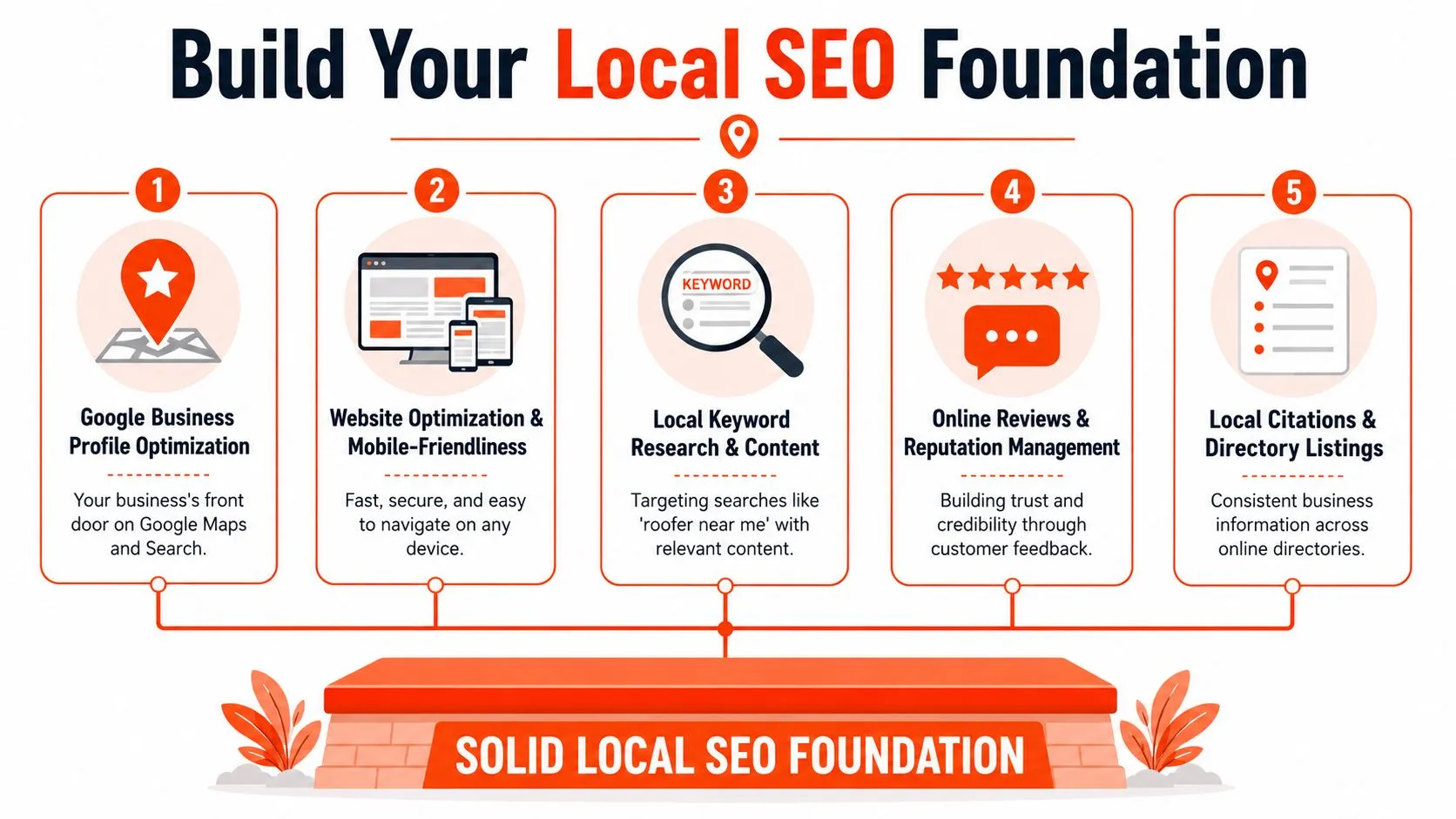
Google Business Profile comes first
Your Google Business Profile is your front door.
If it’s incomplete, unverified, or barely updated, you’re invisible when a homeowner searches during an urgent repair moment. That hurts more than most owners realize.
Start with the basics:
- Verify the profile: If you haven’t fully verified it, do that first.
- Pick the right categories: Make sure roofing is core, not buried.
- Add real photos: Trucks, crews, finished jobs, close-ups, office shots.
- Use service areas carefully: Match where you work.
- Keep hours and contact info current: Wrong info kills trust fast.
A lot of roofers are still missing these basics. That gap shows up in map pack visibility, call volume, and trust.
Reviews and service pages do the heavy lifting
Reviews matter because they answer the homeowner’s first silent question. “Can I trust this company?”
You need a review process after every completed job. Not when you remember. Not when the office has time. Every job.
Use a basic workflow:
- Finish the job.
- Confirm the customer is happy.
- Send the review request the same day.
- Follow up if they don’t respond.
- Reply to reviews so the profile stays active.
Then fix the website.
Most roofing sites are too thin. They have a homepage, a contact page, and one vague services page. That’s not enough. Build separate, mobile-friendly service pages for the work you want more of, plus location pages for the towns you serve.
Practical rule: Don’t send paid traffic to a weak site and expect strong lead quality.
A solid page should clearly show the service, the city, the offer, proof of work, and an easy way to request an estimate. If you want a good framework for how local visibility is changing beyond standard search, this guide on local SEO for AI discovery is worth reading.
Your local checklist
- Map presence: Clean Google Business Profile with current info
- Trust layer: Consistent review asking after each job
- Website depth: Service pages and city pages built for mobile users
- Conversion path: Clear calls, forms, and estimate requests
- Consistency: Same business info across major directories
That’s the floor. Not the ceiling.
Turn on the High-Intent Lead Faucet
Stop judging paid channels by cost per lead. That number hides the only thing that matters. Which channel produces booked jobs at a profit, and how fast your team responds when the phone rings or the form comes in.
Search usually wins because the homeowner already wants help. They are not casually browsing. They are looking for a roofer now, which means lead quality is higher and your speed-to-contact matters more than clever ad copy.
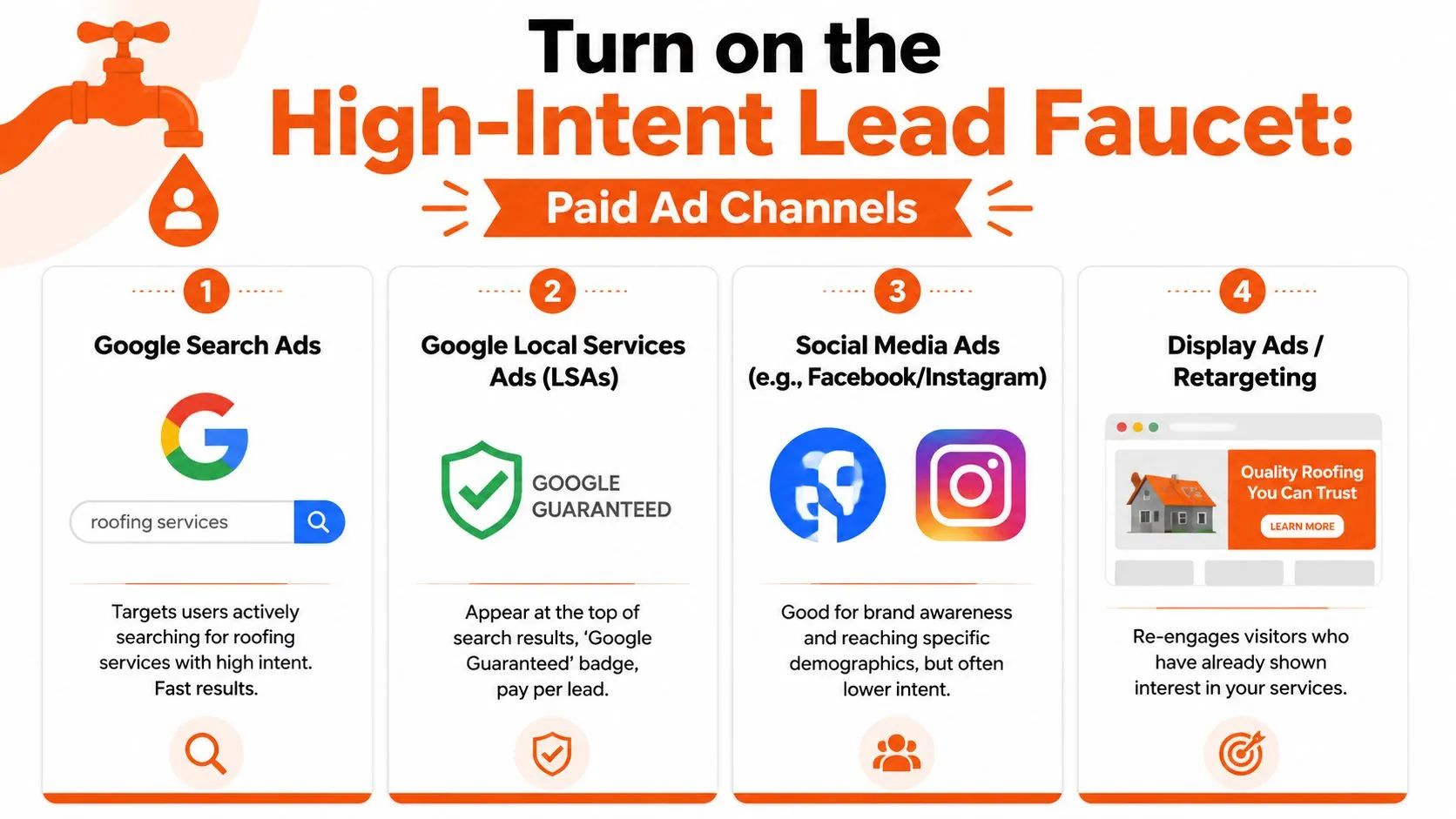
Why LSAs should be first
For many roofing companies, Google Local Services Ads deserve the first paid dollars.
The reason is simple. LSAs sit close to the moment of demand. A homeowner with a leak, storm damage, or an aging roof searches, sees local providers, and wants to talk to someone fast. That is better traffic than broad awareness campaigns and better timing than interruptive ads.
LSAs also expose weak operations fast. If your team misses calls, takes twenty minutes to return a lead, or lets disputed leads pile up, the channel gets expensive in a hurry. That is not a flaw in LSAs. It is a warning sign in your process.
How PPC and shared leads compare
Standard Google Ads can produce strong jobs, but only if you run them with discipline. Roofing clicks are expensive, weak keywords burn money, and generic landing pages attract shoppers instead of buyers. Glasshouse notes that roofing lead costs can run high, with Google Ads often averaging around $187 per lead in some campaigns, according to Glasshouse’s breakdown of roofing lead costs.
Shared lead services sit at the bottom of the list for a reason. You control less, you compete harder, and the homeowner often gets called by multiple roofers within minutes. If your sales process is average, you lose.
Here is the practical comparison:
| Channel | Lead intent | Control | Cost discipline | Best use |
|---|---|---|---|---|
| Google LSAs | High | Medium | Good fit for many roofers | First paid channel |
| Google PPC | High | High | Demands tight setup and tracking | Second search layer |
| Shared lead services | Mixed | Low | Usually poor unless tightly managed | Short-term gap filler |
A lot of roofing owners get fooled by “pay per lead.” That pricing model sounds safer than it is. A cheap lead that never answers, lives outside your service area, or gets contacted by five competitors first is not cheap. It is wasted time for your office and wasted budget for your company.
Track three things by channel: speed-to-contact, appointment rate, and cost per closed job. If LSAs bring fewer leads but your team calls them in two minutes and closes them at a higher rate, that channel beats cheaper form fills every time. If PPC produces a higher lead count but your close rate collapses, fix the campaign or cut it.
The goal is not more leads. The goal is profitable jobs from channels you can control, measure, and improve.
Create Your Own Lead Generation Engine
Ads help when you need volume. They don’t build stability by themselves.
A roofing company gets stronger when it creates lead flow that doesn’t vanish the second ad spend drops. That means referrals, partnerships, and a website built to convert, not just exist.

Referrals beat rented attention
Past customers are your cheapest trust source.
Most roofers say they “get referrals.” Few run an actual referral system. There’s a difference. A system means every finished job triggers a simple ask, a clear incentive, and follow-up.
Good referral programs are boring on purpose. They’re easy to understand. Easy to explain. Easy for the office to manage.
Keep it simple:
- Ask right after satisfaction is highest: Usually right after completion.
- Give the customer one clear action: Share a name, number, or intro.
- Track the source: Don’t let referral leads land in the CRM as “website.”
- Thank people fast: Speed matters here too.
Partnerships and AI visibility matter now
A second owned channel is partnerships.
Property managers, real estate agents, public adjusters, and related trades can send strong work if you’re consistent, responsive, and easy to trust. These relationships don’t need a giant pitch deck. They need reliability.
A simple way to build this channel:
- Pick a short list of local partners.
- Show proof of your work.
- Explain your service area and response process.
- Keep them updated when you take care of someone they sent.
The best lead source is the one that already trusts you before the first call.
There’s another shift worth paying attention to. More homeowners now ask ChatGPT, Perplexity, Gemini, and Google AI Overviews for recommendations before they ever click a website. If your site has thin service pages, weak local signals, and no structured content around real homeowner questions, you’re easier to skip.
This video gives a useful look at how roofing lead systems are changing:
Your goal is simple. Build channels you own, improve channels you can measure, and stop acting like every lead has to be bought.
Master the Storm and Emergency Workflow
Roofers who treat storms like random chaos stay behind.
Storm demand is predictable in one important way. When damage hits, search intent spikes, phones ring, and the fastest organized company gets the first real shot at the work. If you wait until the weather turns bad to prepare, you’re late.
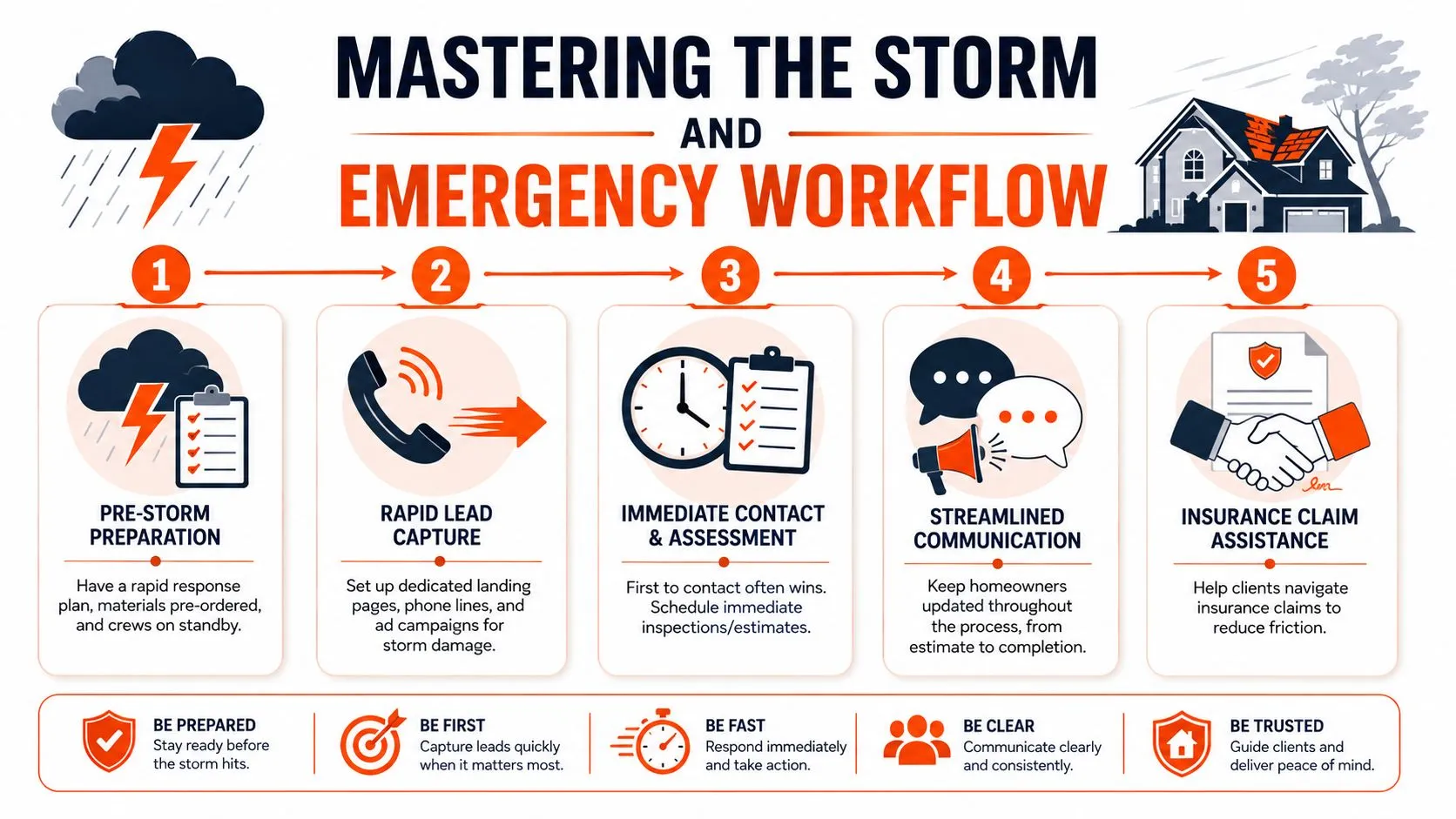
Pre-storm prep
Build the storm kit before you need it.
That means:
- Landing pages ready: Pages for storm damage, hail damage, emergency tarping, and roof leak help.
- Call scripts ready: Office staff should know what to ask and how to book fast.
- Ad drafts ready: Search campaigns should be easy to activate.
- Routing plans ready: Crews and canvassers need assigned zones, not guesswork.
A lot of restoration-heavy companies already understand this. Roofing owners can borrow the same discipline used in storm damage restoration marketing systems.
During-storm execution
Once the storm hits, simplify your messaging.
Homeowners don’t want a long lecture on product specs. They want help now. Your Google profile, website messaging, and ad copy should match that urgency.
Use plain language:
- Emergency roof repair
- Storm damage inspection
- Temporary tarp service
- Insurance claim help
Keep the intake tight. If your team asks too many questions before booking the inspection, they’ll slow the process and lose momentum.
First contact matters more than perfect marketing copy during emergency demand.
Post-storm follow-up
Here, many roofers waste the opportunity.
They knock doors for a day or two, get tired, and stop. Or they collect names and forget to run a real follow-up process. Done right, door knocking is still effective, especially for new companies, but it needs routing, accountability, and digital follow-up behind it.
Use a mixed approach:
| Phase | Main action | What to avoid |
|---|---|---|
| First 24 hours | Rapid inspection booking | Long forms and slow callbacks |
| Next few days | Canvassing and neighborhood saturation | Random route planning |
| Following weeks | Text, call, and email follow-up | Letting old leads go cold |
Emergency demand rewards preparation. Not luck.
Focus on Speed and Follow-Up for Profitability
Roofing owners love to argue about lead cost because it feels measurable. It is also one of the easiest ways to misread your marketing.
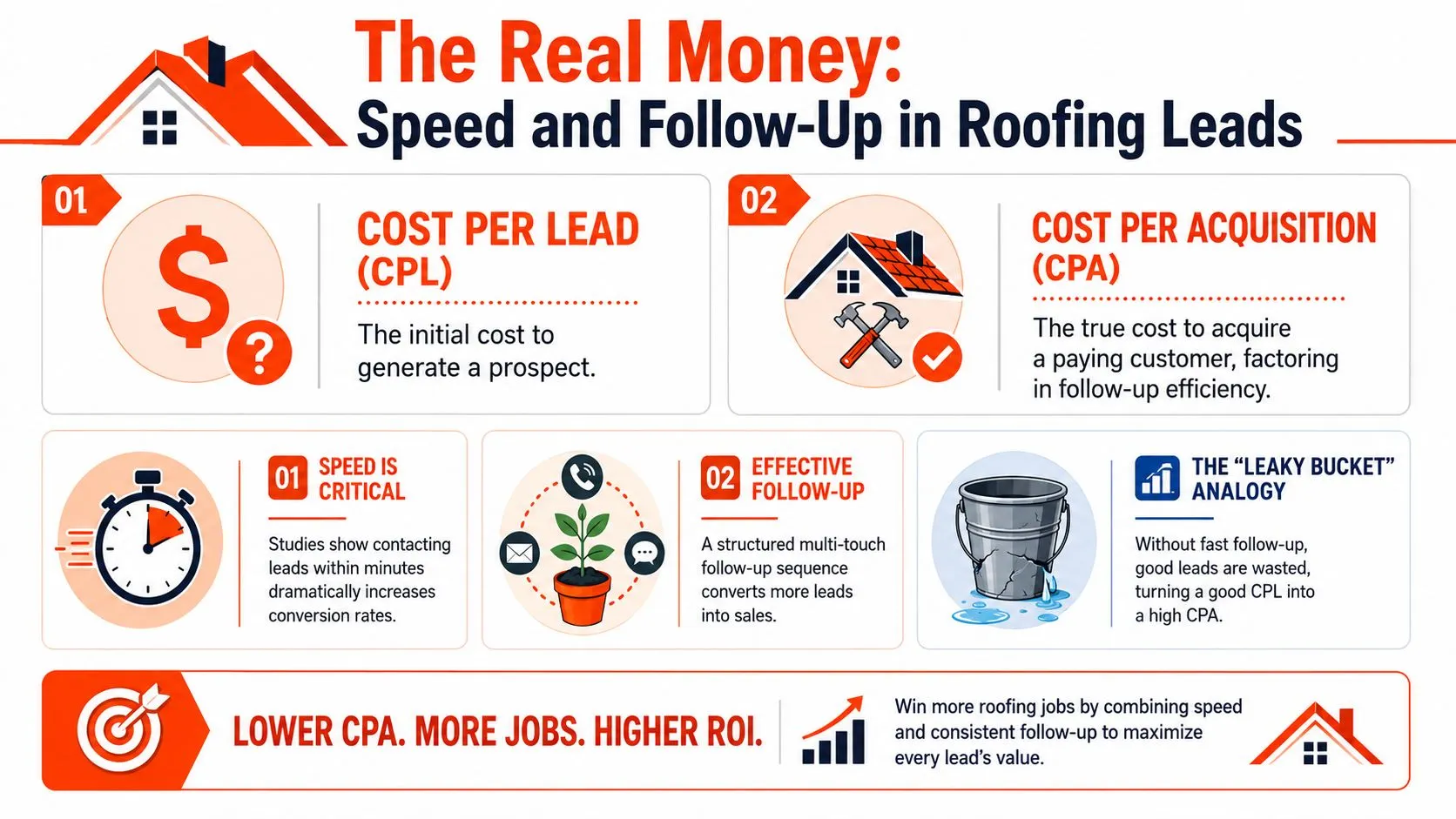
Profit usually gets won or lost after the lead comes in. If your team takes 20 minutes to call back, if nobody texts after hours, or if reps quit after one attempt, you paid for demand you never had a real shot at closing.
Nearly 80% of roofing leads are lost because contractors fail to contact homeowners fast enough, based on this EagleView Facebook post about slow quotes and manual workflows.
Why cost per lead misleads owners
Cost per lead has a place. It just should not run your decisions.
A cheap lead that sits untouched for an hour is expensive. A higher-cost lead from the right channel can print money if your team responds fast, books the inspection, and closes at a healthy rate. That is why smart roofing companies track speed-to-contact, booked inspection rate, and cost per closed job by source.
Contractor Dynamics makes the same point in this video on why roofing owners track the wrong marketing number.
There is another issue owners ignore. New roof leads close at roughly 1 out of 17, about 5.9%, according to this Reddit discussion on roofing lead generation tools. With close rates like that, every missed callback hurts more than a bad ad.
Build a response system that closes jobs
You do not need a fancy setup. You need a fast one.
Start with five parts:
-
Instant acknowledgment
Every form submission should trigger a text and email right away, so the homeowner knows you got it. -
Immediate call task
Your office or sales rep should get notified at once and call within minutes. -
Missed-call text-back
If a prospect calls after hours or hits voicemail, they still get a reply. -
Persistent follow-up
One call is not follow-up. Use a short sequence of calls, texts, and email until the lead books or clearly opts out. -
Source tracking that reaches the sale
Tag every lead by source, then track it through booked inspection, sold job, and revenue.
Owner rule: If your CRM cannot show response time and close rate by source, you are guessing.
Keep the scorecard short:
- Speed-to-contact
- Booked inspection rate
- Close rate by source
- Cost per closed job
- Average job value by source
That is how you judge leads for roofing companies. Not by how many form fills show up. By how fast your team responds, which channels produce booked appointments, and which ones turn into profitable jobs.
Your Roofing Lead System Blueprint
Roofing companies get in trouble when they build for lead volume instead of profit. More leads do not fix a weak system. They usually expose it.
A lead system that holds up has three jobs. Capture demand now, build demand you own, and turn every inquiry into a booked inspection fast enough to win the job. If one part is missing, your marketing leaks money.
What to build first
Build in this order, because sequence matters:
-
Lock down your local foundation
Get your Google Business Profile, reviews, service pages, and city pages in shape first. If branded search and map visibility are weak, every paid channel gets more expensive. -
Add high-intent paid capture
Run LSAs or search campaigns to catch homeowners who already need a roofer. Use them to fill the pipeline, not to become dependent on rented attention. -
Make your website convert
Give people a clear next step. Short forms, click-to-call, financing visibility, and an estimate request that works on mobile beat a pretty site every time. -
Set up follow-up that starts instantly
Every lead should trigger a text, a call task, and source tracking inside your CRM. If your team replies slowly, your ad spend is wasted before the sales conversation starts. -
Systemize referrals
Referrals should be a process, not a hope. Ask at job completion, ask again after the review comes in, and track who sends business.
What to measure
Cost per lead is a weak scoreboard. It makes cheap junk leads look good and hides the channels that produce revenue.
Track the numbers that affect cash:
| Metric | Why it matters |
|---|---|
| Speed-to-contact | Fast response raises booking rates |
| Booked inspection rate | Shows whether leads are real and your intake works |
| Close rate by source | Separates busy channels from profitable ones |
| Cost per closed job | Tells you what customer acquisition actually costs |
| Average job value by source | Helps you fund channels that bring better work |
That is the blueprint. Strong local visibility. Paid capture for immediate demand. A site built to convert. Follow-up measured in minutes, not hours. Reporting tied to closed jobs, not form fills.
If you run your roofing marketing this way, you stop chasing vanity metrics and start building a system that you control, one that shows which channels close fastest, cost less to win, and produce the best jobs.
If you want help building that kind of owned system, FirstMention helps home-service companies show up across Google, Maps, ChatGPT, Perplexity, Gemini, and AI Overviews, then connect that visibility to follow-up, intake, and reporting that lead to booked jobs.