Contractor Lead Service: 2026 Guide to Success
Is a contractor lead service worth it? This 2026 guide covers types, pricing, and red flags for restoration contractors. Get booked jobs now.


Most advice about contractor lead service is upside down.
It tells you to compare lead prices, ask about exclusivity, and buy more volume. That’s lazy advice. A restoration contractor doesn’t stay profitable by collecting names and phone numbers. You stay profitable by turning the right inquiries into booked jobs with solid margins.
A lead service sells possibility. Sometimes that’s useful. Often it’s overpriced chaos. If your team misses calls, responds late, or chases jobs outside your real service footprint, buying more leads just makes the waste bigger.
Table of Contents
- What Is a Contractor Lead Service Anyway
- The Different Types and How They Bill You
- KPIs and Red Flags When Choosing a Service
- Why Your Inbound System Leaks Leads
- The Alternative Build an Owned Marketing System
- Your Decision Framework Which Path Is Right
What Is a Contractor Lead Service Anyway
A contractor lead service is a middleman.
They attract people who might need work done, collect contact details, and pass that information to contractors for a fee. That’s the core model. Strip away the sales language and that’s what you’re buying.
Consider this: You’re not paying for groceries. You’re paying for a shopping list.
That list might be useful. It might even contain exactly what you need. But it isn’t dinner, and it isn’t a booked restoration job. Someone still has to call, qualify, inspect, estimate, follow up, and close.

The basic transaction
A lead service usually does four things:
- Captures attention: It runs ads, ranks pages, or builds marketplace traffic.
- Collects intent: A homeowner fills out a form, calls a tracking number, or requests help.
- Routes the lead: The service sends that inquiry to one contractor or several.
- Bills the contractor: You pay for the lead, not for the job.
That’s where many contractors get fooled. The provider’s job often ends at delivery. Your real work starts after that.
Practical rule: Never confuse lead delivery with revenue delivery.
For restoration companies, that gap matters more than it does in simpler trades. Water, fire, mold, and storm work can be urgent, messy, insurance-related, and location-sensitive. A homeowner may be stressed, price-sensitive, or talking to multiple companies at once. A lead can look good on paper and still turn into nothing.
Why the model creates risk
The lead service gets paid before you get paid. That’s the built-in tension.
Some leads aren’t reachable. Some aren’t qualified. Some are outside your target zip codes. Some want cheap cleanup when you want full-scope mitigation and rebuild. Some already hired the first company that answered.
This is why I don’t judge a contractor lead service by lead count. I judge it by what happens after handoff.
A more useful way to think about it is this:
| What the lead service sells | What you actually need |
|---|---|
| Contact info | A real conversation |
| Stated interest | Qualified scope |
| Lead volume | Booked jobs |
| Delivery speed | A working intake process |
There’s nothing wrong with using a lead service. The mistake is treating it like a complete growth strategy. It isn’t. It’s just one input.
For some restoration contractors, it can fill gaps. For others, it becomes a very expensive crutch.
The Different Types and How They Bill You
Not all contractor lead service models are the same. Some sell contact records. Some sell access to bidding opportunities. Some package traffic, trust, and intake into one platform. If you don’t know which game you’re playing, you’ll overpay.
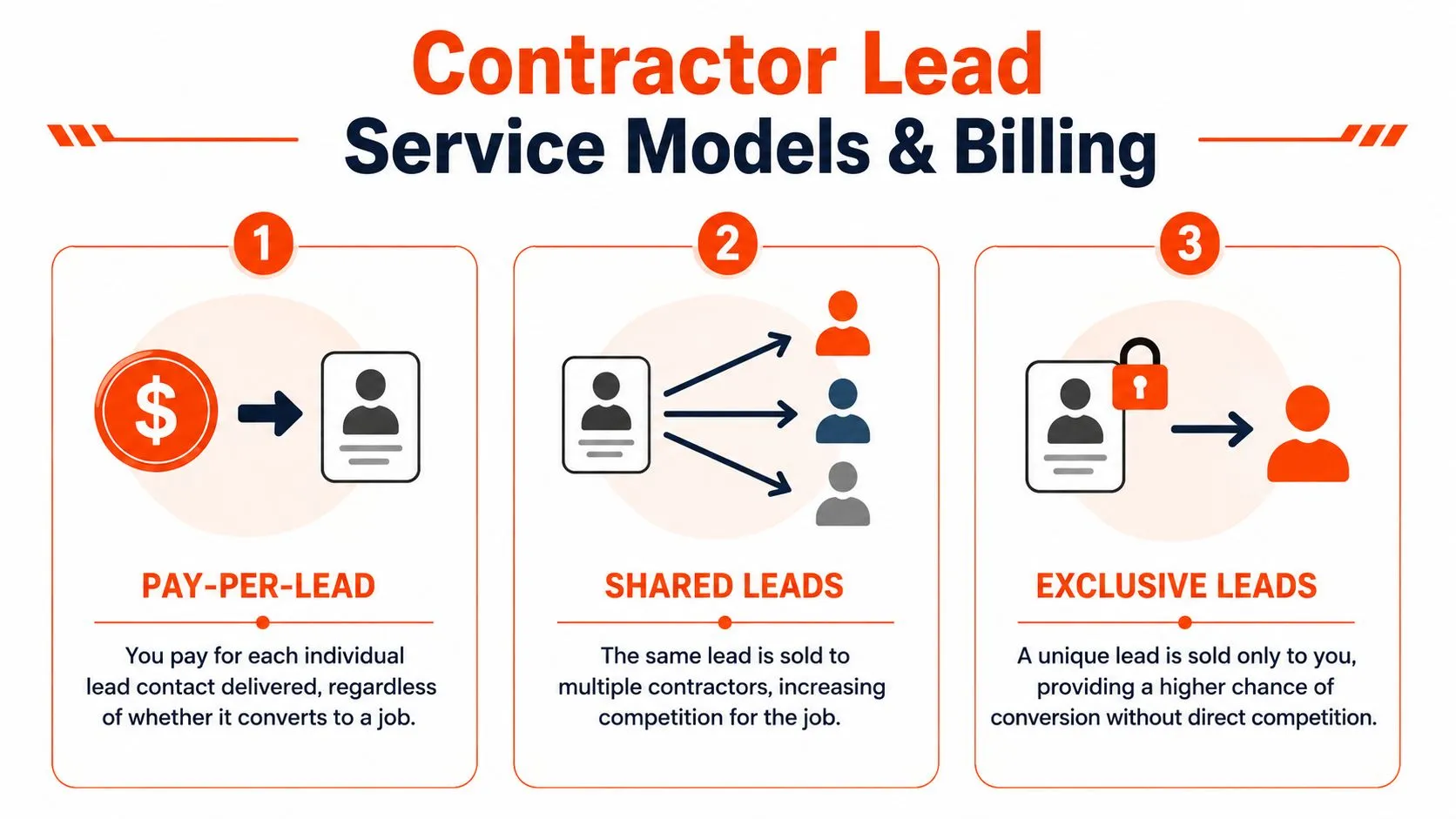
The basic deal
Here are the main models and the trade-off attached to each.
| Model | How it works | The upside | The catch |
|---|---|---|---|
| Pay per lead | You pay when a lead is delivered | Simple to understand | You still carry all conversion risk |
| Shared leads | The same inquiry goes to multiple contractors | Lower entry point | Fastest responder often controls the shot |
| Exclusive leads | The provider says the lead goes only to you | Less direct competition | “Exclusive” doesn’t always mean high-fit or high-intent |
| Marketplace platforms | You buy access inside a larger homeowner platform | Built-in traffic and reviews | You play by their rules, pricing, and routing logic |
| Bid networks | You receive invitations to compete on work | Better for structured commercial opportunities | You’re entering a bid environment, not buying a ready-to-close homeowner call |
Independent lead-market guidance makes an important distinction. Residential pay-per-lead sources can be shared, while commercial bid networks often distribute invitations to compete rather than reselling the same lead. That same guidance points to acceptance rate and speed-to-lead as core quality metrics in this category, which is a better lens than raw lead totals (ActiveProspect on buying construction leads).
If you’re a restoration contractor doing residential emergency work, shared leads can become a scramble. You’re not just selling your service. You’re racing the clock against other contractors and against homeowner fatigue.
If you’re in commercial restoration or larger reconstruction scopes, bid-style systems are different. You’re not buying a consumer lead. You’re entering a managed opportunity where pricing, scope clarity, and bid discipline matter more than quick phone pickup.
Where Google Local Services Ads fit
Google Local Services Ads sit in their own category. They behave like a pay-per-lead system, but with more gatekeeping.
In the U.S., Google Local Services Ads became a major contractor lead channel because eligible businesses must pass license and background checks and then pay per lead rather than per click. One contractor marketing guide notes that campaign budgets for this channel “usually start out around $1500 for ad-spend,” which tells you this isn’t a casual test channel for a small operator (contractor lead generation guide covering LSAs).
That same source notes the lead system is tied to Google Maps listings. Reviews and local visibility affect lead flow. That’s a big deal. It means your profile quality matters, not just your budget.
Google Local Services Ads can be good. They’re still rented demand.
If you want a wider look at how businesses compare outside lead-selling platforms, this breakdown of marketing agency lead generation is worth reading because it helps frame the difference between buying activity and building a system.
My take on each model
Shared leads are for filling holes, not building a company. Use them if crews are idle and you need short-term volume. Don’t build your future around them.
Exclusive leads can work, but ask harder questions. Exclusive to you doesn’t mean exclusive to the category. It may only mean the seller didn’t send that exact form to another buyer.
Marketplaces can help if your reviews are strong and your office answers fast. If your intake is weak, they punish you.
Bid networks matter more when you’re pursuing structured project opportunities. They are not the same thing as homeowner lead marketplaces, and you shouldn’t evaluate them the same way.
KPIs and Red Flags When Choosing a Service
Cheap leads fool contractors every day.
A lead service should be judged on one outcome: how much it costs you to book profitable work after office follow-up, estimator time, travel, and close rate are counted. Cost per lead is a vendor metric. Cost per booked job is an owner metric. Build your scorecard around the number that affects payroll and margin.
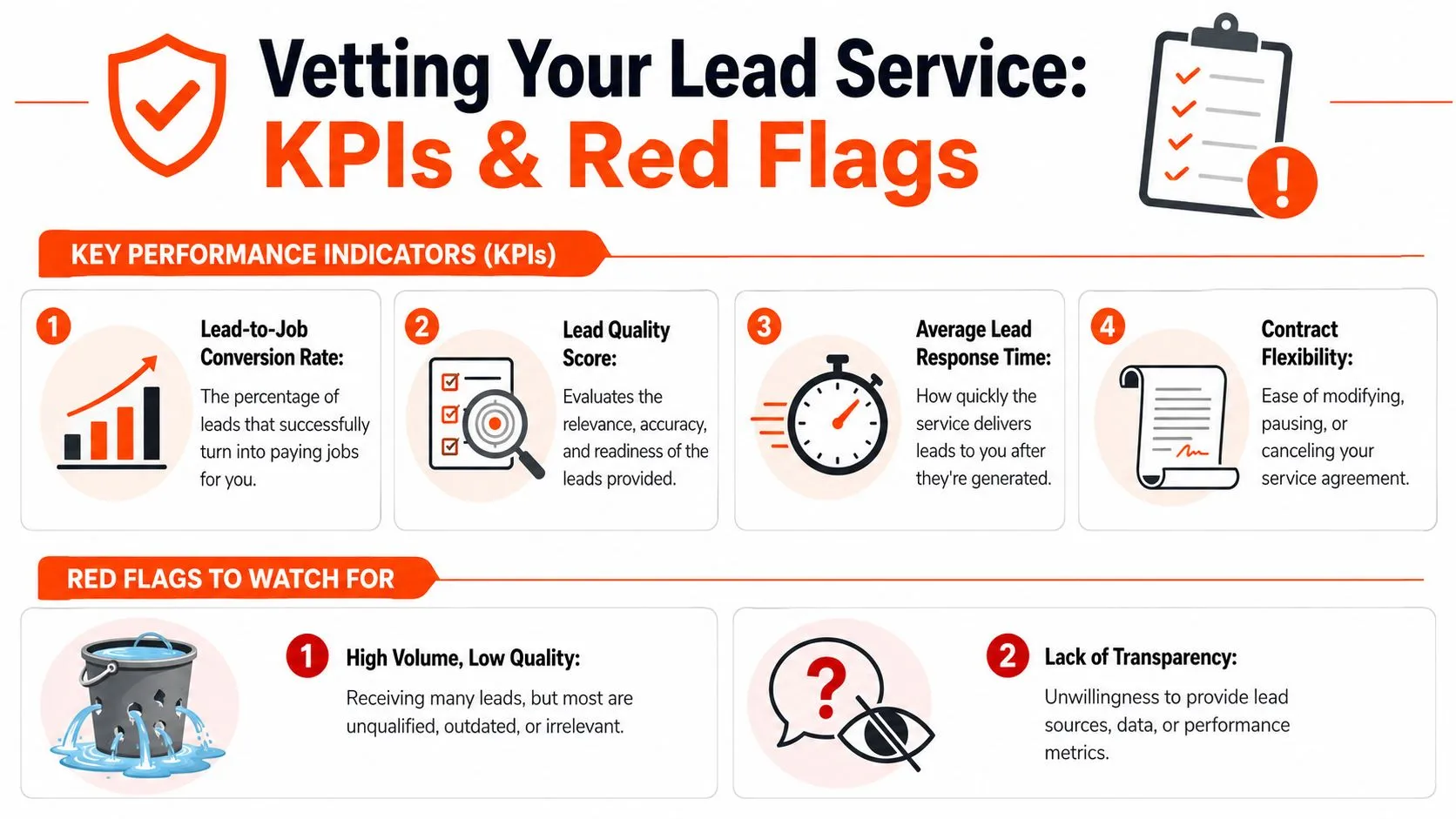
The numbers that actually matter
If a provider can’t show you what happens after the form fill or phone call, treat that as a warning. Impressions, clicks, and “high intent” language do not pay for trucks.
Track the full chain:
- Contact rate: How many delivered leads answer, reply, or call back.
- Qualified rate: How many fit your service area, service line, urgency, and job type.
- Appointment rate: How many become inspections, site visits, or scoping calls.
- Estimate rate: How many turn into a real proposal.
- Booked-job rate: How many become signed work.
- Gross profit by source: Which channels produce jobs worth keeping.
Track every lead by source, outcome, and job value for at least 90 days. That gives you enough time to see what looked cheap up front but stalled in follow-up, no-showed, or turned into low-margin work. Without that window, you will overvalue busywork and undervalue channels that close.
For restoration companies, two extra filters matter:
-
Insurance fit
Separate claim-driven work from out-of-pocket buyers. They behave differently, close differently, and produce different margins. -
Scope fit
Water mitigation, mold, contents, reconstruction, and storm work should never be blended into one conversion bucket. A service that combines them is hiding the truth.
You should also compare rented leads against channels you own. A useful benchmark is the difference between short-term lead buying and a channel mix you control through SEO and PPC services that build direct demand. If your owned channels book jobs at a lower blended acquisition cost after a few months, keep shifting budget there.
Red flags that should slow you down
Good providers answer hard questions fast. Bad providers get slippery.
Watch for these problems:
- Vague lead definitions: If they can’t explain what counts as valid, they can invoice junk.
- No source transparency: If they won’t tell you whether leads came from search, calls, forms, or partner traffic, you’re buying blind.
- Long commitments: If the offer only works under a long contract, the economics probably don’t work.
- No routing detail: You need to know when leads arrive, where they land, and who sees them first.
- Refund theater: Credits do not repay wasted CSR time, estimator hours, or drive time.
- No job-level reporting: If they stop reporting at lead delivery, they are hiding the part that matters.
Ask blunt questions. How many leads become booked jobs? Which job types close best? What does “exclusive” mean in writing? How many other contractors are competing for the same demand in your ZIP codes? If the rep keeps dragging you back to lead volume, end the call.
One more problem gets missed. A service can produce a decent top-of-funnel report and still produce bad unit economics once competition, contactability, travel radius, and close rate are counted. That is the ultimate test. This review of contractor lead generation performance beyond the initial lead makes the same point from a different angle.
The contractor who wins does not buy the most leads. The contractor who wins buys or builds the lowest-cost path to booked jobs, then puts more budget there.
Why Your Inbound System Leaks Leads
More lead volume will not fix a weak intake process. It will just raise the cost of every booked job.
That is the mistake restoration contractors make when they get frustrated with lead flow. They buy more traffic, more leads, or another marketplace, while the significant loss happens after the phone rings. A homeowner calls after hours. The call rolls to voicemail. A form comes in. Nobody claims it. An estimator follows up once, then moves on. The lead count looks fine. Revenue does not.
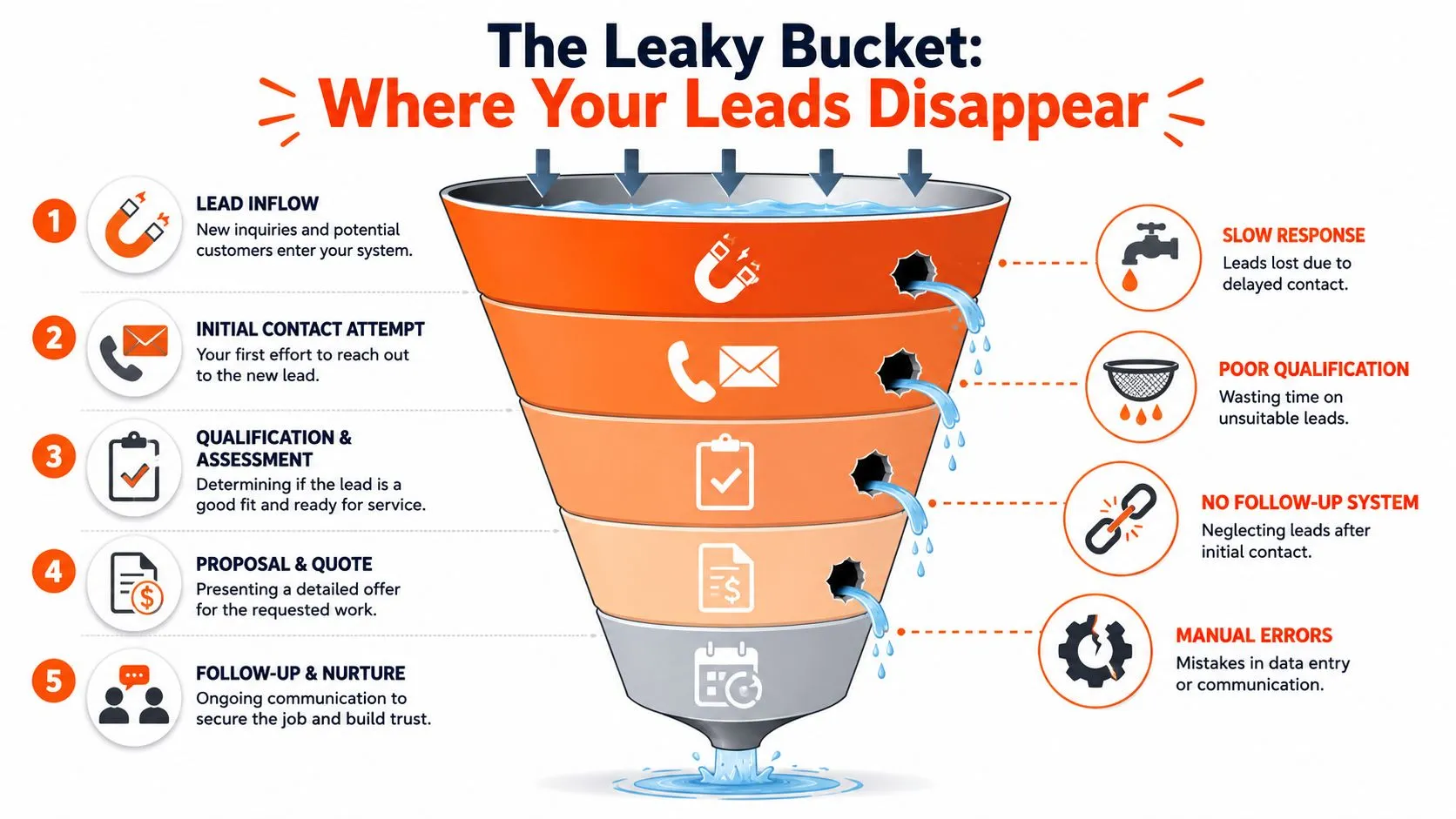
Look at what happens at 6:14 p.m. on a Tuesday.
If your answer is voicemail, a missed-text alert no one checks, or “we call them in the morning,” your problem is not demand. Your problem is conversion speed. In restoration, the company that responds first usually gets the inspection, and the company that gets the inspection has the best shot at the job.
The leak usually happens in plain sight. Calls go unanswered. CSRs capture partial information. Intake staff fail to confirm service area, urgency, or insurance situation. Leads sit unassigned in the CRM. Sales treats follow-up like cleanup work instead of part of the sale. Then the owner says the lead source was bad.
Sometimes the source was bad. Often the process was worse.
For a practical look at how traffic sources only matter when the intake process can turn interest into appointments, this guide to SEO and PPC services for contractors is worth reading. More clicks do not help if your team cannot turn inquiries into scheduled inspections.
Here’s a useful visual on the leak points most owners ignore:
What a tight intake process looks like
A good intake system is simple, fast, and enforced.
Use this standard:
- Answer fast: Route calls to a live person, an after-hours service, or a backup path that gets an immediate callback.
- Capture the right details: Get service type, address, urgency, loss type, insurance status, and preferred contact method on the first interaction.
- Assign one owner: Every new inquiry needs one named person responsible for the next step.
- Set the next action before the call ends: Book the inspection, schedule the callback, or send the estimate timeline. Do not leave leads in a vague open status.
- Follow up until you get a clear outcome: No answer is not a closed loop. Keep working the lead until it books, disqualifies, or chooses someone else.
The lead source matters less than the system that answers, qualifies, schedules, and follows up.
This is why I push contractors to measure cost per booked job, not cost per lead. A cheap lead that sits overnight is expensive. A higher-cost call that gets answered, qualified, and booked today is usually the better buy. If your inbound process leaks at intake, every outside lead service gets blamed for a problem inside your office.
The Alternative Build an Owned Marketing System
A contractor lead service is rented demand. An owned marketing system is an asset.
That’s the difference.
When you rent leads, someone else controls the platform, the pricing, the routing rules, and often the customer relationship. When you build your own system, you control the pages, the reviews, the intake path, the follow-up, and the data.
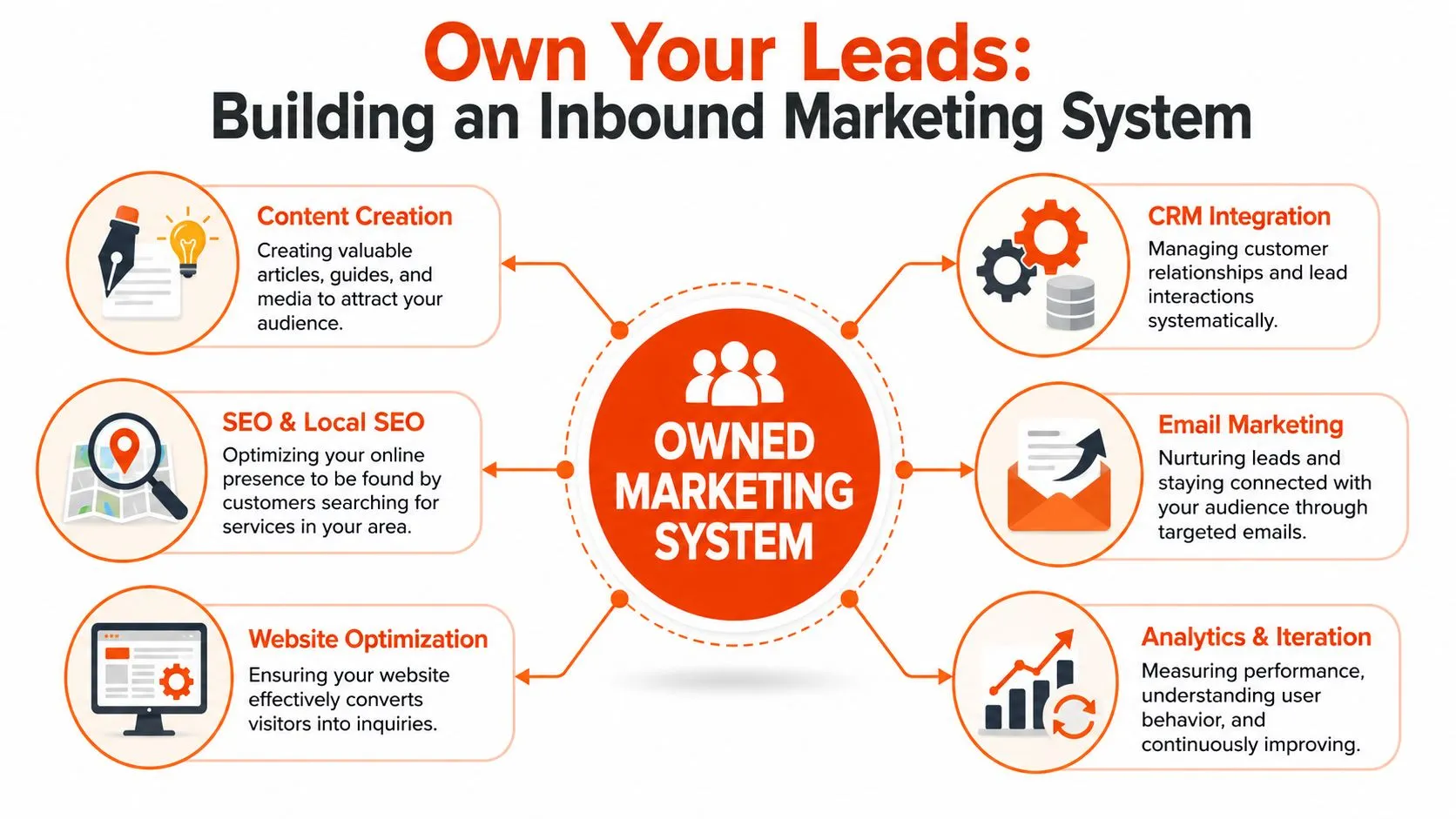
Stop renting demand when you can build it
Independent contractor marketing guidance increasingly emphasizes Google Local Services Ads, Google Maps presence, reviews, photos, and service-specific content as the visibility pieces that shape contact intent and trust. The same guidance implies that some lead services are best used as a temporary demand filler rather than a core growth engine, especially when reseller or marketplace models create dependency (construction lead generation strategies for contractors).
That’s the right way to think about it.
Lead services can help you patch a hole. They are weak foundations for a long-term company. If you stop paying, the flow usually stops. If the platform changes rules, you’re exposed. If the lead quality drops, you have limited influence.
Owned visibility compounds. Reviews keep working. Service pages keep ranking. Good photos keep building trust. A well-structured Google Business Profile keeps driving calls. Clear local signals help you appear where homeowners search.
And now that search behavior is spreading across AI tools, that owned footprint matters even more. Homeowners don’t only bounce between old directories now. They search Google Maps, read reviews, ask AI assistants, and compare businesses based on whoever looks credible fastest.
What owned marketing looks like for restoration
For a restoration contractor, an owned system usually includes:
- Service pages built for actual jobs: Water damage cleanup, fire damage restoration, mold remediation, storm damage, emergency board-up, contents handling, and rebuild. Not one generic “services” page.
- Local visibility that supports trust: Clean Google Business Profile, accurate service areas, current photos, and a review process that doesn’t depend on begging once a quarter.
- Conversion paths that work: Call buttons, tracked forms, fast intake, and clear offers.
- Lead handling after the click: Missed-call text-back, status tracking, estimate follow-up, and reactivation.
- Visibility in AI-driven search surfaces: Useful content and structured pages that help your company get cited and discovered when people ask tools like ChatGPT, Perplexity, Gemini, and Google AI Overviews for local options.
This doesn’t mean you shut off all paid lead sources tomorrow. It means you stop treating them like your business model.
A smart restoration company often uses paid leads tactically while building owned channels steadily. That mix is healthier. It gives you some short-term demand without staying dependent forever.
If you want to see how this thinking applies specifically to trades, this guide on contractor digital marketing is a useful companion.
Build the machine you control. Use rented leads only when they serve that machine.
There’s also a practical segmentation point that many contractors miss. Discovery tools, bid-management networks, and full-lifecycle platforms solve different problems. Some help you find opportunities early. Some help coordinate bids. Some support preconstruction through field execution in one database. You should choose based on whether you need pipeline volume, bid accuracy, or delivery control, not just “more leads” (ProjectMark on lead generation systems for contractors).
Your Decision Framework Which Path Is Right
Don’t make this decision based on hype. Make it based on what breaks first in your business.
Use this framework.
If your phone is quiet, your reviews are thin, and your local visibility is weak, a contractor lead service may help fill the gap for a while. Keep the test small. Avoid long contracts. Judge it by booked jobs, not lead count.
If leads already come in but your office misses calls, follow-up is inconsistent, or estimates sit untouched, stop buying more leads. Fix intake, routing, and follow-up first. More volume won’t save a broken process.
If your response process is tight and you want durable growth, invest in owned marketing. Build strong service pages, improve Maps visibility, collect better reviews, and make sure your business can be found in both search and AI-driven discovery.
If you do commercial work, separate homeowner lead services from bid platforms in your thinking. They are different tools for different motions.
My recommendation for most restoration contractors is simple. Use lead services as a short-term supplement. Build owned visibility as the long-term asset. Track everything through to booked work and margin. That’s how you protect your budget.
If you’re tired of disconnected vendors, rented leads, and missed opportunities, FirstMention helps home-service companies build AI-ready marketing systems that drive booked jobs, not just inquiries. We connect local search visibility, AI visibility, intake, follow-up, and reporting so you can see what’s working and fix what isn’t.