Contractor Digital Marketing: A Playbook for 2026
Get the contractor digital marketing playbook for restoration pros. This guide covers local SEO, Google Ads, and lead-gen systems that turn calls into jobs.


Most contractor marketing advice is backwards.
It tells you to pick a channel. Run Google Ads. Do SEO. Post on Facebook. Buy leads. None of that fixes the underlying problem. Contractors usually don’t have a traffic problem first. They have a system problem. Calls aren’t tracked. Forms go nowhere. The office misses urgent leads. The website ranks for the wrong terms. Nobody knows which jobs came from which spend.
That’s why so much contractor digital marketing feels expensive and vague at the same time. You get activity. You don’t get clarity.
If you want this to work in 2026, stop thinking in silos. Build one machine that does four things well. It gets you found in local search. It gets you found in AI-driven search. It captures intent fast. Then it routes, qualifies, and follows up until a real job is booked.
Table of Contents
- Why Most Contractor Marketing Fails
- Find High-Intent Demand Before Your Competitors
- Your Marketing Engine Local SEO Ads and Landing Pages
- Build a System to Stop Leaking Leads
- Budgets and KPIs That Actually Make Sense
- Frequently Asked Questions
Why Most Contractor Marketing Fails
Most contractor marketing fails because it was never built to answer one simple question.
Which marketing spend turned into booked jobs?
A lot of contractors still run with disconnected vendors and disconnected data. One company handles the website. Another runs ads. Somebody else “does SEO.” The office answers calls however it can. Reports show clicks, traffic, and rankings, but nobody can connect that activity to actual revenue.
That model breaks fast in home services. One missed call can mean a lost emergency job. One bad landing page can waste a month of ad spend. One office bottleneck can make a decent campaign look broken.
A cited ServiceTitan study found that only 45% of businesses in the contracting and construction industries were growing, which helps explain why contractor marketing shifted toward measurable channels like search, call tracking, and lead attribution rather than broad awareness alone, as noted in Blue Corona’s contractor marketing analysis.
Most vendors optimize their piece, not your outcome
That’s the trap.
The SEO vendor wants rankings. The ad vendor wants more clicks. The website shop wants a redesign. The lead seller wants you dependent on their platform. None of those goals are the same as your goal, which is a booked, profitable job.
Practical rule: If your marketing report can’t show call source, lead quality, and booking outcome, it’s not a business report. It’s a vendor comfort report.
Contractor digital marketing only gets useful when you treat it like part of operations. Not branding. Not busywork. Operations.
Here’s what usually goes wrong:
- Tracking is weak: Calls, forms, chats, and text leads aren’t tied back to channel or campaign.
- Pages are generic: The same service page tries to speak to every job type, urgency level, and neighborhood.
- Follow-up is slow: The lead came in. Nobody answered. Nobody texted back. Nobody called again.
- Reporting stops too early: Teams celebrate traffic when they should be checking qualified leads and booked work.
The fix is operational, not cosmetic
You don’t need more marketing noise. You need a tighter system.
That system should do a few basic things every day:
| Part of the system | What it should answer |
|---|---|
| Search visibility | Can homeowners find you when intent is high? |
| Conversion path | Can they call or submit fast without friction? |
| Lead routing | Does the right person get the lead right away? |
| Outcome tracking | Did that lead become an estimate, booking, or job? |
A good contractor digital marketing setup is boring in the best way. It’s measured. It’s repeatable. It helps dispatch, intake, and sales do their jobs better.
That’s what most advice misses. Marketing doesn’t stop when the phone rings. For contractors, that’s where the test starts.
Find High-Intent Demand Before Your Competitors
The old playbook said this was mostly a Google game.
It isn’t anymore.
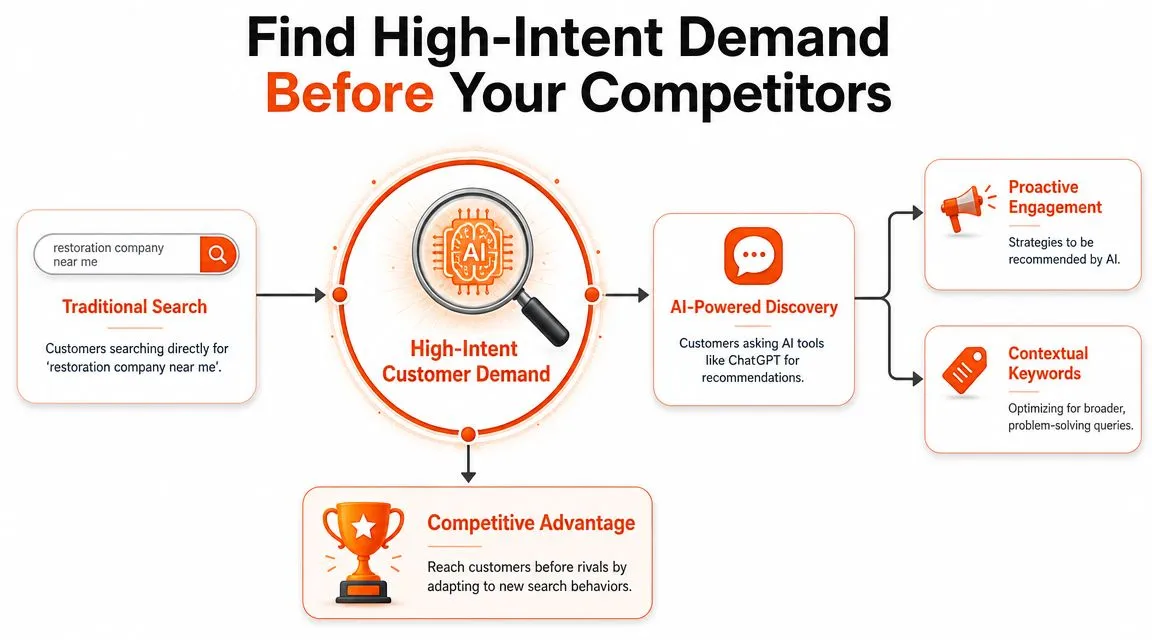
Homeowners still search in Google and Maps. But they also ask AI tools broad, messy questions. They ask for the best company nearby. They ask who handles a specific issue. They ask what kind of contractor they need before they even know the service category. Recent contractor guidance says strategies should be optimized for “Google and AI-driven search visibility,” and points out that most advice still doesn’t answer how to stay visible when homeowners ask ChatGPT, Perplexity, Gemini, or see AI Overviews, as discussed in Market Engine’s contractor marketing guide.
Emergency demand and project demand are different games
Treating all demand the same is lazy marketing.
Emergency demand is fast, direct, and urgent. Think burst pipe, no AC, electrical issue, roof leak after a storm, garage door stuck, sewage backup. The homeowner wants help now. They don’t want a brand story. They want proof you serve their area and answer the phone.
Project demand moves slower. The person may compare providers, read reviews, scan service pages, and ask AI tools broader questions before reaching out. They may search by problem, then by solution, then by company.
Here’s the difference:
- Emergency demand: short path, high urgency, phone-first behavior
- Project demand: longer path, more comparison, content and trust matter more
- Mixed demand: replacement, inspection, and estimate requests often sit in the middle
“If you don’t separate urgent demand from researched demand, your pages and campaigns get watered down.”
You need different landing experiences, different messaging, and often different intake flows.
How to show up in Google and AI answers
Start with the problems people describe. Not just the service names you prefer.
A homeowner may search “water in basement after storm” before searching “restoration contractor.” They may ask an AI tool, “Who handles smoke damage cleanup near me?” or “Best electrician for panel upgrade in my area.”
That means your visibility strategy should include:
-
Clear service pages Separate emergency repair, diagnostics, replacement, and install where it makes sense.
-
Plain-language FAQ content Answer problem-based questions the way customers ask them.
-
Strong review signals Reviews help humans decide. They also reinforce your authority across search surfaces.
-
Local proof Cities, service areas, response expectations, job types, and trust signals should be easy to parse.
If you want a practical read on response time after demand is captured, SkipCalls insights on lead efficiency are worth your time. Speed and availability shape whether high-intent demand becomes a real opportunity or a missed one.
For paid acquisition strategy in a specific trade, this breakdown of ads for electricians shows the kind of intent-focused thinking more contractors need, even outside electrical.
What to look for in your own market
Don’t rely on one keyword list and call it research.
Look at demand from three angles:
- Search terms with urgency: “near me,” “repair,” “emergency,” “same day,” “open now”
- Problem-first wording: “water heater leaking,” “breaker keeps tripping,” “roof leak after hail”
- AI-style prompts: “best HVAC company for old house,” “who fixes sewer line backups,” “who should I call for fire damage cleanup”
Then compare your current presence.
Do your pages answer those problems clearly? Does your Google Business Profile align with what you want to sell? Are your reviews specific enough to support recommendation-style queries?
Most contractors are late here. That’s good news if you move now.
Your Marketing Engine Local SEO Ads and Landing Pages
Most contractors ask the wrong question.
They ask whether SEO or ads work better.
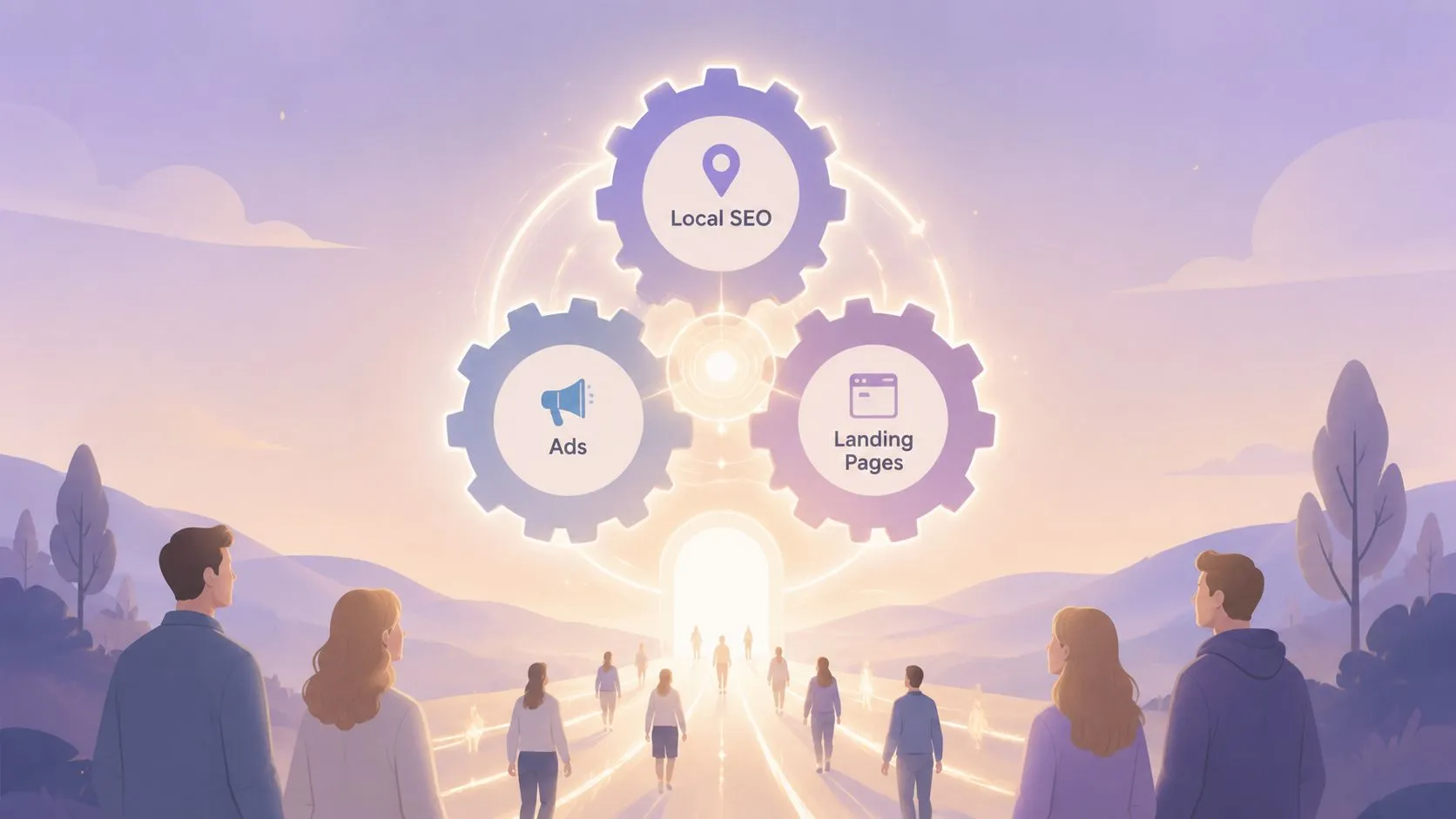
The better question is whether your local SEO, ads, and landing pages are reinforcing each other. If they aren’t, you’re paying for friction.
These channels should work together
A practical digital marketing workflow is to set SMART goals, map buyer personas, audit assets, allocate budget and tools, then track KPIs like SEO rankings, conversion rate, and ROI. The important part is what comes next. Campaigns should be tested and optimized from performance data, not launched once and left alone, as outlined in Adobe’s digital marketing strategy guide.
That advice matters because contractor digital marketing isn’t one channel. It’s one engine with multiple inputs.
Local SEO gives you durable visibility in Maps and organic search. Paid search gives you control when urgency spikes. Landing pages turn that visibility into calls and form fills without wasting intent.
When these pieces line up, each one improves the others:
- A strong local presence makes your ads feel more credible.
- Paid search data shows which offers and terms deserve dedicated pages.
- Landing page behavior tells you which service angles create action, not just visits.
What a usable contractor marketing engine looks like
Think simple. Not fancy.
A solid setup for a plumbing, HVAC, roofing, restoration, or electrical company usually includes:
| Channel | Job |
|---|---|
| Google Business Profile | Capture map intent and local trust |
| Google Ads | Buy top visibility for urgent, high-intent searches |
| Service landing pages | Match query intent and drive action fast |
Your landing pages should not read like generic brochure pages. A homeowner with an active leak doesn’t care about your mission statement. They care about whether you handle the issue, where you work, and how fast they can reach you.
Good contractor landing pages usually include:
- A direct headline: match the service and urgency
- A visible phone action: especially on mobile
- Location relevance: cities, neighborhoods, or service area detail
- Trust proof: reviews, photos, certifications, or service guarantees stated plainly
- One clear next step: call, request service, or send details
The best landing page for urgent service feels like an open door, not a brochure.
A lot of companies also need better coordination between organic and paid efforts. If your SEO pages rank for broad educational queries and your ads target emergency intent, don’t dump both audiences onto the same page.
An integrated search strategy is key. If you want a deeper look at how teams combine channels instead of treating them like separate vendors, this guide to SEO and PPC services working together is useful.
The point is straightforward. Your local SEO builds trust over time. Your ads capture immediate demand. Your landing pages convert both. Pull one piece out, and the whole engine gets weaker.
Build a System to Stop Leaking Leads
A lot of contractors think marketing ends when the phone rings.
That’s wrong.
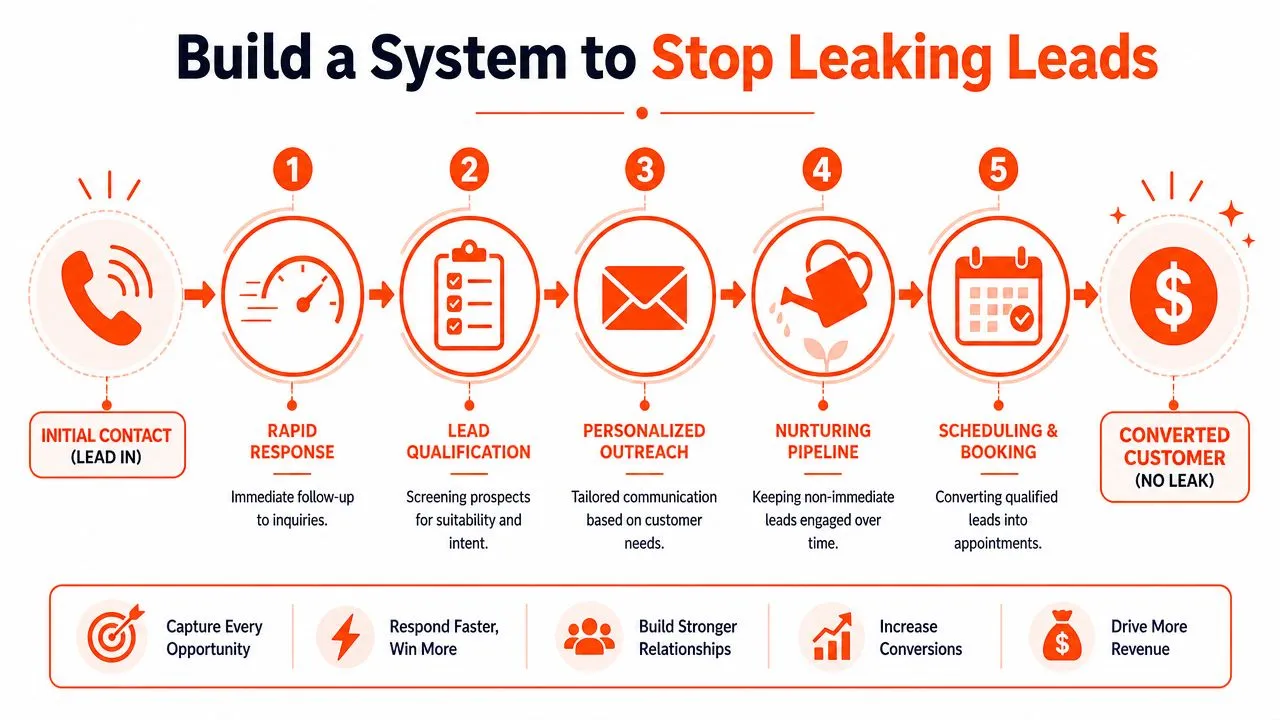
If the call goes unanswered, if the form sits in an inbox, if nobody qualifies the request, the marketing failed. The lead doesn’t care whether the breakdown happened with your office, your CRM, your call rail, or your dispatcher. They just move on.
Lead capture is part of marketing
This is the least glamorous part of contractor digital marketing, and it’s where a lot of profit gets lost.
In practice, contractors that fail to monitor conversion instrumentation metrics lose the ability to connect spend to booked work, while structured KPI tracking is the basis for measurable improvement, as explained in Northwestern Medill’s overview of digital marketing success metrics.
That sounds technical, but it’s simple in the field. You need to know what happened after the click.
Did the lead call? Did someone answer? Was it qualified? Was it booked? Did it become revenue?
If you can’t answer those questions, you’re guessing.
A simple lead handling workflow
Use a workflow that protects speed and clarity.
-
Capture every entry point Calls, forms, chats, text messages, and after-hours inquiries should all flow into one visible queue.
-
Route by service and urgency Emergency restoration and high-value repair requests shouldn’t sit behind low-priority estimate requests.
-
Use missed-call text-back If the office misses the call, the system should respond fast with a simple next step.
Before you overcomplicate this, watch how a practical intake flow works in practice:
-
Qualify before dispatch Basic details matter. Location. issue type. urgency. job fit. duplicate or new lead.
-
Push non-immediate leads into follow-up Not every lead books on first contact. Some need estimates, reminders, financing follow-up, or seasonal reactivation.
A lot of contractors also need a better top-of-funnel to booked-job handoff. This guide on plumbing lead generation systems is useful because it shows how lead flow and follow-up have to connect, not operate as separate tasks.
Operator’s view: A missed lead is usually not a traffic problem. It’s a handoff problem.
What to track after the lead comes in
Don’t just track source. Track movement.
A practical internal scorecard should answer:
- Intake quality: Was the lead real, reachable, and relevant?
- Response execution: Did your team answer, call back, or text back quickly?
- Sales progress: Was the lead scheduled, quoted, and followed up?
- Outcome: Booked job, lost job, or dead lead
This part of contractor digital marketing often feels like admin work. It isn’t. It’s conversion work.
If your team gets this right, the same ad spend and the same search visibility produce more actual jobs. If your team gets it wrong, no amount of new traffic fixes the leak.
Budgets and KPIs That Actually Make Sense
Most contractor reporting is padded with numbers that don’t help an owner make decisions.
Clicks. Impressions. Reach. Traffic spikes.
Those numbers can be useful diagnostics. They are not the scoreboard.
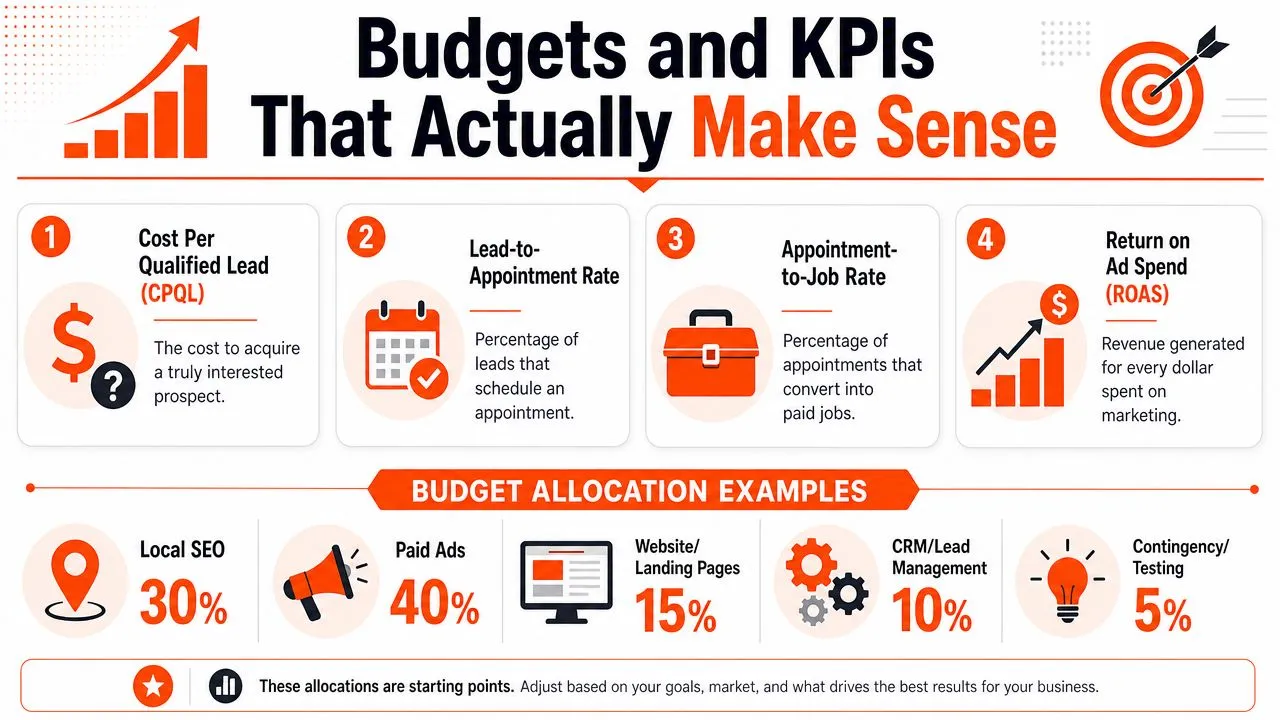
In a 2025 guide, one operator said effective online advertising often requires roughly $3,000 to $5,000 in monthly ad spend before cost per lead becomes workable, and that some contractors may see costs near $1,000 per lead when spending below that threshold. He also argued that the key metric is not clicks, but cost per qualified lead, as explained in this contractor advertising discussion on YouTube.
Stop reporting on cheap metrics
That budget reality matters because contractor digital marketing is governed by job economics.
If your average job value and close rate support acquisition cost, paid search can work well. If they don’t, the campaign may still generate leads but fail as a business decision.
So stop asking whether the ad got clicks. Ask better questions:
- Is this producing qualified leads?
- Are those leads turning into appointments?
- Are appointments becoming jobs?
- Is the margin there after ad spend and intake costs?
That’s the right conversation.
If you’re trying to tighten the gap between visits and inquiries, this piece on turning website traffic into leads is a useful companion read because it focuses on the lead capture layer, where a lot of contractor campaigns underperform.
Use a scorecard tied to jobs
Keep the scorecard lean.
| KPI | Why it matters |
|---|---|
| Cost per qualified lead | Tells you whether acquisition is economically sane |
| Lead-to-appointment rate | Shows whether intake and sales response are working |
| Appointment-to-job rate | Reveals lead quality and sales execution |
| ROI or return on ad spend | Connects marketing spend to revenue outcome |
A few blunt recommendations:
- Set budgets based on capacity: Don’t buy more demand than your office and field team can handle well.
- Separate branded and non-branded performance: One hides the other if you lump them together.
- Review by service line: Emergency repair, install, maintenance, and inspection leads behave differently.
- Cut slow pages first: If a page gets traffic but not action, fix the page before raising spend.
Most contractors don’t need more dashboards. They need one scorecard that ties source, lead quality, booking, and revenue together.
Budgeting also gets easier when you stop treating every channel like a standalone bet. Local SEO supports branded search and map trust. Ads capture urgency. Better lead handling protects every dollar spent.
That’s how contractor digital marketing starts making business sense instead of just producing monthly reports.
Frequently Asked Questions
A lot of this sounds bigger than it is. The system matters more than the software stack.

Do I need a lot of tools
No.
You need the basics working together. A website or landing page builder, call tracking, form tracking, a CRM or pipeline tool, review collection, and some kind of follow-up automation. If you add AI tools, use them to speed up intake, content support, and response handling. Don’t use them as a substitute for clear offers and real operations.
A messy stack is worse than a small stack.
Should I build this system or just buy leads
Build the system.
Lead sellers can fill gaps, but they don’t give you an owned asset. You don’t control the search presence. You don’t control the customer journey. You usually don’t control the economics for long either.
Owned contractor digital marketing compounds. Better pages, better reviews, better local visibility, better follow-up. Each part makes the next part stronger. Bought leads rarely do that.
How long until this starts working
Different parts move at different speeds.
Paid search and landing page fixes can change lead flow quickly if the intake side is ready. Local SEO and AI visibility take longer because you’re building discoverability and trust across multiple surfaces. Follow-up and missed-call fixes can improve performance almost immediately because they affect demand you already paid to generate.
That’s why you shouldn’t wait for perfect conditions. Start by fixing the leaks first.
What should I do first if my marketing feels broken
Run a blunt audit.
Check these in order:
- Lead handling first: Are calls answered, routed, and logged?
- Tracking second: Can you see where calls and forms came from?
- Conversion path third: Do service pages make it easy to take action?
- Visibility last: Once the system works, push harder on SEO, maps, ads, and AI search presence.
If you reverse that order, you pay to scale confusion.
What matters most in 2026
Integration.
Not “SEO vs ads.” Not “website vs lead service.” Not “Google vs AI.”
The winners will be the contractors who show up where homeowners search, capture demand cleanly, and follow up without delay. That’s the work.
If you’re tired of disconnected vendors, vague reports, and missed opportunities, FirstMention helps home-service companies build an integrated marketing system that gets found across Google, Maps, ChatGPT, Perplexity, Gemini, and AI Overviews, then turns that demand into booked jobs with tracking, follow-up, and clear reporting.