Plumbing Lead Generation: Your 2026 Playbook
Stop buying dead-end leads. This practical guide to plumbing lead generation shows you how to build a reliable system to get more high-intent booked jobs.


Most advice on plumbing lead generation starts in the wrong place. It tells you where to buy more leads.
That sounds practical. It isn’t. If your business depends on aggregators, rented ad platforms, or one-off vendors, you don’t own the demand. You borrow it. Then you pay again every month to keep the phone ringing.
A stronger model is to build an owned system. You control the pages, the profile, the tracking, the call flow, the follow-up, and the reporting. That’s what turns marketing from a monthly expense into a business asset.
Table of Contents
- Stop Buying Leads and Start Owning Your Pipeline
- Build Your Unleakable Lead Capture Foundation
- Choose Your High-Intent Lead Channels
- The Follow-Up Flow That Books the Job
- Setting a Realistic Budget and Measuring What Matters
- Your 30-Day Plan to More Booked Jobs
Stop Buying Leads and Start Owning Your Pipeline
Lead sellers aren’t useless. They can fill gaps. But they rarely build durable growth.
When you buy leads, you usually get three problems at once. Thin margins. Weak control. Bad visibility into what converted to revenue. The vendor owns the traffic source, the routing rules, and often the customer relationship before you even answer the phone.
Why bought leads create weak businesses
A plumbing company doesn’t need “more leads” in the abstract. It needs more booked jobs from the right service areas and job types.
That’s why an owned pipeline matters. Your Google Business Profile, website service pages, call tracking, CRM, missed-call recovery, and follow-up flow work together. If one part breaks, you can see it and fix it.
Practical rule: If you can’t trace a lead from search to call to booking to job value, you don’t have a marketing system. You have activity.
This matters even more now because local discovery isn’t limited to blue links on Google. FieldEdge notes that home-service discovery now spans Google, Maps, ChatGPT, Perplexity, Gemini, and Google AI Overviews. If your business only shows up through paid marketplaces, you’re exposed. You’re missing the places homeowners now use when the problem is immediate and local.

What an owned pipeline looks like
An owned plumbing lead generation system is simple in principle.
- You control discovery. Your business appears where local intent happens.
- You control capture. Calls, forms, and messages route into a trackable process.
- You control follow-up. Missed calls don’t die. Estimates don’t sit.
- You control measurement. You know which channel produced booked work.
That’s a very different posture from buying a name and phone number from a third party and hoping your office staff gets there first.
If you want a good comparison for the difference between renting attention and building a repeatable acquisition engine, this breakdown of marketing agency lead generation systems gets at the same business problem from another angle.
The point isn’t to swear off every paid source forever. The point is that paid sources should feed your system, not replace it.
Build Your Unleakable Lead Capture Foundation
Most plumbing companies don’t have a traffic problem first. They have a leak problem first.
They send people to a weak website. Their Google Business Profile is half-finished. Calls aren’t tracked. Nobody can tell whether the lead came from Maps, organic search, ads, or a directory listing. Then they buy more traffic and hope volume covers the waste.
Start with the assets you control
A strong foundation for plumbing lead generation starts with structure. LeadFoxy recommends one service page per intent-driven keyword set, a fully optimized Google Business Profile, citation cleanup, and call tracking so every source can be measured. That setup improves relevance and reduces attribution loss.
That advice is boring. It also works.
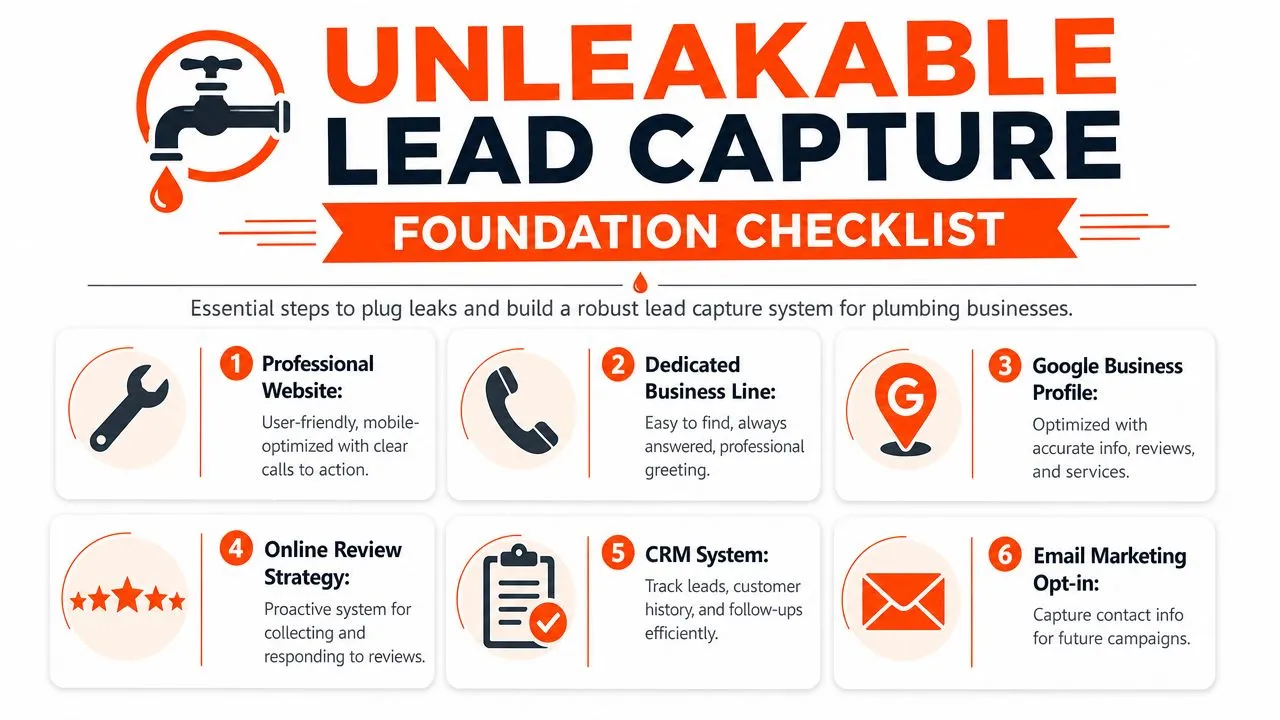
Here’s the foundation I’d fix before adding budget:
-
Google Business Profile completeness
Fill out hours, services, service areas, business description, and photos. Keep your name, address, and phone data consistent everywhere. Homeowners often decide from the profile alone, especially on mobile. -
One page per core service intent
Don’t stuff drain cleaning, water heater repair, sewer line repair, and emergency plumbing onto one generic page. A searcher looking for a burst pipe at night and a homeowner pricing a water heater replacement are not the same lead. -
Phone-first page design
A plumbing site is not a brochure. Put the phone number high on the page. Keep forms short. Make the call to action obvious. Mobile users shouldn’t have to hunt. -
Service-area clarity
Don’t be vague about where you work. If your team only serves specific towns or ZIP clusters, say so clearly. That helps with lead quality and dispatch fit.
If the homeowner has urgency, friction kills the lead. Long pages aren’t the problem. Hidden next steps are.
Fix the tracking before you buy traffic
Attribution falls apart fast in home services because calls still drive a huge share of conversions. If you don’t use call tracking, you can’t trust your channel reporting.
That affects real decisions. You may think a directory listing works because calls happen after someone sees your profile there. In reality, they may have searched your brand on Google later and called from your website. Without tracking, you’ll keep funding the wrong source.
Build a basic measurement stack:
- Call tracking numbers for major channels
- Form tracking with service-type fields
- CRM tagging by lead source and service type
- Missed-call alerts so the office can recover fast
- Citation cleanup so bad listings don’t send people to old numbers
A lot of shops can handle this with CallRail, a simple CRM, and cleaner intake rules. Others use all-in-one field service software. Some use specialized systems that tie visibility, intake, and follow-up together. FirstMention is one example in that category. It connects AI visibility, service pages, call tracking, missed-call text-back, AI intake, follow-up, and reporting for home-service companies.
You don’t need fancy software to start. You do need clean inputs. Bad tracking makes smart decisions impossible.
Choose Your High-Intent Lead Channels
Not every channel deserves the same budget. A plumbing company that wants emergency calls this week should not build the same mix as a company focused on higher-value installs and replacements.
That’s where most channel advice goes sideways. It talks about reach. Owners need to think about lead intent, lead type, and operational fit.
Match the channel to the job type
A useful way to think about plumbing lead generation is by urgency.
Emergency and repair searches usually carry stronger buying intent. They also come with different economics. Gushwork’s plumbing lead guidance highlights that emergency and repair keywords have higher urgency and conversion potential, and that plumbers need segmentation and margin-based scoring rather than generic more-leads tactics.
So pick channels based on what kind of work you want more of.
- Google Search ads fit urgent demand well. Someone searches with a problem and wants help now.
- Local SEO and Google Business Profile work build long-term visibility for both urgent and non-urgent jobs.
- Social media usually plays better for awareness, remarketing, and trust building than for true emergency demand.
- Lead marketplaces can fill holes, but they often bring weaker control and more pricing pressure.
Plumbing lead channel comparison
| Channel | Typical Cost | Lead Intent | Time to Results |
|---|---|---|---|
| Google Search ads | Costs vary by market and keyword | High for urgent repair and emergency searches | Fast |
| Local SEO and Google Business Profile | Front-loaded time and setup cost | High when rankings and map visibility are established | Slower at first, then steadier |
| Social media ads | Costs vary by audience and offer | Lower direct intent, better for awareness and retargeting | Fast to launch |
| Lead vendors and marketplaces | Pay per lead or platform fees vary | Mixed, often shared or price-sensitive | Fast |
| Referral and reactivation campaigns | Usually lower media cost, but require process | High trust, often strong fit | Moderate |
A few channel rules keep budgets from getting scattered:
- Run search ads only when someone can answer. If calls hit voicemail during your best hours, the campaign is feeding waste.
- Use SEO for service depth. Separate pages for each job type help you rank and convert.
- Use social with a narrower goal. Promote maintenance, financing conversations, seasonal reminders, or remarketing. Don’t expect it to behave like emergency search.
- Keep vendor leads in a box. Treat them as overflow, not your core pipeline.
If you’re comparing how other trades think about paid traffic in high-intent local markets, this guide on ads for electricians is useful because the decision logic is similar even though the services differ.
The mistake is trying to be everywhere at once. One strong channel mix beats five half-managed channels every time.
The Follow-Up Flow That Books the Job
A lead is only valuable if someone answers, qualifies it, and books it.
That sounds obvious. It still breaks every day. Calls go unanswered. Form fills sit in an inbox. Office staff call back hours later, and the homeowner has already booked another plumber.
Fast response wins more jobs
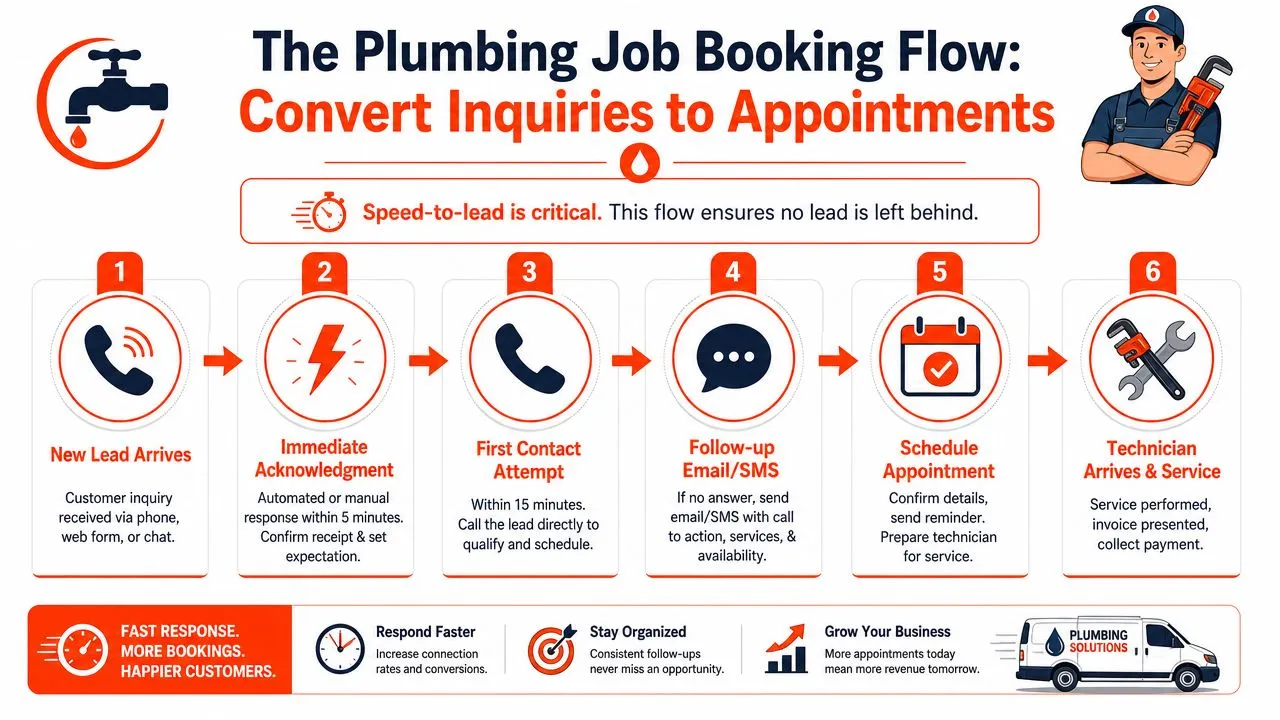
Speed-to-lead is the most impactful part of the conversion process. SonicK Marketing recommends responding within 5 to 60 minutes and using automated follow-up at 1 day, 3 days, and 1 week to reduce lead leakage.
That range tells you something important. There isn’t one magic tactic. There is a clear direction. Faster works better.
Lead response has to match plumbing reality:
- Emergency lead needs near-immediate contact.
- Repair lead still needs same-day follow-up.
- Estimate or install lead needs structured follow-up so it doesn’t drift.
Here’s the workflow I’d put in place first.
A quick walkthrough helps if you want to visualize the handoff points:
A simple booking workflow
1. Acknowledge immediately
When a web lead comes in, send a text or email right away. Don’t try to sound clever. Confirm receipt and say when someone will contact them.
Sample text:
Thanks for reaching out to [Business Name]. We got your request and will contact you shortly to help with your plumbing issue.
2. Call fast
Call while the problem is still top of mind. If they don’t answer, leave a short voicemail and send a text.
Sample missed-call text:
Sorry we missed your call. This is [Business Name]. Text us your issue and address, or call back now and we’ll help you schedule service.
3. Qualify without dragging it out
The office only needs a few key details. What’s the issue, where is the property, how urgent is it, and when can someone be there. Don’t turn intake into an interview.
The best intake scripts don’t sound scripted. They move the customer from stress to a scheduled next step.
4. Tag the lead correctly
Mark it by service type. Emergency, repair, install, maintenance, commercial. This helps dispatch and later reporting.
5. Follow up on open estimates
A lot of plumbing revenue gets lost after the first visit or quote. Use a simple sequence:
- At 1 day ask if they have questions
- At 3 days restate the scope and availability
- At 1 week offer the next scheduling step
6. Review missed calls every day
This part gets skipped. It shouldn’t. A short missed-call recovery list is one of the easiest ways to book more work without raising spend.
You can manage this with ServiceTitan, Housecall Pro, Jobber, or even a shared spreadsheet if the office is disciplined. The software matters less than the habit.
Setting a Realistic Budget and Measuring What Matters
Most owners ask the wrong budget question.
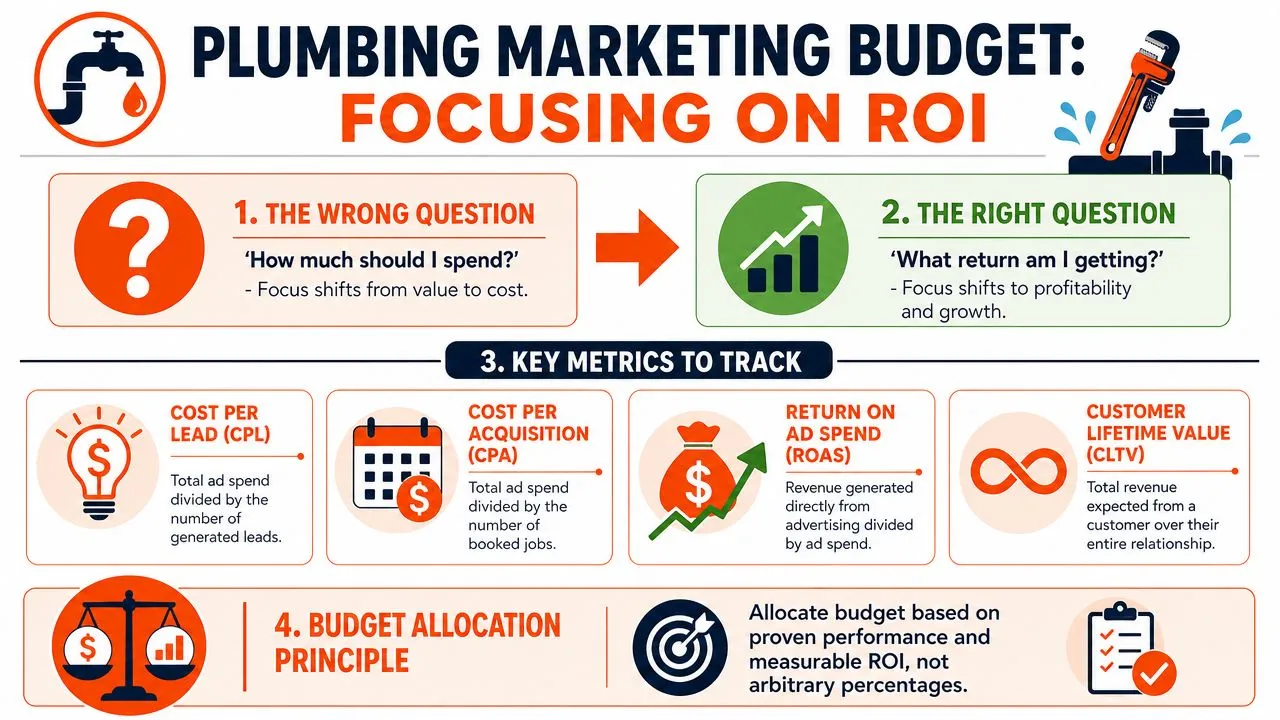
They ask, “How much should I spend?”
A better question is, “What am I paying for a booked job, and does that cost make sense for this service line?”
Budget from outcomes, not guesswork
There is no universal plumbing marketing budget that makes sense in every market. But you do have benchmark guardrails.
That should reset expectations.
If you’re buying higher-urgency traffic, it may cost more. That doesn’t mean it’s worse. It may still be more profitable if the booking rate and job value hold up.
A budget only makes sense in context:
- Service mix matters
- Response speed matters
- Answer rate matters
- Close rate matters
- Average job value matters
If those are weak, more spend just scales waste.
Track the numbers that change decisions
Most dashboards are full of noise. Owners don’t need more charts. They need a handful of numbers they can act on.
Track these:
| Metric | What it tells you | Why it matters |
|---|---|---|
| Cost per lead | How much you paid to generate an inquiry | Good starting point, but not enough on its own |
| Cost per booked job | How much you paid for actual scheduled work | Better operational metric |
| Booking rate | How many leads turn into appointments | Exposes intake and response problems |
| Close rate by service type | Which jobs convert after booking or quoting | Helps you reallocate budget |
| Return on ad spend | Revenue tied to spend | Tells you whether the channel earns its keep |
Two practical rules keep reporting honest:
- Separate emergency from non-emergency leads. They behave differently and shouldn’t be judged by one blended number.
- Look at booked jobs, not clicks. Clicks don’t dispatch technicians.
If you’re trying to decide how SEO and PPC should work together instead of fighting for budget, this guide on SEO and PPC services for lead generation is worth reading.
There’s one more business reality here. The U.S. plumbing market is large, and demand isn’t the only constraint. IBISWorld-based reporting cited by Linxup puts U.S. plumbing industry revenue at about $169.8 billion in 2025 with a 3.2% CAGR over the prior five-year period, while also projecting a shortage of around 550,000 plumbers by 2026 and roughly 44,000 annual openings across the 2024 to 2034 decade. That means capacity can become the bottleneck. When labor is tight, each good inbound lead matters more. Wasted leads hurt more too.
Your 30-Day Plan to More Booked Jobs
Most plumbing companies don’t need a massive rebuild. They need a short sprint and cleaner execution.
Week 1 and Week 2
Week 1. Fix the leaks
Audit the basics first.
- Clean up your Google Business Profile with full service info, hours, photos, and accurate contact details.
- Review your website pages and make sure each core service has its own page.
- Check mobile conversion paths so calls and forms are easy to use.
- Set up call tracking and form tracking so every lead has a source.
- List your service areas clearly so poor-fit calls drop before they waste office time.
Week 2. Launch one high-intent channel
Pick one channel based on your goal.
If you need urgent repair calls, start with Google Search targeting tight service terms and service areas. If you already get branded demand but lose visibility on non-brand searches, strengthen local SEO and your service-page structure first.
Don’t split your attention across too many platforms. One focused campaign with clean tracking beats scattered spend.
Week 3 and Week 4
Week 3. Install the follow-up flow
Put the office process in writing.
- Use an immediate acknowledgment for form leads.
- Call new leads fast during staffed hours.
- Turn on missed-call text-back if you have it.
- Create simple follow-up templates for unbooked estimates.
- Tag leads by service type so reporting becomes useful later.
Week 4. Build the reporting habit
You don’t need a fancy dashboard. You need consistency.
Review these every week:
- Lead count by source
- Booked jobs by source
- Booking rate
- Missed calls
- Cost per lead
- Cost per booked job
Then make one decision. Pause something weak. Improve a script. Tighten service-area targeting. Add budget to what books profitably.
That’s how plumbing lead generation gets better. Not from hacks. From owning the system and improving the weak point that’s leaking jobs right now.
If you want help building that kind of owned system, FirstMention works with home-service companies on the full chain: search visibility, AI visibility, service pages, tracking, intake, follow-up, and reporting. The main value isn’t more marketing noise. It’s a setup you can measure and improve.