Marketing Agency Lead Generation for Restoration Pros
Guide to marketing agency lead generation for restoration companies. Build a system for exclusive, high-quality jobs, not shared leads. Get started today!

Most advice on marketing agency lead generation is backwards.
It tells restoration companies to get more leads. That sounds right. It usually isn’t. If the calls are shared, poorly tracked, slow to route, or impossible to tie back to jobs, more leads just means more waste.
For restoration, the better question is simple. Are you building a system that produces exclusive inbound demand you can track to booked work, or are you renting access to someone else’s list and hoping your team wins a speed contest?
That’s the line that matters. Everything else is tactics.
Table of Contents
- Stop Buying Shared Leads Build an Asset Instead
- Find Where Your Best Jobs Are Hiding
- Choosing Channels That Deliver Emergency Calls
- From Ringing Phone to Booked Job Tracking
- The Economics of Exclusive vs Shared Leads
- Fine-Tuning Your Lead Generation Machine
- How to Hire an Agency That Gets It
Stop Buying Shared Leads Build an Asset Instead
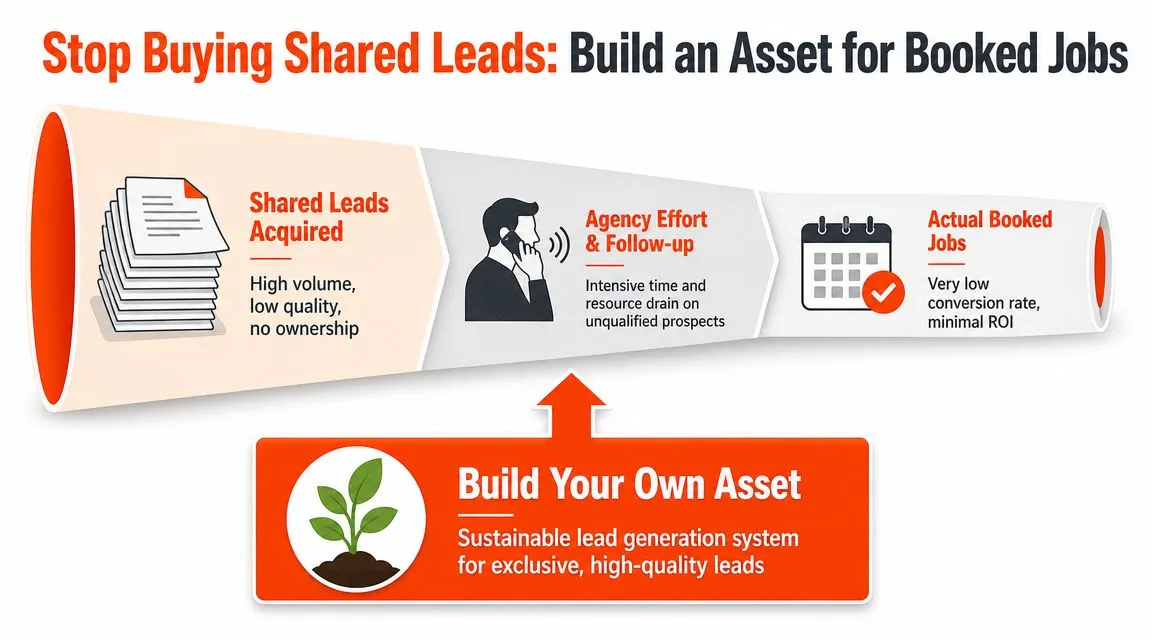
Shared leads are usually sold as convenience.
You pay. The phone rings. A rep says the volume is there. But what’s delivered isn’t demand; it’s access. Temporary access, with weak control over quality, weak control over timing, and no real ownership of the relationship.
That model hurts restoration companies in the same way over and over. You get a lead at the same time as other vendors. Your office scrambles to call first. The homeowner answers one company and ignores the rest. Now your team spent money and time just to enter a race you didn’t need to be in.
Why rented demand keeps disappointing
A rented lead source doesn’t make your brand stronger. It doesn’t improve your Google Business Profile. It doesn’t build your local service pages. It doesn’t increase your visibility on Maps, Google, or AI tools.
You keep paying, but you don’t keep the asset.
An owned lead generation system works differently. The pieces can vary, but the core usually includes your site, your Google Business Profile, your local landing pages, your call tracking, and a paid layer that pushes urgent searches into your funnel. If you’re doing this right, each improvement compounds.
Practical rule: If a lead source disappears tomorrow and your demand disappears with it, you don’t own a system. You own a dependency.
What an owned system looks like
For restoration companies, I want the lead path to be direct and clear:
- Search visibility: Your company shows up when someone needs water damage, fire damage, mold remediation, or storm cleanup in your service area.
- Trust signals: Reviews, service pages, before-and-after proof, and location relevance reduce hesitation.
- Conversion path: One obvious action. Call now, request emergency help, or book an audit if the buyer is earlier in research mode.
- Tracking: Every call, form, and booked appointment ties back to a source.
This is the part many lead vendors get wrong. They optimize for lead delivery. A serious operator optimizes for booked jobs.
That shift changes everything. It changes your budget decisions. It changes how your office answers the phone. It changes what your agency should be building for you each month.
Find Where Your Best Jobs Are Hiding
Most restoration companies don’t have a traffic problem first. They have a visibility map problem.
They’re visible for the wrong services, in the wrong towns, on the wrong surfaces, or with the wrong message. Before you buy more clicks, you need to know where the gaps are.

Start with the jobs you actually want
Not every restoration lead deserves the same attention.
Some companies want more commercial water damage work. Others want high-value residential emergency jobs. Others need to smooth out seasonality with mold or storm demand. If you skip that decision, your marketing gets generic fast.
Start your audit with a short list:
-
Highest-value services
List the job types you want more of. Be specific. “Water damage” is too broad if your best work is commercial dry-outs or slab leak mitigation. -
Best geography
Draw the actual service area, not the fantasy one. Include the zip codes and cities your crews can serve fast and profitably. -
Best customer type
Homeowners, property managers, commercial facility teams, insurance-adjacent referrals. These audiences search differently and respond to different proof.
One useful way to pressure-test demand is to review how adjacent emergency categories behave in local search. For example, this look at storm damage restoration demand patterns is a good reminder that urgent local intent often clusters around specific service-and-location combinations, not broad head terms.
Audit the map pack and local organic results
Once you know what work you want, search like a buyer.
Use plain service queries. Use city modifiers. Use “near me” language. Check Google Maps, local organic results, and the business profiles that keep showing up.
You’re looking for patterns like these:
- Weak category targeting: A competitor ranks, but their primary category or service focus looks off.
- Thin review positioning: They have reviews, but not many that mention the service you want to win.
- Poor landing pages: Their page title says one thing, but the content is generic and weak.
- Broken trust flow: Slow site, bad mobile UX, no clear emergency CTA, buried phone number.
- Gaps in service-area coverage: Strong in one city, invisible in nearby towns.
If three competitors dominate one service in one city, don’t assume the market is closed. Check the next layer down. Nearby suburbs, secondary services, and weak profile optimization often create easier openings than the obvious head term.
I also like to compare what a company says in its ads, its profile, and its website. When those three things don’t match, conversions tend to suffer. A restoration buyer in a hurry doesn’t want mixed signals.
A good lead-flow audit should leave you with a simple answer. Where are you already trusted, where are you invisible, and where can you win without entering a price war?
Choosing Channels That Deliver Emergency Calls
Restoration isn’t a normal buying cycle.
People don’t browse casually for flood cleanup after midnight. They need help fast, they want reassurance, and they usually check more than one surface before they call. That’s why marketing agency lead generation for this category has to be multi-channel, but not random.
The broad lesson from B2B still applies. Email remains the most widely used channel at 88%, and LinkedIn remains central, with 89% of B2B marketers using it for lead generation and 62% saying it produces leads effectively, according to the 2025 B2B lead generation roundup cited here. The point isn’t that restoration buyers behave like B2B software buyers. The point is that strong lead generation systems now rely on coordinated touchpoints, not one channel in isolation.
Use the channels buyers already use
For restoration, the core channels are different from agency outbound, but the orchestration principle is the same.
A homeowner might search Google first. Then check the map pack. Then read reviews. Then visit your website. Then ask ChatGPT who to call. Then come back and call from mobile. If your company only shows up in one of those moments, you’re easier to skip.
The channels that usually matter most are:
- Google Business Profile for urgent local intent and map visibility
- Local SEO pages for service-in-city and problem-specific searches
- Google Ads for immediate capture when someone needs help now
- Retargeting to bring back undecided visitors
- AI discovery surfaces, including ChatGPT and similar tools, where buyers ask direct trust-based questions
- Outbound prospecting if you’re an agency trying to win restoration clients, often through Google Maps list building, enriched contacts, short email, and LinkedIn follow-up
If you run agency-side outbound to sign restoration clients, personalized outreach matters more than volume. Teardown offers and visibility audits consistently outperform generic guides because they point to a visible business problem right now.
What this looks like for restoration
The strongest setup is usually simple.
Own the map pack where you can. Build service pages with real location intent. Run paid campaigns for urgent categories. Add tracking so you know what drove the call. Then test emerging surfaces before they get crowded.
A lot of companies still treat AI search as a curiosity. I think that’s a mistake. If someone asks an AI tool for the best local fire damage company, the intent is often cleaner than a broad informational search. That person isn’t browsing. They’re trying to decide.
This is also why narrow local ad strategy beats broad awareness spend for emergency services. A useful comparison is how trade businesses need channel precision, not generic reach, in guides like this on ads for electricians. Restoration is even more urgent, so wasted impressions hurt more.
The winning channel mix isn’t the one with the most traffic. It’s the one that makes your company visible at the exact moment a stressed buyer tries to choose.
From Ringing Phone to Booked Job Tracking
A call log is not reporting.
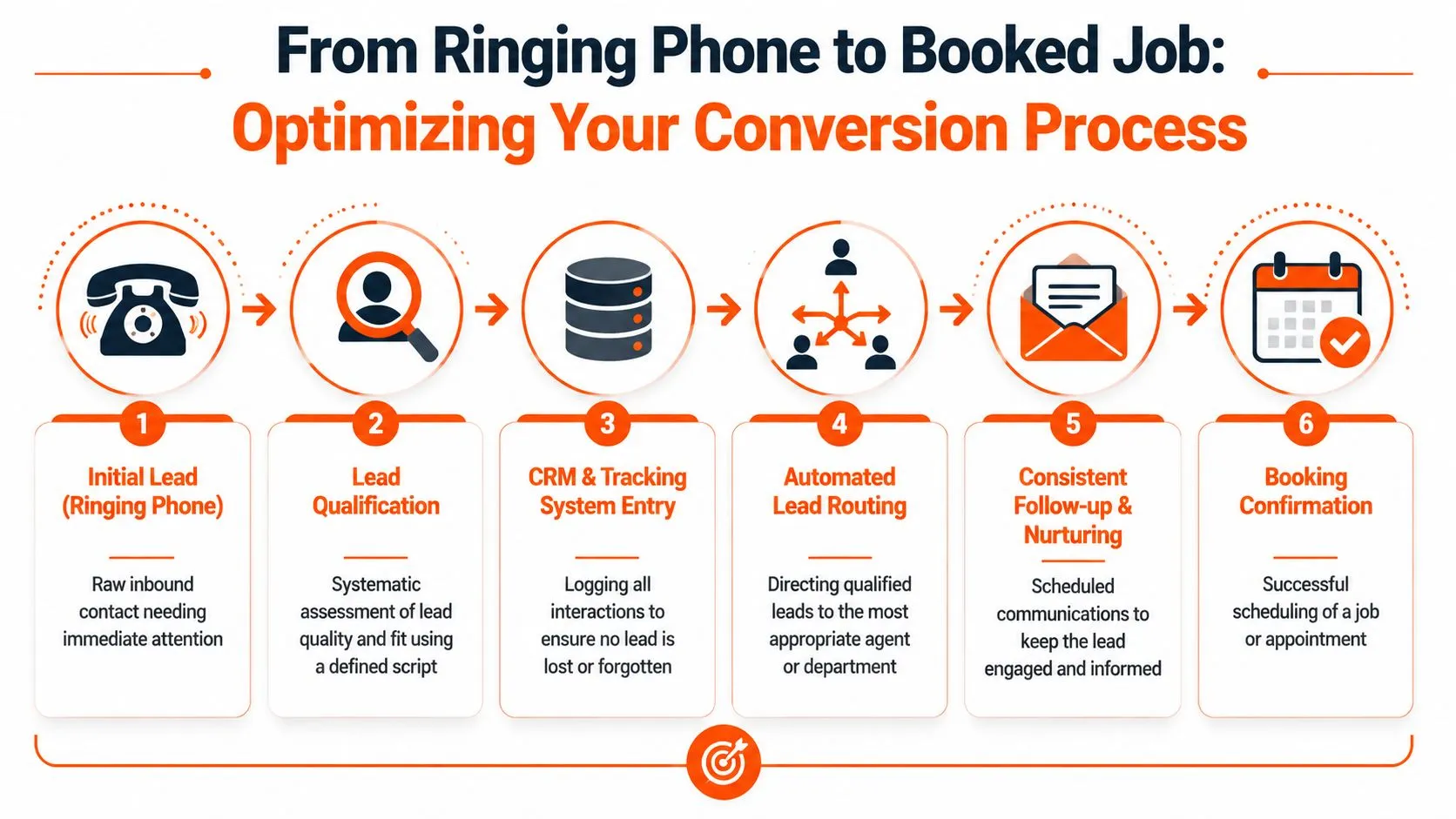
A ringing phone tells you almost nothing by itself. It doesn’t tell you which campaign produced the lead, whether the caller was in your service area, whether the office answered well, or whether the job was booked.
That missing middle is where a lot of agencies fail.
Track the full path, not just the call
A proper setup connects marketing data to operations data.
That usually means dynamic call tracking, form tracking, CRM logging, call recording, lead qualification notes, and a status system that shows whether the lead was bad, qualified, dispatched, or booked. Without that, you can’t tell the difference between noise and revenue.
I like the classic five-stage funnel here: attract, capture, qualify, nurture, convert. That structure is consistent with HubSpot’s lead generation framework, but in restoration the qualification and routing steps have to happen much faster than in a long sales cycle.
A simple operational model looks like this:
| Stage | What needs to happen |
|---|---|
| Attract | Show up on search, maps, paid ads, and other discovery surfaces |
| Capture | Route calls and forms into one trackable intake path |
| Qualify | Confirm service type, location, urgency, and fit |
| Nurture | Follow up fast if they don’t book on first contact |
| Convert | Dispatch, schedule, or book the inspection |
For a deeper look at measuring newer search surfaces, this guide on GEO KPIs and benchmarking is useful because it pushes past vanity metrics and focuses on what can be verified.
A short breakdown helps here:
Build response speed into the system
Speed matters more than most owners think.
According to the lead generation statistics roundup here, leads are 9x more likely to convert when businesses follow up within 5 minutes, and AI-powered lead scoring can improve lead conversion rates by up to 30%. That matters a lot in restoration because urgency is built into the category.
The practical implications are obvious:
- Route calls immediately: Don’t let emergency calls sit in a generic office queue.
- Score and tag leads fast: Out-of-area, vendor spam, and low-fit requests should be filtered quickly.
- Use scripts that qualify without friction: Ask only what helps dispatch or book.
- Review recordings: Bad lead handling often looks like a marketing problem until you hear the calls.
A fast response system beats a bigger media budget surprisingly often, especially when competitors are slow, sloppy, or impossible to reach after hours.
If your agency can’t show you how a click turned into a booked job, they’re not managing lead generation. They’re just buying attention.
The Economics of Exclusive vs Shared Leads
At this point, the argument usually ends.
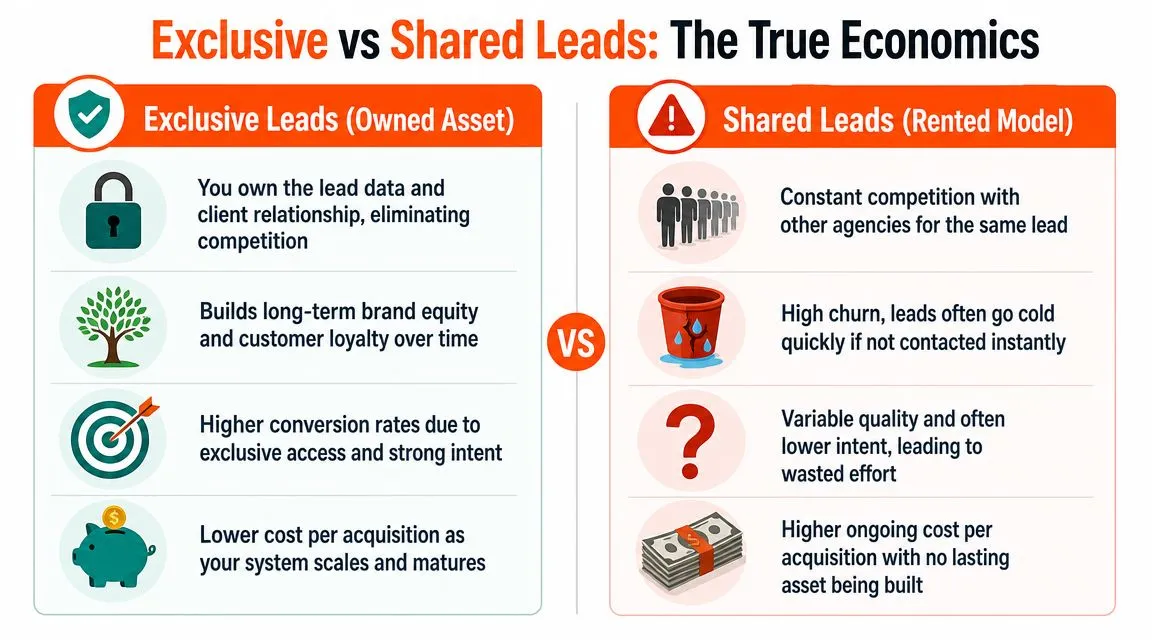
Not because the math is hard. Because once you frame the choice correctly, the trade-off gets obvious. Shared leads often look cheaper at first because the invoice is easy to understand. But restoration companies don’t make payroll with cheap leads. They make payroll with booked and completed jobs.
What changes operationally
With exclusive leads from an owned system, your team starts from a stronger position. The caller found your brand. The search context matched your service. The path to contact is easier to track. Your office isn’t one voice in a pile of callbacks.
With shared leads, the opposite happens. Your staff spends energy chasing. Morale drops because good reps lose jobs to speed or randomness. Managers start blaming the office, then the vendor, then the market. Usually the model is the issue.
Here’s the cleanest side-by-side way to think about it.
A simple comparison framework
Exclusive Leads vs. Shared Leads for Restoration Companies
| Metric | Exclusive Leads | Shared Leads |
|---|---|---|
| Relationship control | You control the brand path and follow-up process | The lead source controls first access and often the terms |
| Competition | No direct seller race on the same inquiry | Multiple companies may contact the same prospect |
| Tracking clarity | Easier to tie call, form, and booking back to source | Harder to verify what actually caused the job |
| Team workload | More focused on qualified intake and conversion | More time spent chasing, re-dialing, and sorting weak inquiries |
| Long-term value | Builds site strength, profile strength, and local trust | Little lasting value if spend stops |
| Pricing pressure | Lower when trust and intent are strong | Higher when buyers compare several vendors at once |
There is one fair point in favor of shared leads. They can create immediate activity if you have no pipeline at all. If your phones are dead, some owners will accept almost any channel that creates motion.
That’s understandable. It’s just not a strategy.
Shared leads can fill a short-term gap. They rarely build a durable business advantage.
The better way to judge a lead source is this. Does it improve your ability to generate the next booked job without paying the same toll to someone else again?
If the answer is no, you’re renting demand.
Fine-Tuning Your Lead Generation Machine
A lead system drifts when nobody tunes it.
Keywords get stale. Intake scripts go off-track. Ads attract the wrong service mix. Service pages rank for terms that don’t convert. None of this is dramatic on its own. It just slowly wastes budget.
That’s why the useful optimization loop starts at the bottom of the funnel, not the top.
Use booked-job feedback to improve targeting
The strongest signal in the account is not impressions, clicks, or raw lead count. It’s what happened after contact.
If booked jobs keep coming from one service type, your budget should reflect that. If callers keep asking about a city you barely mention on the site, your content should change. If the office struggles with a certain question, your ad and landing page message may be setting the wrong expectation.
A few examples:
- Call reviews reveal message gaps: People ask about board-up services, but your main page barely mentions them.
- CRM notes reveal geographic demand: One suburb keeps producing good opportunities, but it has no dedicated landing page.
- Disposition data reveals wasted spend: Calls from one campaign are real, but they’re outside your service area.
- After-hours logs reveal poor fit: Plenty of calls come in late, but the booking quality is weak, so scheduling needs a tighter rule set.
What to review every week
The discipline here is simple. Review what moved to booked-call or booked-job status, then adjust the front end.
That lines up with guidance from monday.com’s lead generation overview, which argues that conversion rate instrumentation matters more than top-of-funnel lead count, and that teams waste budget when they stop at raw lead volume.
My weekly review usually centers on questions like these:
- Which sources produced qualified conversations?
- Which keywords or pages drove bad-fit calls?
- Did the office respond fast enough?
- Which jobs booked, not just which forms came in?
- What should be paused, expanded, or rewritten?
This is the difference between running campaigns and running a machine. Campaigns launch. Machines learn.
How to Hire an Agency That Gets It
A lot of agencies can talk about traffic.
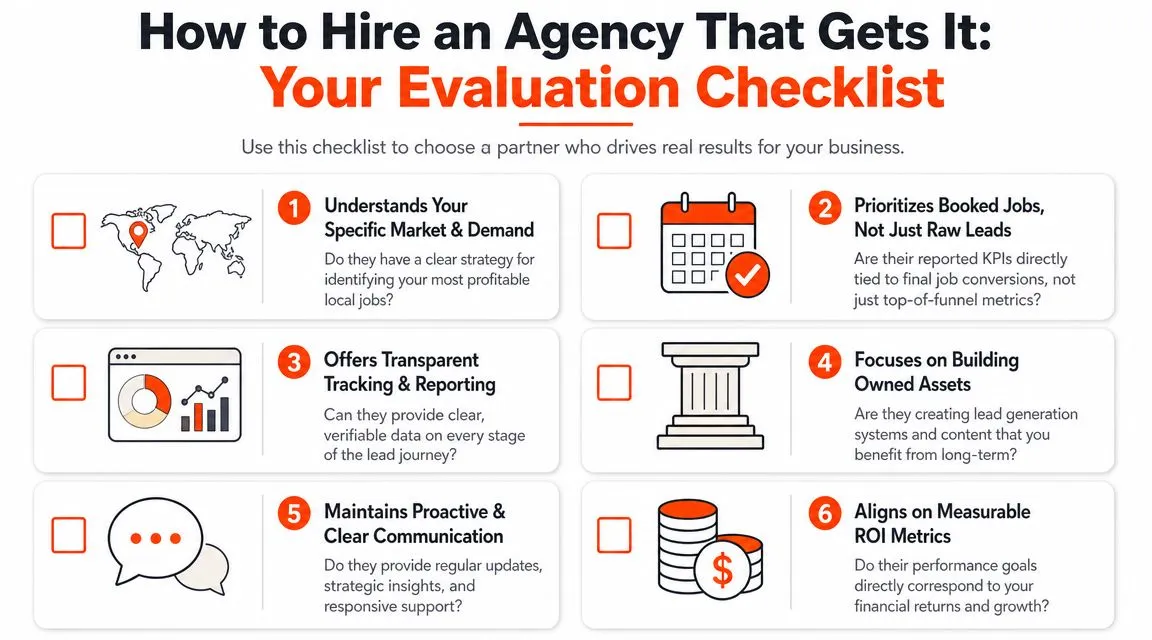
Far fewer can talk clearly about intake, routing, qualification, and job attribution. That’s the test. If you’re hiring for marketing agency lead generation in restoration, don’t hire the best presenter. Hire the team that understands how emergency demand turns into booked work.
Questions that expose weak agencies fast
Ask direct questions. Good agencies won’t need to dance around them.
-
How do you track a lead from click to booked job?
If the answer stops at calls or forms, keep digging. -
What counts as a qualified lead in our market?
They should talk about service type, geography, urgency, and decision-maker fit. -
Will we own the data and the assets?
That includes landing pages, tracking setup, creative, and reporting access. -
How do you handle lead routing and response speed?
If they only talk about traffic generation, they’re skipping the hard part. -
What do you optimize toward?
The answer should sound like booked calls, qualified opportunities, and revenue impact. Not vanity dashboards.
The gap in the market is real here. As noted in this callbox discussion of agency partnerships, most content explains how to get leads, but not how to prove lead quality and revenue impact. That’s exactly why so many restoration owners get trapped in fuzzy reporting.
What a real partner sounds like
A real partner usually speaks in operational language.
They ask how your office handles after-hours calls. They want to know which services are most profitable. They ask who marks a lead as booked. They care whether your map profile and landing pages match the calls you’re trying to generate.
They also won’t hide behind MQL language if you’re a service business. Restoration companies don’t need a pile of form fills. They need jobs.
The agency should be able to explain, in plain English, what happens after the lead arrives:
- How it’s captured
- Who sees it
- How it’s scored
- How fast someone responds
- What gets reported back
- What changes next month because of that data
If they can’t walk that path clearly, they probably don’t control it.
The best agency relationships feel less like buying leads and more like building infrastructure. That’s the standard.
If you’re a restoration company that wants to build owned demand instead of depending on shared leads, FirstMention focuses on ChatGPT Ads for US restoration brands. The work is built around urgent local intent, clear tracking, qualified routing, and booked jobs, so your company shows up when homeowners and property managers ask AI who to call.