Hiring Pay Per Click Experts: A Restoration Owner's Guide
Find, vet, and hire the right pay per click experts for your restoration business. Get tips on KPIs, pricing, red flags, and measuring true ROI.


Most advice about pay per click experts is backwards.
It tells restoration owners to chase cheaper clicks, higher click-through rates, and cleaner dashboards. That sounds smart until the phone rings after a pipe burst, nobody answers, and the lead dies before your estimator even knows it existed. A cheap click that never turns into a booked mitigation job is still wasted money.
A PPC partner’s job isn’t buying traffic. It’s building a system that turns urgent search demand into calls, handled leads, scheduled inspections, and paid work. That means ads matter. Landing pages matter. Call tracking matters. Your front desk matters. Missed-call text-back matters. AI intake matters. If your PPC person ignores everything after the click, they’re only managing part of the problem.
Table of Contents
- What a Real PPC Expert Does for Restoration
- Finding Your Expert Agency vs Freelancer
- Vetting Candidates and Spotting Red Flags
- Setting Budgets and Measuring What Matters
- Hiring and Onboarding Your PPC Partner
- Beyond Clicks Your PPC Growth System
What a Real PPC Expert Does for Restoration
Restoration isn’t a normal lead gen business.
Some searches come from panic. Basement flood. Fire cleanup. Sewage backup. Board-up. Those people need help now. Other searches are slower and more considered, like mold inspection or rebuild work. A real PPC expert knows those two paths need different campaigns, different landing pages, and different follow-up speed.
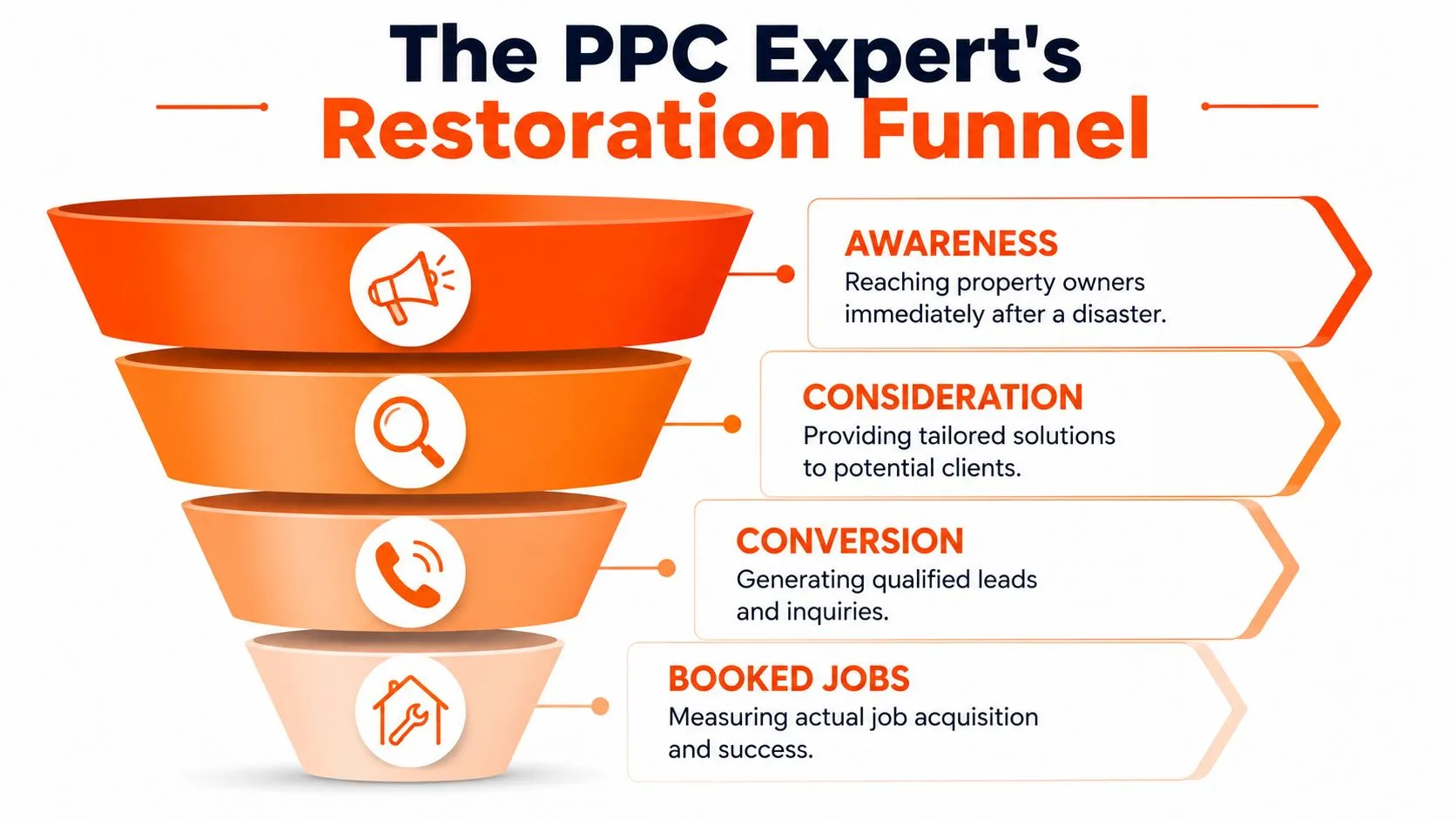
The common industry pitch is still, “We’ll get you more clicks at a lower CPC.” That’s lazy thinking. In home services, and restoration especially, cost per booked job matters more than cost per click. If the ad drives calls but your team misses them, low CPC doesn’t save you.
One of the biggest blind spots in this space is post-click lead handling. According to No Boundaries Marketing’s breakdown of PPC for home services, PPC experts rarely integrate ad data with missed-call recovery and AI intake for home-service leads, causing 20–30% of emergency calls to leak unbooked. The same source says 28% of HVAC/roofing leads go cold due to no follow-up within 5 minutes. Restoration owners should read that as a warning, not a side note.
Practical rule: If your PPC partner can’t talk clearly about call handling, missed-call recovery, and booking workflow, they are not managing revenue. They are managing clicks.
A real operator looks at the full chain:
- Search intent: Are you targeting “emergency water removal” differently from “mold remediation company”?
- Ad message: Does the ad match urgency, location, and service type?
- Landing path: Does the visitor land on a page built for one action, not a generic homepage?
- Lead handling: Are calls tracked, answered, and recovered if missed?
- Booked job outcome: Can anyone tie ad spend back to real jobs, not just form fills?
That last point matters. The PPC ad market is huge, and it’s not going away. The global PPC advertising market report estimates the market will reach USD 12,622.32 million in 2026 and is projected to grow to USD 12,664.79 million by 2035. The same report notes Google search ads achieve a 3.17% click-through rate, paid search campaigns generate over 2.55% conversion rates, and machine learning-optimized campaigns deliver 20% better ROI than manual optimization.
Those numbers don’t mean every restoration company should spend blindly. They mean smart PPC management is still a core growth lever. If you want a broader view of how serious operators think about paid media for growth leaders, look at frameworks that connect media buying to pipeline and revenue, not vanity reporting.
What the job actually includes
Good pay per click experts do more than set bids in Google Ads.
They segment by service line. They separate emergency from non-emergency traffic. They build location intent into campaigns. They install call tracking. They connect form leads and calls to your CRM or dispatch workflow. They review search terms. They cut waste. They pressure-test landing pages. They care whether the lead got booked.
Restoration PPC works when ads and operations are connected. It breaks when marketing says “we generated leads” and the office says “none of them were any good.”
Finding Your Expert Agency vs Freelancer
You don’t need the “best” option in the abstract. You need the right setup for your shop.
Some restoration companies need a team with bench strength because calls spike, service lines overlap, and the owner doesn’t want to manage vendors. Others do better with a sharp freelancer who knows Google Ads cold, moves fast, and works directly with the owner or GM.
Agency vs Freelancer at a Glance
| Factor | PPC Agency | PPC Freelancer |
|---|---|---|
| Depth of support | Usually broader. You may get media buying, landing page help, tracking support, and reporting under one roof. | Usually narrower. Strong freelancers often handle strategy and execution well, but design, dev, or CRM work may need other vendors. |
| Communication | More structured. Expect meetings, account managers, and process. | More direct. You usually talk to the person doing the work. |
| Speed | Can be slower when requests move through layers. | Often faster on small changes and campaign pivots. |
| Continuity | Better coverage if one team member is out. | Greater risk if one person gets overloaded or unavailable. |
| Specialization | Can be strong if the agency has home-service experience. Can also be generic if they serve everyone. | Can be excellent if the freelancer lives in paid search for local lead gen. |
| Scalability | Better fit if you want PPC tied into landing pages, reporting, and call systems over time. | Better fit if you mainly need campaign management and you already have the rest handled. |
| Owner involvement | Often lower once systems are set. | Usually higher, especially early on. |
The trap is assuming agency means better and freelancer means cheaper. Sometimes the opposite is true. A bloated agency can give you layers, meetings, and pretty reports with very little strategic thinking. A weak freelancer can disappear when storm demand hits and your account needs daily attention.
When an agency makes more sense
An agency is often the better fit if your business has multiple branches, multiple service lines, or a messy stack.
That matters in restoration because campaigns touch more than ads. You may need landing page edits, conversion tracking fixes, call recording review, CRM tagging, and local market coordination. If your current setup is fragmented, a team can help stabilize it.
A local example of how agencies position PPC support can be seen in this look at a PPC agency in Tampa. What matters isn’t the city. It’s whether the partner can handle local intent, lead tracking, and operational follow-through.
When a freelancer can be the better move
A freelancer can be the smarter choice if you want a senior practitioner close to the account.
That’s especially useful when the owner still wants visibility into search terms, budgets, service-area targeting, and lead quality. Good freelancers are often less interested in polish and more interested in the account working. That can be a plus.
Use this filter before deciding:
- Choose an agency if you need support across ads, landing pages, reporting, and integrations.
- Choose a freelancer if you already have internal help and want one skilled person owning paid search.
- Avoid both if they only talk about impressions, CPC, and clicks.
The right question isn’t “agency or freelancer?” It’s “who can own the path from search to booked job without dropping the handoff?”
What restoration owners usually underestimate
Capacity.
Emergency demand doesn’t arrive on a neat schedule. Storms, freezes, and local incidents create spikes. During those windows, your PPC partner has to move fast, adjust budgets, review search terms, and keep the account clean. If you’re hiring a freelancer, ask how they handle those surges. If you’re hiring an agency, ask who directly touches the account when speed matters.
Vetting Candidates and Spotting Red Flags
You don’t learn much from a slick pitch deck.
You learn from process. You learn from how someone answers simple operational questions. You learn from what they ask you before they make promises. The best pay per click experts usually sound less magical and more specific.
Start with the checklist below.
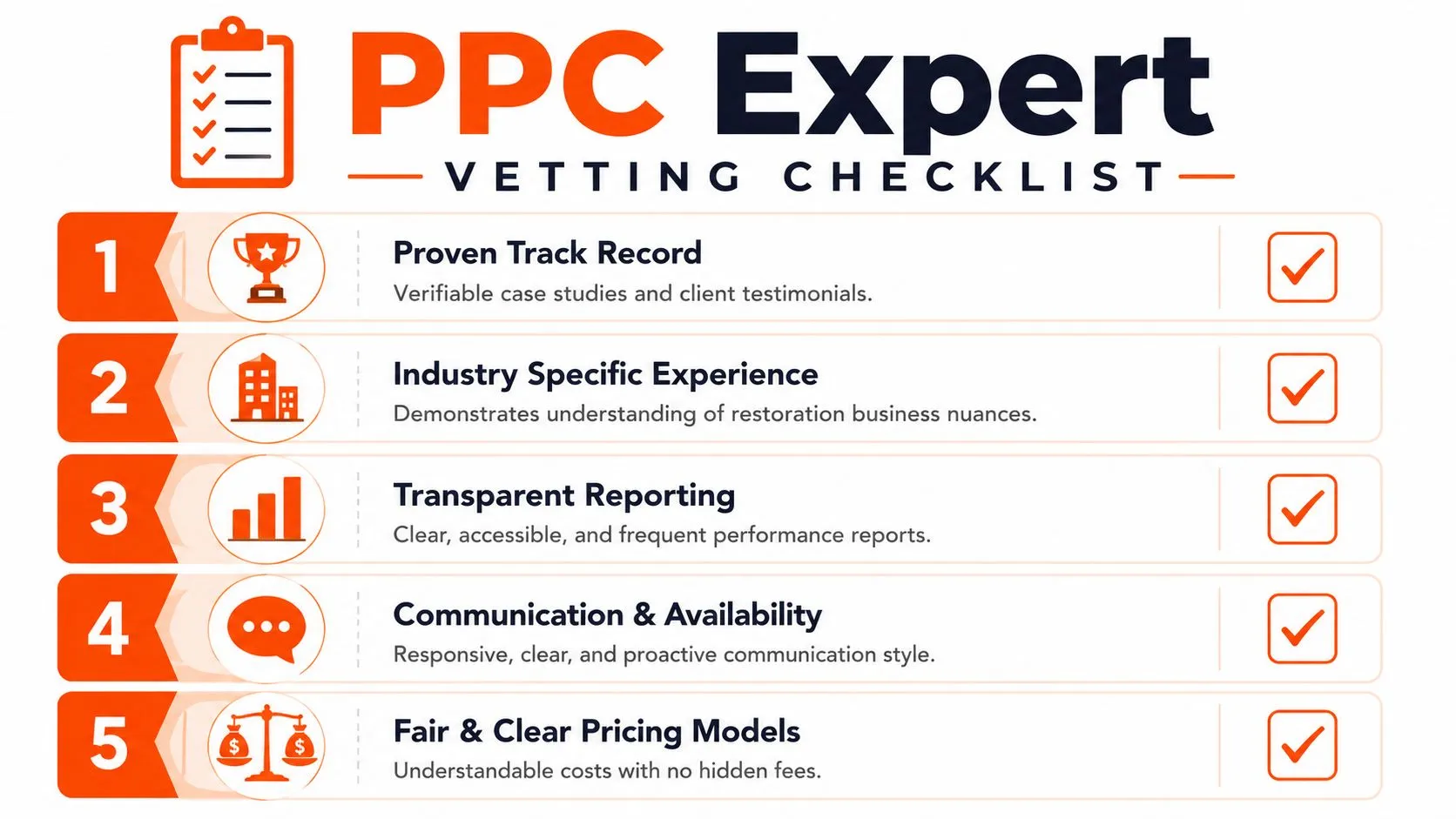
Questions that expose real process
Ask what happens before scaling.
A serious PPC operator should mention testing, alignment, and data quality. The Straight North guide to foundational PPC strategy says a sound method requires a 2-4 week statistical testing phase before scaling, and less than 25% of ads typically generate conversions initially. The same source notes that strong operators use tools like SEMrush to study competitor gaps and keep ads, keywords, and landing pages tightly aligned.
That gives you a good first interview question: “What do you test first, and how long do you wait before scaling?”
If they answer with “we optimize continuously” and nothing else, keep pushing.
Other questions worth asking:
- How do you separate emergency calls from slower restoration services? If they don’t split intent, they don’t understand the business.
- How do you track phone calls, web forms, and booked jobs? “We track conversions in Google Ads” is not enough.
- What happens if we miss a call from a paid lead? Such a situation quickly reveals weak vendors.
- Do you send traffic to service pages or the homepage? Why? Good answers are specific.
- How do you review search terms and negative keywords? You want a routine, not a shrug.
- What do your reports show besides clicks and leads? Listen for lead quality, call outcomes, and booking visibility.
If pay-per-call matters heavily in your business, it helps to review how marketers think about pay per call before these conversations. It sharpens your questions.
A useful way to hear how someone explains PPC basics is to watch how they teach. This video gives a solid starting point for that.
Red flags that should kill the deal
Some red flags are obvious. Others sound impressive until you know what to listen for.
Walk away if you hear things like:
- “We can guarantee results fast.” Paid search can move quickly, but no one serious guarantees a clean outcome before data comes in.
- “Our system works for every industry.” Restoration is not med spa PPC. The lead path is different.
- “We optimize for the lowest CPC.” That tells you they’re focused on traffic cost, not revenue quality.
- “You don’t need call tracking if calls come through your main line.” Wrong. If you can’t isolate paid calls, you can’t judge the account properly.
- “We send all traffic to the homepage because it converts best overall.” That’s usually a shortcut, not a strategy.
- Vague reporting language. If they hide behind platform screenshots, that’s a problem.
A weak vendor loves broad metrics because broad metrics are harder to argue with.
Also watch what they ask you. If they never ask about your average job value, margins, booking rate, service mix, dispatch coverage, or who answers the phone after hours, they are not thinking like a business partner.
What a solid answer sounds like
A strong candidate usually sounds grounded.
They’ll tell you some campaigns need time to settle. They’ll explain why emergency services need tight ad groups and dedicated landing pages. They’ll care about whether the office answers live and how missed calls are recovered. They’ll push for clean attribution, not just last-click credit. They won’t try to impress you with jargon.
You should also hear real operational language. Google Ads. Google Keyword Planner. SEMrush. SpyFu. Landing page variants. Negative keywords. Call recording review. Conversion imports. Those are working terms, not decoration.
Setting Budgets and Measuring What Matters
Budget conversations go sideways when people start with platform metrics instead of business math.
The clean way to do this is simple. Start with what a new restoration job is worth to you. Then work backward into what you can afford to pay for a booked job. Everything else sits under that number.

Start with allowable CPA, not ROAS bragging
A lot of PPC reporting is built to sound good in meetings.
The problem is that a “good” ROAS is not a fixed number. It depends on your margins. The Embryo explanation of PPC metrics makes the point clearly: good managers calculate maximum allowable CPA by subtracting the desired profit margin from the average job value, then use that to judge whether the campaign is profitable.
That matters in restoration because job values vary a lot. Emergency extraction, contents, mold, rebuild, and insurance-driven work don’t all carry the same economics. If your PPC expert keeps waving around ROAS without talking about margin, they’re skipping the hard part.
Key takeaway: Your account isn’t healthy because the platform says ROAS looks strong. It’s healthy when acquisition cost fits the economics of the work you actually want.
For lead generation, bid strategy should reflect that reality. A LinkedIn post on measuring PPC campaigns notes that Target CPA is the right bidding model for lead generation, while Target ROAS fits e-commerce better. Restoration is a lead gen business. Treating it like online retail creates bad incentives.
If you need a plain-English benchmark for planning spend ranges and expectations, this guide to Google Ads budgets for businesses is a useful companion piece.
What to track every month
A restoration owner doesn’t need fifty metrics.
You need a short list tied to the funnel:
- Qualified calls and forms: Not every lead counts. Some are junk, out of area, or wrong service.
- Booked jobs from paid leads: This is the number that matters most.
- Cost per booked job: Better than cost per lead in most restoration accounts.
- Missed-call rate on paid traffic: If this is bad, ad optimization alone won’t save you.
- Service-line performance: Water, fire, mold, storm, board-up. Don’t lump them together.
For broader contractor context, this overview of contractor digital marketing helps frame PPC inside the bigger demand and conversion system.
How to judge the fee model
There isn’t one perfect pricing model.
Flat retainers are easier to forecast. Percentage of ad spend can make sense if the work expands with complexity. Performance-based pricing sounds attractive, but it gets messy fast when lead quality, call handling, and job booking depend on both sides.
What matters more is alignment. Ask the partner what they are accountable for, what they can influence, and what they need from your team. If they take credit for every lead but won’t talk about tracking quality or phone handling, the pricing model doesn’t matter. The incentives are already broken.
Hiring and Onboarding Your PPC Partner
A good hire can still fail with a sloppy start.
Most PPC problems in the first month aren’t strategy problems. They’re access problems, tracking gaps, unclear expectations, and delayed approvals. If you want traction, onboarding needs to be clean and fast.
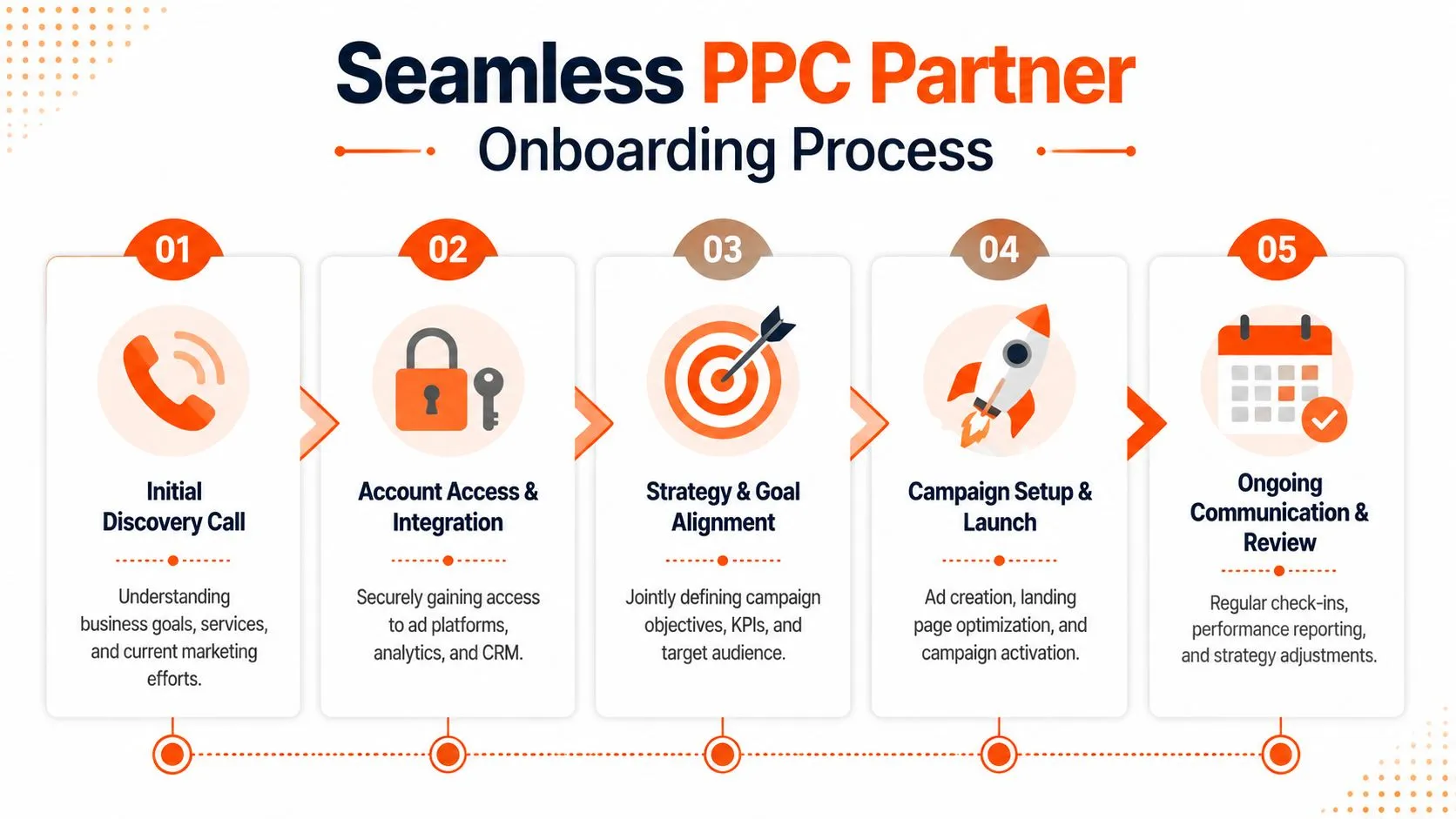
The access checklist
Your new partner should not be building blind.
They usually need access to:
- Google Ads: Full campaign visibility and billing-safe permissions.
- Google Analytics: To verify traffic paths and conversion behavior.
- Google Business Profile: Useful for local alignment and branded search behavior.
- Call tracking platform: So they can review source data and call outcomes.
- CRM or dispatch system: Enough access to verify lead status and booked jobs.
- Landing pages or site CMS: Even small edits matter.
- Tag management setup: If you use one, it speeds up cleaner tracking fixes.
Grant access by role, not by sharing logins. That’s safer and easier to unwind later if needed.
What should happen in the first 90 days
The first stretch should feel structured.
Early on, the partner should audit the existing account, review tracking, inspect search terms, assess landing pages, and understand your service mix. After that, they should rebuild or refine campaigns around actual intent and geography.
A useful operational frame comes from the PPC performance guidance at Cleart’s review of PPC issues. It notes that experts use the formula Visitors Needed = Conversions / Conversion Rate, and gives the example that 300 conversions at a 3% rate requires 10,000 visitors. The same source says campaigns often need 3-6 months to fully demonstrate value, with weekly bid adjustments and monthly negative keyword updates supporting performance over time.
That doesn’t mean you wait passively. It means you should expect real setup work first, then a period of disciplined refinement.
A sane first-90-days flow looks like this:
- Audit and cleanup Existing campaigns, conversion actions, search terms, landing pages, and tracking.
- Alignment Services, locations, hours, after-hours routing, and what counts as a qualified lead.
- Build New campaigns, ad groups, assets, and landing paths based on intent.
- Verify Test forms, phone routing, call tracking, and booked-job visibility.
- Optimize Search terms, negatives, bids, ad copy, and page improvements.
The communication rules
Don’t leave reporting vague.
Set the meeting rhythm early. Decide who owns approvals. Decide how urgent changes get handled during storms or seasonal spikes. Decide what gets reported every month and what happens when lead quality drops.
You hired a PPC partner to reduce guesswork. If you still can’t answer where leads came from, who handled them, and how many booked, the onboarding didn’t work.
A healthy relationship has short feedback loops. The office should report bad lead quality fast. The PPC manager should report waste fast. Nobody should wait for a monthly deck to say the phones weren’t being answered.
Beyond Clicks Your PPC Growth System
Hiring pay per click experts is only step one.
The stronger move is building a system where paid search feeds the rest of your marketing. Search term data can sharpen your service pages. Call recordings can improve ad copy and intake scripts. Landing page winners can shape SEO pages. Follow-up gaps can show you where operations are killing good demand.
This is also where restoration companies stop thinking like ad buyers and start thinking like system owners. If you know which campaigns produce calls, which calls get answered, which leads get booked, and which jobs are profitable, you can improve the whole machine. If you only know clicks and spend, you’re guessing.
Lead handling is part of that machine. If your team struggles to catch urgent calls after hours, solutions like professional answering for restoration businesses are worth evaluating because they affect paid performance more than most owners realize.
PPC should not sit alone as a rented service. It should connect to tracking, intake, follow-up, local visibility, and the pages you own. That’s how you turn paid traffic into a growth asset instead of another monthly expense.
If you’re done with disconnected vendors and want a clearer path from search visibility to booked jobs, FirstMention builds AI marketing systems for home-service and trade companies that connect visibility, tracking, intake, follow-up, and reporting into one system you can understand.