Pay Per Call: A Guide for Restoration Contractors
Thinking about pay per call for your restoration business? Learn how it works, the real risks, and how to turn qualified calls into booked jobs.

Your phone rings at 8:17 p.m. A homeowner has a basement full of water. They need help now. If your team answers, qualifies the job, and dispatches fast, that call can turn into revenue.
If nobody picks up, or the caller gets bounced around, your ad spend just bought someone else a job.
That’s the central conversation around pay per call for restoration companies. It’s not just about getting the phone to ring. It’s about whether your business can turn that ring into a booked job.
Table of Contents
- Tired of Paying for Clicks That Don’t Call
- How Pay Per Call Actually Works
- The Good and The Bad for Restoration Contractors
- Understanding Pricing and Tracking Mechanisms
- How to Choose a Pay Per Call Vendor
- Turning Calls into Booked Restoration Jobs
Tired of Paying for Clicks That Don’t Call
It usually starts the same way. A pipe bursts, a homeowner searches in a panic, and your company has already paid to show up. The click lands, the budget gets charged, and then nothing happens. No call. No dispatch. No job.
That gap is why restoration owners start looking at pay per call.

For restoration, a phone conversation often matters more than a website visit. People dealing with water, smoke, mold, or storm damage want a fast answer, a clear next step, and some confidence that a crew can respond. They are not shopping the way someone shops for a kitchen remodel.
That changes how lead quality should be judged.
A click can come from weak intent, sloppy targeting, or somebody comparing five companies at once. A call usually signals a more immediate problem. But even that is only part of the equation. Revenue comes from booked jobs, not from hitting a call-duration threshold in a vendor report.
Why restoration owners look at it differently
In this category, the handoff between marketing and operations is where money is won or lost. A lead source can produce legitimate inbound calls and still underperform if the phone is answered late, the CSR sounds uncertain, or no one asks for the job.
That is the mistake I see all the time. Owners buy a channel that promises “qualified calls,” then judge it in isolation. Meanwhile, the actual leak is inside the business.
Three standards matter more than raw lead volume:
- Is the caller in your service area?
- Is the job type one you want?
- Did your team convert the call into a scheduled inspection, emergency dispatch, or signed job?
If the answer to the third question is weak, the first two stop mattering.
Practical rule: If a lead source looks good in reporting but your office staff says the calls rarely turn into work, trust the staff first and audit the source second.
A lot of general lead gen advice skips that operational layer. Restoration companies do not need more “engagement.” They need calls their team can answer, qualify, and book. If you are comparing channels, this guide to marketing agency lead generation for service businesses is useful for separating lead volume from lead value.
What pay per call does well, and what it doesn’t
Pay per call can tighten the connection between ad spend and direct response. That is a real advantage for emergency service lines where speed matters and forms often slow people down.
It will not fix poor intake.
It will not screen out every bad call, stop spam, or make after-hours coverage less important. It will not rescue a campaign if calls route to voicemail on weekends, or if the person answering sounds more like a receptionist than someone ready to help a stressed homeowner.
Vendors tend to sell the call. Restoration owners need to measure what happens after the call. That is the difference between buying activity and buying jobs.
How Pay Per Call Actually Works
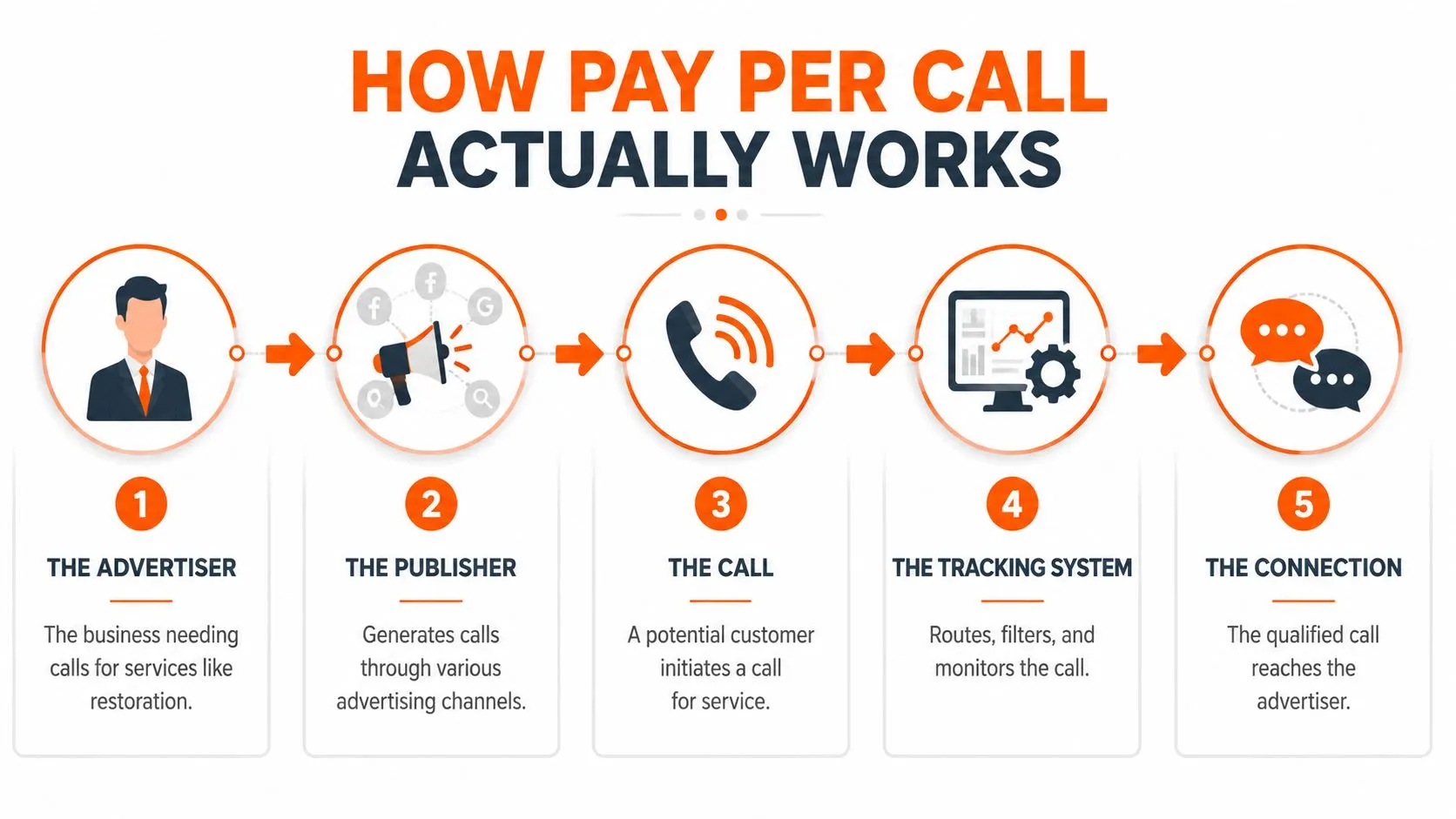
A homeowner finds a burst pipe at 9:40 p.m., searches for help, taps a call ad, and reaches a tracking number that forwards to your office or after-hours line. If the call meets the campaign rules, the vendor charges for it. That is the model.
The mechanics are simple. The business risk is not. A restoration company can buy a high volume of calls and still lose money if routing is sloppy, service filters are loose, or the person answering fails to move the caller to a booked inspection or dispatch.
As described in HubSpot’s pay per call guide for beginners, pay per call started in offline media like TV and radio, then shifted into digital campaigns built around trackable phone numbers, call routing, and source attribution.
Why this model got traction
Three parties usually drive the setup:
| Role | What they do | What you should care about |
|---|---|---|
| Advertiser | That’s your restoration company | You pay for calls that meet agreed rules |
| Network | Manages routing, tracking, and payouts | This is the vendor you need to vet hard |
| Publisher | Generates the calls through ads or placements | Their traffic quality affects everything |
The tracking number is the foundation. It ties the call to a source, shows where it was routed, and gives you a record to review when quality slips.
That matters more in restoration than in slower sales cycles. If a vendor sends water damage calls to the wrong location, or sends general home services calls into your emergency line, your team still burns time answering them. On paper, the campaign can look active. In the office, it feels like noise.
Some vendors add geo filters, time-of-day rules, IVR steps, and call recordings. Those tools help, but only if they are set up around your operation. A beautiful reporting dashboard does not fix bad routing.
A quick visual helps if you’re new to the model:
What makes a call billable
The billing rules are where owners need to slow down and read the fine print.
You are usually not paying for every inbound ring. You are paying for calls that match a set of conditions the vendor defines with you, or in weaker setups, defines for you. That difference matters.
Common qualification rules include:
- Connection requirement. The call must reach a live person or valid answering point.
- Duration threshold. Very short calls usually do not count.
- Geography fit. Calls from outside your service area should be filtered out.
- Service match. The inquiry should match the services and job types you want.
The problem is that a “qualified call” is still only a chance to win the job. A 90-second call from the right ZIP code sounds good in a report. It has no value if the caller needed emergency extraction and your line rolled to voicemail, or if your CSR failed to ask the questions that lead to dispatch.
That is why experienced restoration owners look past call count and ask better questions. Did the caller have covered damage? Was the property in your target area? Did your team book the next step?
If a vendor cannot explain, in writing, when a call becomes billable and how disputes are handled, do not rely on the sales pitch.
For restoration companies, the money is made after the call connects. The vendor can deliver the opportunity. Your process has to turn that opportunity into scheduled work.
The Good and The Bad for Restoration Contractors
A pipe bursts at 11:40 p.m. The homeowner is standing in water, searching on a phone, and wants a person now. In that situation, pay per call lines up with how restoration jobs are won. The problem is what happens after the phone rings. Plenty of campaigns produce billable calls and still disappoint because the handoff from marketing to intake is weak.
Where pay per call helps
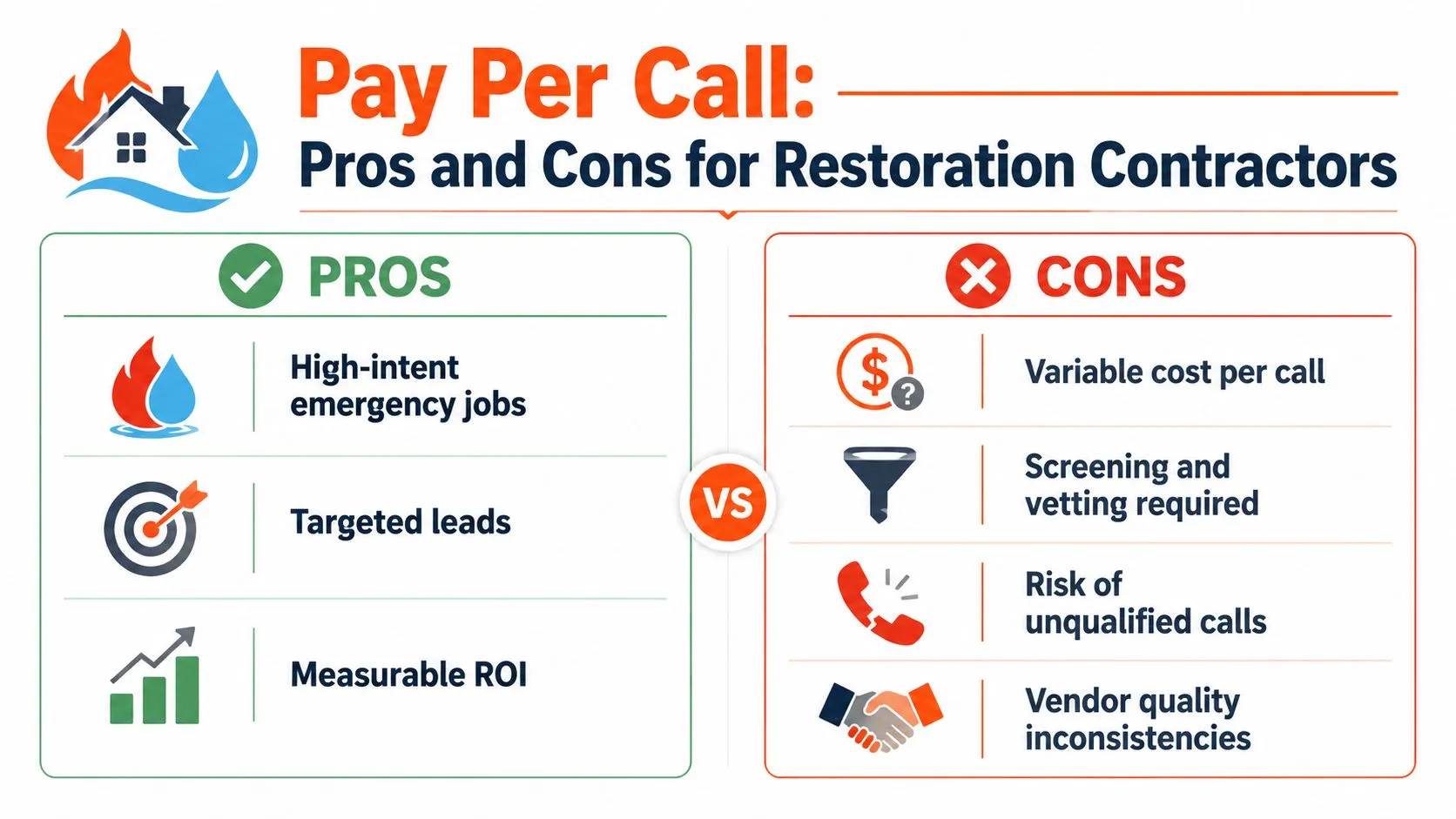
The model works best when speed matters and the caller already knows there is a problem. That fits water, fire, smoke, sewage, and other urgent losses better than slower, research-heavy services.
It also gives owners something many lead programs do not. Visibility. You can review recordings, check timestamps, see whether calls were answered, and hear whether your CSR asked the questions that lead to a dispatch or inspection.
There is also a practical financial benefit. You are paying closer to an actual sales conversation than you would with traffic, impressions, or form-fill volume. That does not guarantee profit, but it shortens the distance between ad spend and a booked job.
Where it breaks down
The weak point is usually not the ad. It is the operation behind it.
A caller can meet the vendor’s billable rules and still be a poor fit for your company. Wrong county. Apartment tenant when you only want owner-approved work. Mold inquiry when you are trying to buy water mitigation calls. Insurance question with no active damage. Those calls create activity, not revenue.
Vendor quality also varies more than sales reps admit. Some providers control routing, targeting, and source quality closely. Others buy mixed traffic from multiple publishers and push it into one pool. That is when you start hearing the same pattern on recordings. Confused callers, price shoppers, bad geography, and service requests your team never agreed to buy.
The trade-off is straightforward:
- You can get urgent callers fast. That matters in restoration.
- You give up some control over how demand is generated. The source quality has to be watched.
- You can inspect the call itself. That makes disputes easier than with anonymous leads.
- You still need a tight intake process. Missed calls, slow answers, and weak scripting waste the spend.
I have seen this play out the same way many times. An owner buys calls, sees decent volume, and assumes the campaign is working. Then we listen to recordings and find after-hours calls going unanswered, CSRs failing to ask loss type and location, or no clear path to book the next step. The vendor did their part well enough to generate the opportunity. The revenue died in intake.
Pay per call helps restoration companies buy conversations. It does not fix staffing, call handling, or dispatch discipline.
That is the good and bad. Pay per call can put high-intent homeowners on the line quickly. It can also expose every weakness in your front-end process. Contractors who treat it as a lead source usually get mixed results. Contractors who treat it as part of a full booking system usually make it work.
Understanding Pricing and Tracking Mechanisms
A restoration owner does not lose money on pay per call because the invoice says $85 instead of $70. The loss usually happens because the billing rules are loose, the tracking is incomplete, and nobody ties the call back to whether it could have become a job.
Start with the contract, not the rate card.
Pay per call pricing is usually a fixed amount per qualified call, sometimes with different prices by service line, geography, or urgency. The format matters less than the trigger for billing. If a vendor cannot define that trigger in plain English, expect bad calls on the invoice and slow arguments when you challenge them.
A usable agreement should answer four questions without interpretation:
- What counts as a qualified call? Duration alone is not enough if the caller is outside your area or asking for a service you do not offer.
- Which job types are included? Water damage, fire cleanup, mold, sewage, contents, and reconstruction do not carry the same value.
- Where must the caller be located? City, ZIP, county, or service radius should be written clearly.
- How do credits work? You need a real dispute process, a review timeline, and access to recordings.
The minimum call length still matters. It weeds out misdials, hang-ups, and obvious junk before a call becomes billable. But owners make a mistake when they treat duration as the whole quality standard. A 90-second call from the wrong county is still a bad buy. So is a long call with a renter asking for a service your crew does not handle.
That is the gap many contractors run into with lead services for contractors. The lead looks valid on paper. The office cannot turn it into revenue.
Tracking tools that matter
Vendors like to talk about tech stacks and AI routing. Fine. The tools that matter are simpler than the sales pitch.
| Tool | Why it matters |
|---|---|
| Tracking numbers | Shows which campaign, source, or publisher drove the call |
| Call recording | Lets you audit quality, train CSRs, and dispute bad charges |
| Routing rules | Sends calls by service, location, or time of day to the right person |
| Call logs | Gives your team timestamps, outcomes, missed calls, and callback history |
If those four pieces are weak, the rest is decoration.
Dynamic number insertion can help on landing pages or multi-channel campaigns, especially if you are comparing search traffic against other sources. It is useful, not magical. Clean call logs, accurate routing, and consistent recording review do more for profit than fancy attribution features most restoration companies never act on.
The practical test is simple. Pull a sample of billed calls every week. Listen to the recordings. Check whether the caller was in territory, matched the service line, reached a live person, and had a real path to inspection, dispatch, or next step. Then match that against the invoice and your booking outcome.
That last part gets missed a lot. Tracking should not stop at “qualified call received.” If your office dispositions calls as booked, lost, wrong service, bad geography, duplicate, or no answer, you can see where the money breaks. Sometimes the vendor is sending weak traffic. Sometimes the calls are fine and the office is failing to convert them. You need enough tracking to tell the difference.
How to Choose a Pay Per Call Vendor
A decent vendor will answer hard questions without getting slippery. A weak vendor will dodge, generalize, or try to push you back to “overall lead quality” talk.
That’s your cue to keep digging.
Questions worth asking before you sign
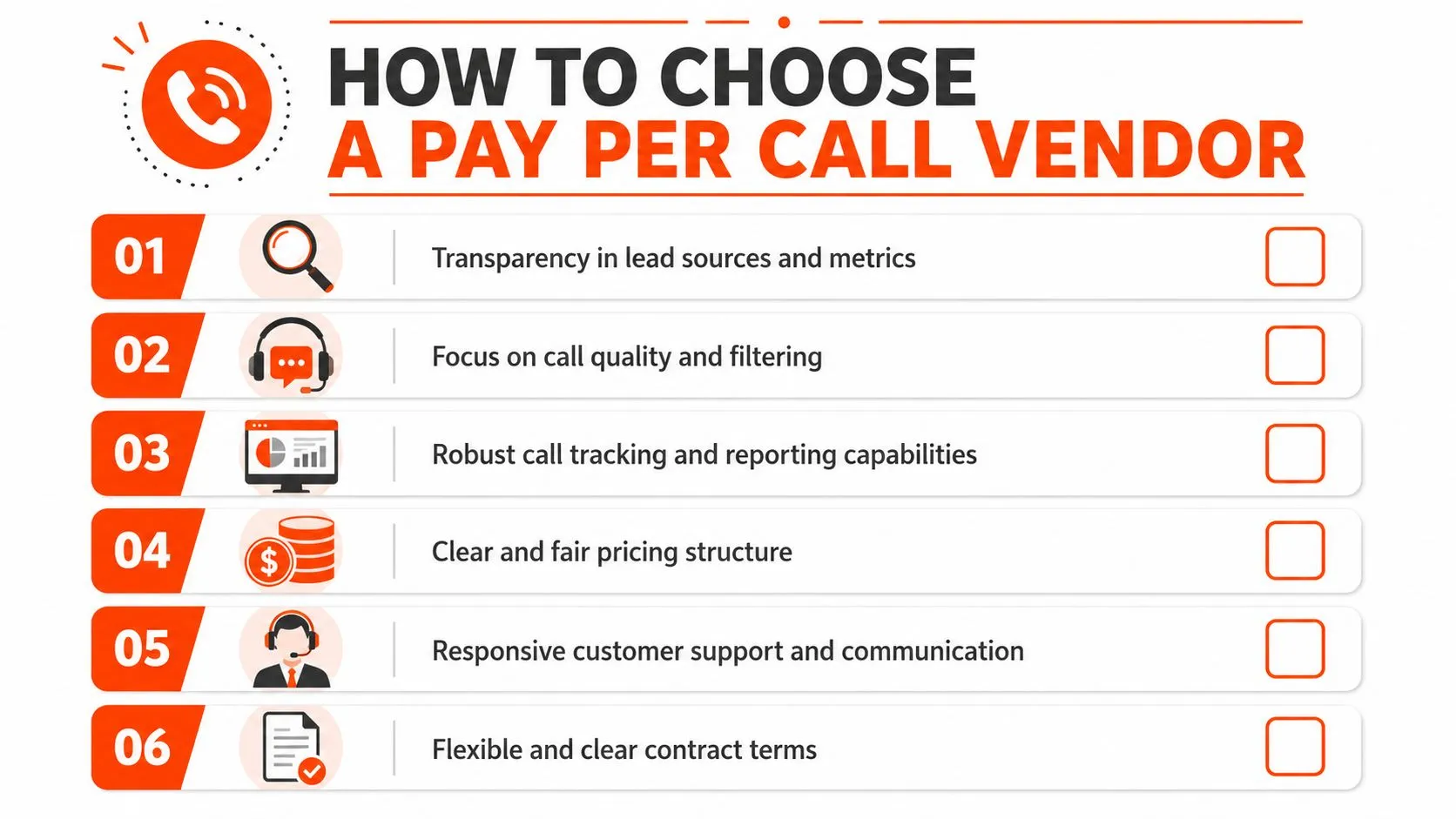
Start with source transparency. Ask where the calls come from. Search traffic, display, affiliate inventory, directory placements, social, and mixed publisher traffic all behave differently. If they won’t tell you, assume the source mix is broad and uneven.
Then ask what “qualified” means in their contract, not in their pitch.
Use a checklist like this:
- Where do these calls originate? Ask for channel categories, not vague comments about “premium traffic.”
- How do you define a qualified call? You want the duration rule, geography rules, and service filters in writing.
- Can you suppress bad-fit categories? If you don’t do certain restoration services, the campaign should reflect that.
- How are disputes handled? Ask who reviews them, how quickly they’re decided, and whether recordings are available.
- What does reporting include? You need call detail, timestamps, routing visibility, and dispositions your office can review.
If you’re weighing vendor categories more broadly, this guide to contractor lead service options for home-service companies is useful because it shows how lead sellers, agencies, and performance vendors differ in practice.
Red flags that usually mean trouble
Some warning signs show up early.
| Red flag | Why it matters |
|---|---|
| They won’t discuss sources | Hidden sourcing usually means weak accountability |
| They only talk about volume | Volume without fit creates office chaos |
| No access to recordings | You can’t verify quality cleanly |
| Loose service-area controls | You’ll pay for calls you can’t serve |
| Long contract with weak transparency | You carry the risk while they keep the margin |
The cheapest call source often becomes the most expensive one after missed dispatches, refunds, and time wasted by your front office.
A strong vendor won’t promise perfection. They’ll show you how the campaign is filtered, how calls are tracked, and how bad leads get handled.
Turning Calls into Booked Restoration Jobs
Most pay per call content often stops prematurely. A qualified call is not the same as a booked job, especially in home-service categories where after-hours demand and fast response shape profitability, as discussed in this analysis of what happens after the call is answered.
That point matters more in restoration than almost anywhere else. Water loss doesn’t wait for office hours. Fire and smoke calls don’t care whether your coordinator stepped out. The lead only has value if your operation can catch it and move.
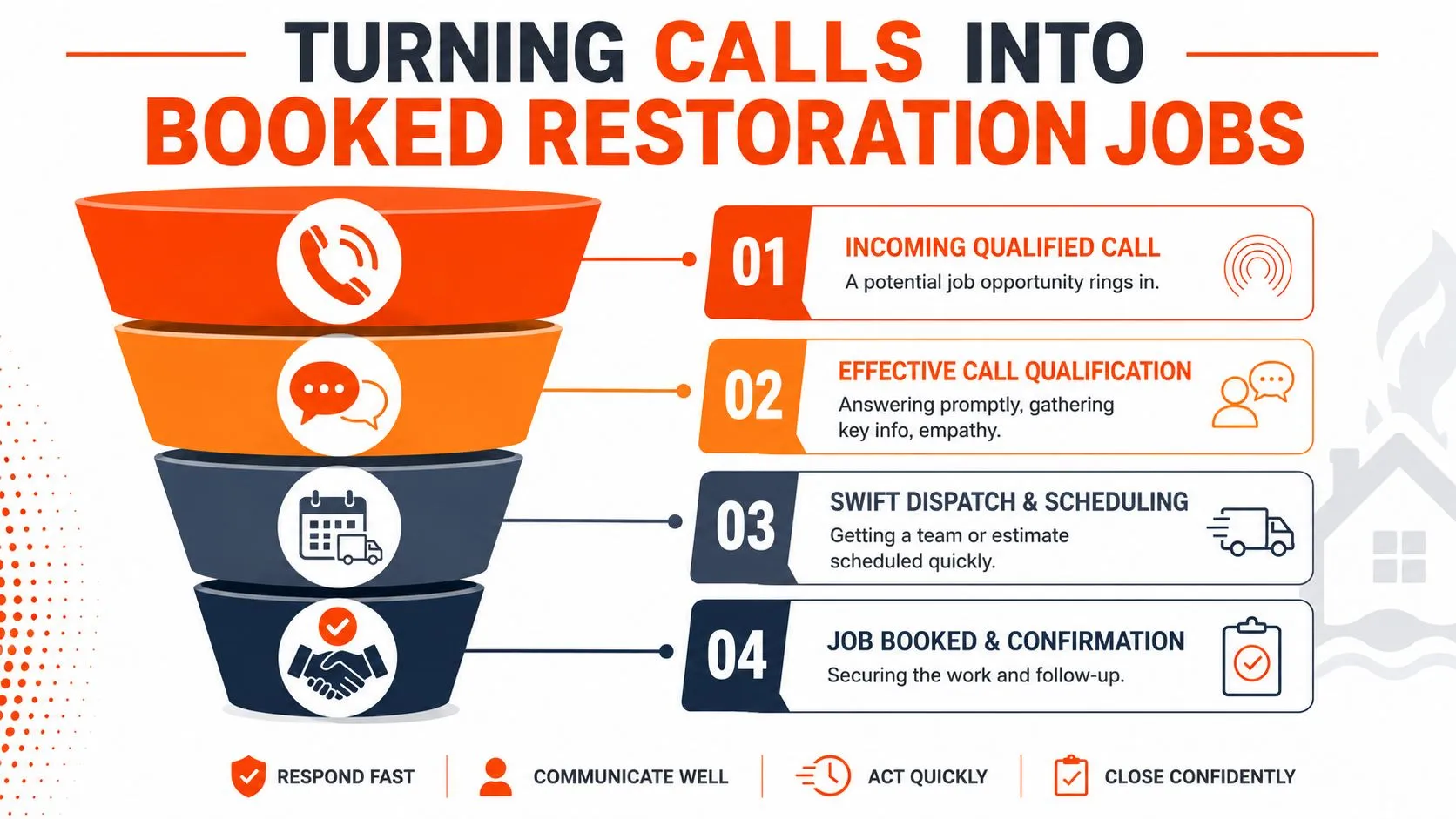
Answering fast is only step one
A lot of owners think call handling means “make sure someone answers.” That’s part of it, but not enough.
The person answering needs a simple process:
-
Confirm the problem Water, fire, mold, storm, sewage, or something else. Don’t make the caller explain it three different ways.
-
Confirm serviceability Make sure the address is in territory and the job type fits your team.
-
Move toward action Book the inspection, dispatch the crew, or lock the next step while the caller is still engaged.
-
Capture details clearly Name, phone, address, loss type, urgency, insurance status if relevant, and any access issues.
That process should live in one place. Not in the owner’s head. Not scattered across sticky notes. A call script, intake form, and routing plan make a huge difference when the office is busy.
Build a recovery process for missed calls
No restoration company answers every call perfectly. The issue is whether you recover fast when you miss one.
Your missed-call process should include:
- Immediate text-back. A short message that tells the prospect you received the call and can help.
- Rapid callback. Not later on. As soon as a live person is available.
- After-hours routing. If nights and weekends matter, send calls to someone trained to gather enough detail and escalate properly.
- Disposition tracking. Mark whether the call booked, no-showed, was out of area, or was a bad fit.
Fast follow-up is part of the product in restoration. The homeowner doesn’t separate your marketing from your response time.
The strongest pay per call campaigns are tied to operations. Routing rules connect to coverage hours. Dispatch knows what marketing is sending. The office knows what counts as a real opportunity. Ownership reviews booked jobs, not just call totals.
That’s also why broader contractor digital marketing systems for local service companies tend to outperform disconnected lead buys over time. When visibility, call handling, follow-up, and reporting work together, more of the demand you already paid for turns into jobs.
If you remember one thing, make it this. Don’t judge pay per call by call count alone. Judge it by booked work, response quality, and whether your team can handle the demand when it arrives.
If your restoration company is tired of disconnected vendors, weak lead tracking, and missed-call leaks, FirstMention helps build the full system around demand, from visibility and call tracking to AI intake, follow-up, and booked jobs.