Template for a Testimonial: 6 You Can Use Today
Need a template for a testimonial? Get 6 ready-to-use examples for restoration companies, plus scripts and tips to get reviews that book jobs.


Stop getting weak reviews. Steal these templates.
Getting testimonials feels like a chore. You finish a hard restoration job, ask for a review, and get, “They did a good job.” That’s polite. It’s also useless if you want the next homeowner to call you instead of the company down the street.
A vague review doesn’t answer essential buying questions. Did you show up fast? Did you explain the process? Did you protect the house? Did you make a stressful situation feel under control? Those details are what sell.
For restoration companies, this matters even more. People hire you when they’re dealing with water, smoke, mold, storm damage, or an insurance headache. They want proof, not compliments. Strong testimonials act like short case studies. They show the problem, the fix, and the outcome. That structure is widely recommended in testimonial guidance, especially the Problem-Solution-Result format, because it pushes customers to be specific and include measurable proof when possible, as noted by Testimonial’s customer testimonial template guide.
This guide gives you six practical templates for a testimonial you can use right now. Not just what to ask. Also where to place each one, how to collect it, and how to turn it into a repeatable marketing system that helps book better jobs.
Table of Contents
- 1. The Before-After Problem-Solution Testimonial
- 2. The Star Rating + Short Quote Testimonial
- 3. The Detailed Case Study Testimonial
- 4. The Video Testimonial
- 5. The Specific Metric Testimonial
- 6. The Social Proof List Testimonial
- 6 Testimonial Template Comparison
- Build a Testimonial System That Works for You
1. The Before-After Problem-Solution Testimonial
If you only use one template for a testimonial, start here. It matches how homeowners remember a restoration job. First there was a mess. Then your crew stepped in. Then life got back to normal.
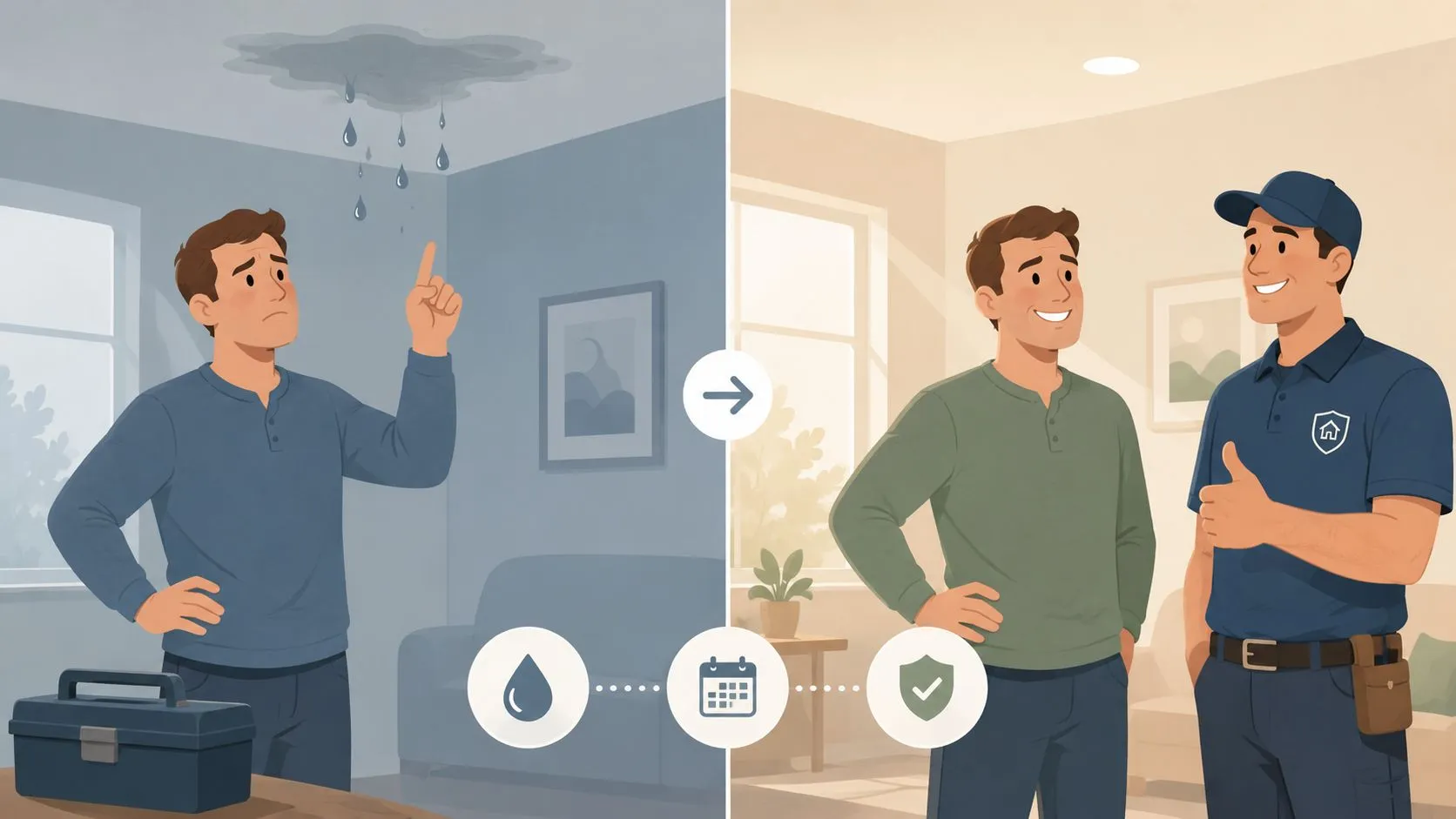
This structure works because it isn’t just praise. It’s a mini story. For service businesses, that matters. Buyers trust testimonials more when they include identifiable details, a use case, and proof instead of broad compliments. Zendesk notes that positive reviews and customer testimonials directly affect trust for 72 percent of customers, citing BigCommerce data in its guide on customer testimonials and trust-building.
Why this one works in restoration
Restoration jobs have built-in drama. A pipe burst overnight. A sump pump failed. Smoke spread through the kitchen. The homeowner was scared, tired, and looking for someone steady. That emotional arc makes this format easy for customers to complete and easy for future prospects to believe.
A weak version sounds like this: “Great company. Nice people.”
A strong version sounds like this: “We found water coming through the ceiling after dinner. They answered right away, walked us through the next steps, and had drying equipment in place fast. They kept us updated and helped us feel calm.”
Practical rule: Ask for the “before” while the stress is still fresh, and ask for the “after” once the customer can see the house stabilizing.
A simple prompt you can send
Text or email this after a good job:
- What happened: “What was going on before we came out?”
- What we did: “What did our team do that helped most?”
- What changed: “How did things feel after the job was underway or complete?”
- Local detail: “Can we use your first name and city?”
That last line matters. Local credibility beats anonymous praise almost every time.
On your website, put these on the exact service page tied to the problem. Water damage stories belong on water damage pages. Sewage backup stories belong on sewage cleanup pages. If you’re building a lead engine, they also fit well inside a broader marketing agency lead generation system for home services where the testimonial supports the offer on the page instead of floating in a random slider.
2. The Star Rating + Short Quote Testimonial
This is the fast food version of social proof. Quick to collect. Easy to scan. Surprisingly powerful.
For busy restoration owners, this format is the one you can gather at volume. It’s short enough that customers will finish it. It also works well on Google Business Profile, location pages, and mobile pages where nobody wants to read a wall of text.
Where this format pulls its weight
Think of this as your everyday testimonial, not your trophy testimonial.
Examples look like this:
- Water damage call: “★★★★★ Fast response, clear communication, clean crew.”
- Mold job: “★★★★★ Honest about what needed work and what didn’t.”
- Storm cleanup: “★★★★★ Showed up when they said they would and handled everything professionally.”
The trade-off is simple. Short reviews don’t tell a full story. But they create repetition. And repetition builds trust. When prospects see the same themes again and again, fast response, clean work, honest communication, they stop wondering what they’ll get.
Short reviews win when the buyer is still deciding who to call first.
A short review request that gets better responses
Most companies ask too vaguely. “Can you leave us a review?” gets weak language.
Ask this instead:
- Start with the rating ask: “If you felt good about the job, would you leave us a quick Google review?”
- Give them a direction: “Mention the service, how our team responded, and anything you appreciated.”
- Keep it light: “One or two sentences is perfect.”
Systems matter. Restoration companies miss reviews because nobody asks at the right moment. The job closes, the team moves on, and the window is gone. A simple follow-up flow sent after a positive interaction usually beats waiting for office staff to remember.
If you want more of these without chasing people manually, study how other service businesses use ads and follow-up workflows to create demand and capture reviews. Different trade, same lesson. Fast follow-up gets better response quality than a random request weeks later.
3. The Detailed Case Study Testimonial
A homeowner dealing with a pipe burst or fire loss is not looking for a clever quote. They want proof that your team can handle a complicated job without creating more stress. That is where a detailed case study testimonial earns its keep.

This format works best when the job involved more than cleanup. Insurance questions. Containment. Change orders. Rebuild coordination. Family updates. Those details matter because restoration buyers are judging your process as much as your final result.
Short reviews help you win attention. Case study testimonials help you win trust after the prospect starts comparing companies.
Use this when the job had real complexity
Save this format for jobs with a clear sequence and a meaningful decision point. Good examples include a water loss that required extraction, drying, demolition, insurer documentation, and reconstruction. A mold job can work if you corrected the source, explained containment, and kept the customer informed through clearance. A fire project can work if the customer was worried about odor, contents, or whether the home would feel normal again.
The strength of this testimonial is context. It shows how your team thinks under pressure, how you communicate, and what the customer experienced at each stage. That is why it fits well inside a marketing system. A short review can sit on your Google profile. A case study testimonial belongs on service pages, sales follow-up, and estimate presentations where a prospect needs more confidence before booking.
The structure that keeps it believable
Use a simple five-part build:
- The challenge: What happened, what the customer was worried about, and what made the job difficult.
- Our approach: What your team inspected, explained, documented, and prioritized first.
- The solution: What happened in sequence, including any coordination with adjusters, trades, or testing.
- The result: What changed for the customer, including practical outcomes they care about.
- What the customer said: A direct quote that sounds like a real person, not a brochure.
Keep the write-up focused. One guide on how to get customer testimonials and shape them into case studies recommends keeping the finished case study short enough for a homeowner to finish in one sitting. That is the right standard. If the story runs long, cut the background and keep the moments that prove competence.
Here’s a simple media format that works well on service pages:
How to get a case study testimonial that sounds real
Do not ask, “Can you write us something detailed?” You will get vague praise or nothing at all.
Ask better prompts after the job is complete:
- What was happening before you called us?
- What were you most worried about?
- What did our team explain clearly?
- What part of the process made things easier on you?
- What result mattered most in the end?
Those questions pull out the story behind the job. Then your team can shape the answer into a clean case study, while keeping the customer’s wording where it counts.
I have found that the strongest restoration case studies include one uncomfortable detail. Maybe the customer expected to be left in the dark. Maybe they were worried about the adjuster. Maybe another company never called back. That tension makes the finished testimonial credible because it reflects how people decide to purchase.
Add photos, short captions, and the customer’s own words. Keep the tone plain. If every line sounds polished by marketing, prospects will treat it like marketing instead of proof.
4. The Video Testimonial
Video is the closest thing to word of mouth on a page. You can hear relief in the customer’s voice. You can see the repaired space. You can tell whether they sound coached.
For restoration companies, that matters because your buyers are often stressed and skeptical. A real person talking calmly about what happened gives them something a polished paragraph can’t.
What to ask on camera
Don’t script the customer. Prompt them.
Ask simple questions:
- What happened at the house?
- What worried you most at the start?
- What did our team do that stood out?
- How do you feel now?
That sequence naturally pulls out the strongest parts of the story. It also mirrors a classic testimonial structure. As noted earlier, strong testimonial guidance often centers on before, solution, and result. Video just makes that arc easier to feel.
A good restoration video doesn’t need expensive gear. A phone is fine. Good light is better than fancy editing. Clear audio matters more than cinematic shots.
Let the customer pause, laugh, or search for a word. Small imperfections make the testimonial more believable.
What makes video feel real instead of staged
Shoot near the completed work if possible. A dry basement, a repaired ceiling, a cleaned-out room, or a restored living area gives the viewer context fast.
Keep it short. If the customer says one sharp thing in twenty seconds, use that. If they tell a fuller story in under a couple of minutes, keep the strongest cut for the page and save shorter clips for social.
One mistake I see all the time is asking for a video too late. By then the emotional memory is gone. Ask soon after a positive moment, while the relief is still there. Another common mistake is over-directing. If you feed them every line, you’ll get a stiff testimonial that sounds like your office manager wrote it.
If you want one reusable rule, use this. Ask for honesty, not enthusiasm. Honest beats enthusiastic almost every time.
5. The Specific Metric Testimonial
A homeowner calls after a pipe burst on Sunday night. What they remember a week later is rarely your equipment list. They remember how fast you showed up, how soon the water was out, and when the house felt livable again. That is where a metric-based testimonial earns its spot.
Used well, this format gives prospects something concrete to trust. It turns “great company” into “they arrived in 45 minutes and had three rooms dry enough to reopen by Tuesday.” For restoration companies, those details often matter more than broad praise because buyers are comparing urgency, reliability, and risk.

Use numbers that a prospect can understand fast
Good numbers are plain and specific. Response time. Days to dry-out. Downtime avoided for a business. Number of rooms affected and restored. Insurance paperwork handled without delays, if the customer can describe that clearly.
Bad numbers create friction. Inflated savings claims, fuzzy percentages, or ROI language the customer would never say can make the quote feel scripted. In restoration, that can also create trouble if the wording overpromises results or brushes too close to insurance claims you cannot support.
The rule is simple. If the customer can verify the number from their own experience, use it. If your team has to “polish” it, skip it.
Ask for proof, then shape it into a usable quote
Metric testimonials usually do not show up on their own. You have to ask better questions than “Would you leave us a review?”
Use prompts like these:
- Speed: “How long did it take for our team to respond or start work?”
- Operational result: “How quickly were you able to use the space again?”
- Comparison: “Was this faster, clearer, or less disruptive than you expected?”
- Permission check: “Are you comfortable with us using that number in your testimonial?”
This works because it helps the customer recall facts, not just feelings. That gives you cleaner raw material for a website, a service page, or an ad.
Why this template works in a marketing system
A specific metric testimonial does more than fill a quote box. It supports the claim on the page.
If your water damage page says you respond fast, a testimonial with a real response window backs that up. If your commercial page says you reduce business interruption, a testimonial about reopening sooner makes the message stronger. This is why I like using these quotes inside SEO and PPC service pages for local lead generation. They connect the promise in the headline to a customer outcome that feels real.
They also help inside systems like FirstMention, where one strong testimonial can be repurposed across service pages, review requests, follow-up emails, and sales materials. The quote stays consistent, but the placement changes based on what the buyer needs to believe.
One caution. Do not force every testimonial into a money story. In restoration, lower stress, faster response, and getting a family or facility back to normal are often the metrics that determine the decision.
6. The Social Proof List Testimonial
A single testimonial can help. A cluster of them does more work.
That’s why a social proof list, carousel, or mini-review grid often outperforms one featured quote on a homepage. Instead of asking the visitor to trust one person, you let them see a pattern across multiple customers, services, and neighborhoods.

Why grouped testimonials beat a lonely quote
This format is especially useful for restoration companies with more than one service line. Water damage, mold, fire cleanup, storm damage, crawlspace issues. A grouped display lets you show range without making the page feel heavy.
The missing piece in many testimonial templates is deployment. A testimonial shouldn’t look the same everywhere. Guidance from a conversion-focused video on testimonial deployment across channels points out that testimonials often need different treatments on homepages, case study pages, social posts, and review platforms. That’s dead on. The best version for a homepage is often shorter than the best version for a service page.
How to build the list without making your page messy
Use a simple structure for each entry:
- Name and city: Keep it local and human.
- Service received: Water damage cleanup, mold removal, smoke cleanup.
- Short quote: One useful line, not a speech.
- Optional visual: Photo, logo, or star graphic if you have permission.
You can also ask for multiple lengths from the start. One line for a card. Two or three sentences for a service page. A longer version for a case study. That saves a lot of rewriting later.
A testimonial collection works best when each review says something slightly different. Don’t stack six versions of “great service.”
One more practical point. Permission matters. Typeform’s testimonial form guidance emphasizes getting clear approval to use the response and the customer’s name in marketing, and sending the form soon after a positive interaction while keeping it short, as shown in its testimonial form template guidance. That’s smart. Clean consent keeps your marketing usable and defensible.
6 Testimonial Template Comparison
| Testimonial Type | 🔄 Implementation Complexity | ⚡ Resource Requirements | ⭐ Expected outcomes / 📊 Impact | Ideal use cases | Key advantages / 💡 Tips |
|---|---|---|---|---|---|
| The Before-After Problem-Solution Testimonial | Medium, structured follow-up questions and editing | Low–Medium, short text or video; minimal production | ⭐ High relatability; 📊 improves conversions on specific service pages | Emergency/home‑repair scenarios (plumbing, HVAC, roofing) where transformation is clear | Advantage: shows clear before→after story; Tip: ask “what was it like before/after?” and use local name/city |
| The Star Rating + Short Quote Testimonial | Low, simple capture and display workflow | Very Low, automated review requests and platform links | ⭐ Good for volume-based trust; 📊 strong impact on Maps/AI snippets | Local SEO and Maps listings, quick review collection across platforms | Advantage: easy to collect and scale; Tip: automate 24–48h review prompts and aim for many short 5★ reviews |
| The Detailed Case Study Testimonial | High, interviews, writing, and editing required | High, customer interviews, photos/video, professional copy | ⭐ Very high for high‑consideration buyers; 📊 improves SEO dwell time and lead quality | Complex or high‑ticket projects (roof replacement, whole‑home HVAC) | Advantage: demonstrates expertise and process; Tip: structure with clear headings and include before/after media |
| The Video Testimonial | Medium–High, shooting, editing, and consent workflows | High, camera/audio/editing (smartphone often sufficient) | ⭐ Highest conversion impact; 📊 strong CTR lift on ads and landing pages | Homepage hero, landing pages, social ads, YouTube embeds | Advantage: emotional authenticity and shareability; Tip: record within 48h, add subtitles and short social clips |
| The Specific Metric Testimonial (ROI/Efficiency Focus) | Medium, requires measurement methods and verification | Medium, follow‑up tracking and data collection | ⭐ Persuasive to budget‑focused buyers; 📊 drives ROI‑oriented decisions and ad performance | Upgrades, efficiency projects, B2B accounts (HVAC efficiency, lighting retrofits) | Advantage: quantifiable credibility; Tip: always include time period, measurement method and payback period |
| The Social Proof List Testimonial (Mini-Review Carousel) | Medium, curation and responsive UI/rotation rules | Medium, design, integration (Google/Yelp APIs), regular updates | ⭐ Amplifies trust through volume; 📊 increases engagement when fresh and well‑designed | Homepages, service pages, sidebars, local landing pages | Advantage: volume + consistency = perceived reliability; Tip: auto-refresh monthly, limit rotation speed and show recent reviews |
Build a Testimonial System That Works for You
These templates work best when you stop treating testimonials like random extras.
Most restoration companies collect them by accident. A homeowner says something nice, someone screenshots it, maybe it gets posted somewhere, maybe it doesn’t. That approach creates clutter, not assets. You need a simple system that turns customer feedback into material you can reuse across your website, Google Business Profile, service pages, sales follow-up, and social posts.
Start with timing. Ask soon after a positive moment. Don’t wait until the customer has moved on. If the job was straightforward, send the short review ask. If the job had complexity, send the before-after or case study prompt. If the customer is expressive and clearly happy, ask for video.
Then store everything in one place. Keep the raw review, the approved name, city, service type, date, and any permission notes. Save short, medium, and long versions when possible. That way one testimonial can become a Google review, a homepage quote, a service page proof block, and a full case study.
This also helps you avoid a common mistake. Too many companies collect nice words but never match them to the right page. A mold testimonial belongs where mold prospects are deciding. A storm damage testimonial belongs on the storm page. A generic homepage slider won’t carry the whole load.
There’s also a quality control side to this. Strong testimonials are specific. They mention the situation, the response, and the outcome. Overly sugary praise usually underperforms because it feels less real. Slightly restrained and detailed often wins. Buyers trust concrete details more than polished enthusiasm.
The other big shift is operational. Testimonials aren’t just website filler anymore. They’re part of a trust-building workflow. When your team knows when to ask, what prompt to send, how to get permission, and where each format gets used, you stop chasing reviews and start building a proof library.
That’s the primary value of a good template for a testimonial. It saves time, yes. But more important, it gives your customers a structure that helps them say the useful part out loud. And when they do that consistently, your marketing gets easier, your pages get stronger, and better-fit jobs get easier to win.
If you want help turning testimonials into a real booking system, FirstMention builds AI marketing systems for home-service companies that connect visibility, lead capture, missed-call text-back, follow-up, service pages, and reporting. For restoration companies, that means your reviews don’t just sit on a profile. They support the pages, workflows, and trust signals that help turn search demand into booked jobs.