Emergency Plumbing Cost: A 2026 Price Guide
What's a fair emergency plumbing cost? Get 2026 price ranges for common jobs, learn what drives your bill, and see how to avoid overpaying for urgent repairs.

Most emergency plumbing jobs land around $210 to $621, with a national average of $361. In plain terms, that usually means you’re looking at a bill somewhere in the $200 to $600 range, and that’s often 1.5 to 3 times the cost of a regular plumbing visit.
If you’re reading this with water on the floor, the question usually isn’t just “What does an emergency plumber cost?” It’s “Should I pay this now, or can I wait until morning without making the bill worse?”
That’s the right question.
A lot of homeowners fixate on the emergency rate and miss the bigger risk. The real cost decision is whether you’re paying for urgent access to stop damage, or gambling that the problem stays small. Sometimes waiting is smart. Sometimes waiting is the expensive move.
Table of Contents
- Why Emergency Plumbing Costs So Much More
- Average Emergency Costs for Common Problems
- Four Factors That Drive Your Final Bill
- When an Emergency Call Is Actually the Cheaper Option
- Questions to Ask Your Plumber to Control the Cost
- Making the Right Call When Water Is Everywhere
Why Emergency Plumbing Costs So Much More
The sticker shock is real because emergency plumbing isn’t priced like a normal service call. It’s priced like a disruption.
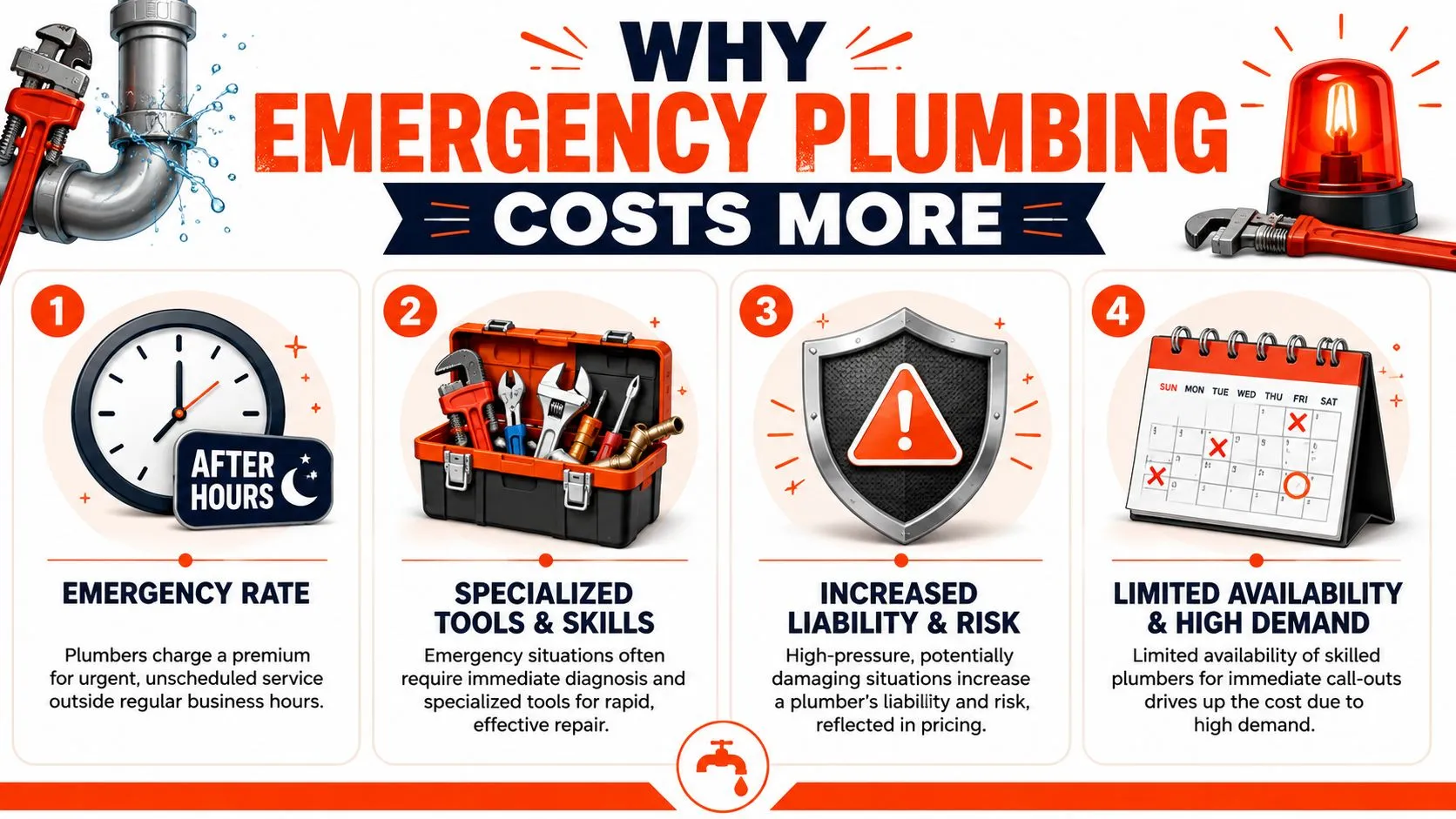
When a plumber comes out on a weekday appointment, you’re paying for scheduled labor. When they come out late at night, on a weekend, or on a holiday, you’re paying for immediate availability, dispatch speed, and the fact that they had to drop whatever else they were doing.
You’re paying for access, not just repair time
Industry pricing has treated emergency plumbing as a service-access problem for years. American Mains and Drains notes that the biggest jumps happen during after-hours, weekends, and holidays, when plumbers commonly charge time-and-a-half or double their normal rate. It also puts emergency hourly pricing around $150 to $300, with $75 to $200 in call-out fees before labor starts.
That last part matters. A lot of homeowners hear an hourly rate and assume that’s the whole cost. It usually isn’t.
A typical emergency bill often has at least two moving parts:
- Call-out or trip fee. This covers dispatch, travel, and showing up fast.
- Emergency labor rate. This is the premium rate for doing the work now instead of later.
- Parts and materials. These can be minor or they can swing the bill hard, depending on the repair.
Why the bill feels high fast
Here’s what catches people off guard. The meter is running before the actual repair starts.
The plumber has to diagnose the issue, locate the shutoff point if needed, protect the area, and decide whether this is a fast fix or a larger failure hiding behind a wall, under a slab, or in a drain line. That’s why two jobs that sound similar on the phone can price very differently in person.
Practical rule: An emergency plumbing bill is usually charging for speed, logistics, and damage control first. The repair itself is only part of it.
What doesn’t work is shopping the job like it’s a routine faucet replacement. In an active leak, the cheapest quote can still become the most expensive outcome if the response is slow, incomplete, or misses the true source of the problem.
Average Emergency Costs for Common Problems
The broad benchmark is straightforward. Angi’s emergency plumbing pricing guide puts the national average emergency plumbing job at $361, with a common price band of $210 to $621. It also notes that emergency plumbers typically cost 1.5 to 3 times as much as regular plumbers.
That gives you a decent starting point. But homeowners don’t deal with “average jobs.” They deal with a toilet that won’t stop overflowing or a pipe that just let go behind the laundry wall.
A simple way to read the numbers
Use the table below as a triage tool, not a quote sheet.
If your problem is contained and isolated, you’re usually closer to the lower end of the common emergency range. If water is spreading, sewage is involved, or the repair may need more time, materials, or cleanup, you should expect the job to move out of the “few hundred dollars” zone fast.
Estimated Emergency Plumbing Costs by Job
| Emergency Problem | Typical Cost Range |
|---|---|
| Severely clogged toilet or drain | $210 to $621 |
| Overflowing toilet that must be stopped immediately | $210 to $621 |
| Running toilet with active overflow risk | $210 to $621 |
| Small after-hours leak needing immediate attention | $210 to $621 |
| Burst pipe emergency | $400 to $1,500+ |
| Water heater emergency | $400 to $1,500+ |
| Sewer backup or major drain emergency | $600 to $4,000+ |
| Major burst-pipe or restoration-heavy case | $1,000 to over $5,000 |
A few points matter here.
First, the lower-cost emergencies are still expensive because they’re happening on emergency terms. Even a modest problem gets billed at premium access rates.
Second, the upper end often has less to do with the plumbing part alone and more to do with what the failure caused. A burst pipe that gets stopped quickly is one kind of bill. A burst pipe that soaks drywall, flooring, insulation, or a finished basement becomes a different problem.
Small emergency jobs often stay in the common emergency band. Damage-heavy jobs don’t.
If you’re trying to judge whether a quote is reasonable, compare the scope, not just the label. “Burst pipe” is not one price. “Sewer backup” is not one price. The conditions on site drive the number.
Four Factors That Drive Your Final Bill
The same plumbing problem can be manageable at one hour and ugly at another. That’s why emergency plumbing cost has so much variance.
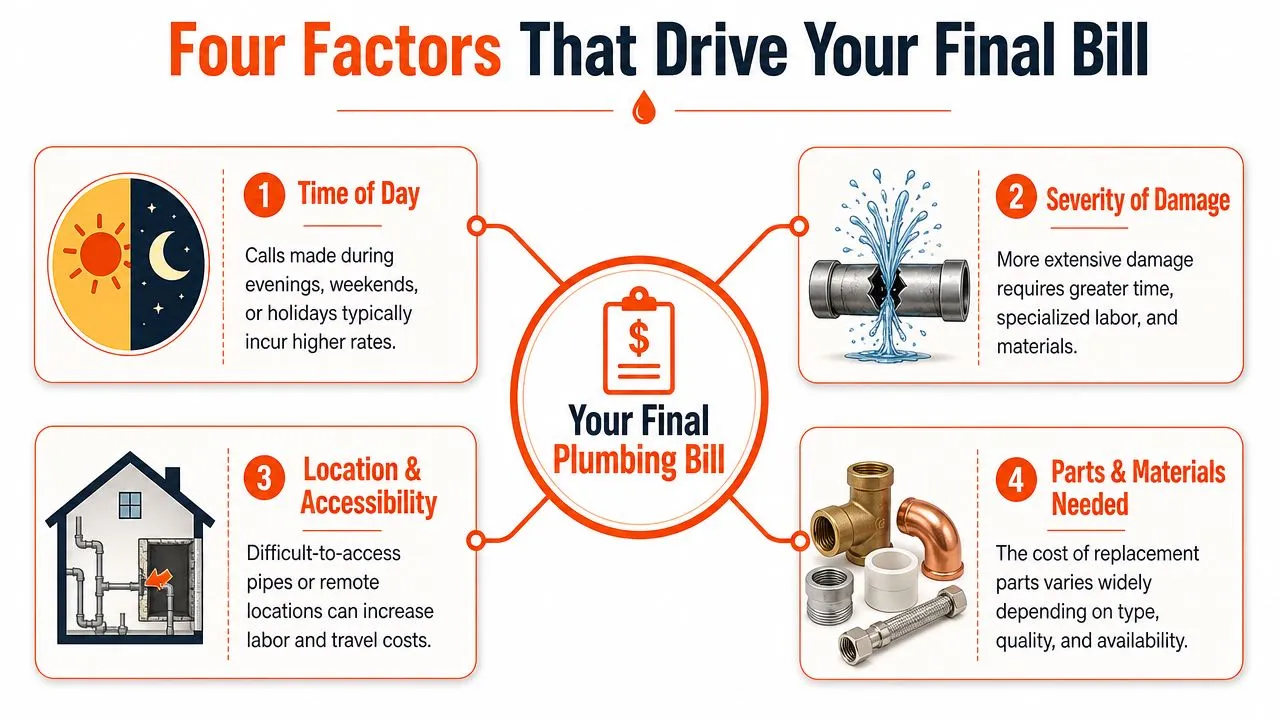
The four biggest drivers are timing, severity, accessibility, and parts.
Timing changes the math
The first thing to understand is rate structure. ServiceAgent’s plumbing pricing guide says emergency service commonly runs about $150 to $500 per hour, which is roughly a 1.5x to 3x premium over normal rates. It also says homeowners often pay a separate $75 to $300 service-call or trip fee, which can push the first-hour total much higher than the posted hourly rate.
So yes, a 2 a.m. holiday call will usually price very differently from a weekday evening visit.
Here’s the practical takeaway:
- Late night costs more because the crew is being pulled into true off-hours dispatch.
- Weekends and holidays cost more because availability is thinner.
- A same-night visit for a minor issue may be a convenience purchase, not a damage-control move.
This short video gives a useful visual on how plumbing repair costs can shift in the field.
Damage, access, and parts change everything
Severity is the next driver. A leak under a sink with an accessible shutoff is one kind of emergency. A ruptured line inside a wall is another. The harder it is to isolate and stop, the more labor you’re buying.
Accessibility matters more than homeowners expect. Pipes hidden in a crawlspace, behind tile, or under cabinets slow everything down. The plumber isn’t just repairing. They’re gaining access, protecting the area, and trying to avoid making a bad situation worse.
Then there are parts.
Some emergency calls only need labor and a basic fitting. Others need valves, connectors, water heater components, drain equipment, or replacement sections of pipe. If the repair needs harder-to-source parts at an odd hour, your options narrow and the bill can climb.
If you want the fastest estimate of where your bill is headed, ask yourself four things: what time is it, how much water is moving, how easy is the area to reach, and what likely has to be replaced?
What doesn’t work is assuming the hourly rate tells the whole story. On emergency jobs, the bill follows conditions on site.
When an Emergency Call Is Actually the Cheaper Option
A lot of homeowners try to avoid the emergency charge at all costs. That instinct makes sense. It’s just not always the cheapest decision.
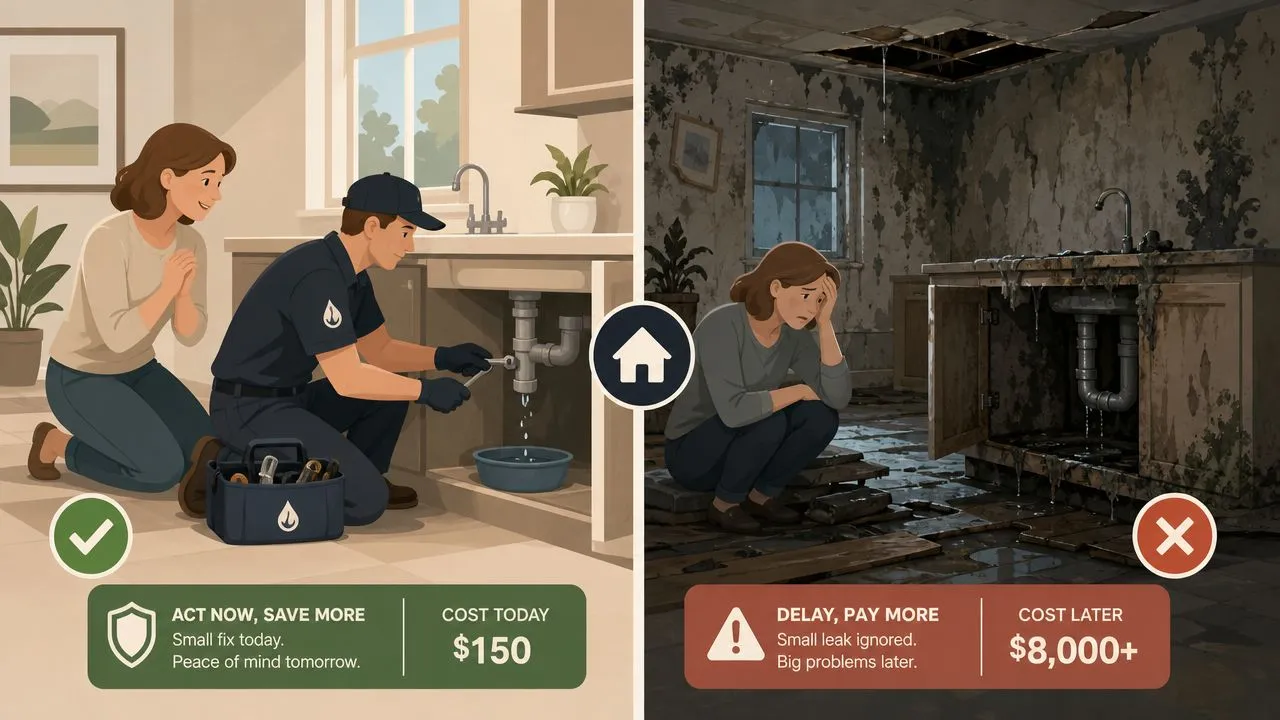
Carefree Home Pros explains that a minor after-hours call might cost $210 to $621, while delaying a severe leak can turn into a burst-pipe or sewer-backup event costing $600 to $4,000+ once water damage and restoration are involved. For severe leaks, immediate service is often the cheaper financial move.
Call now problems
Pay the premium now if the problem is still actively causing damage or can turn into a sanitation issue.
That usually includes:
- Active water flow that you can’t fully stop with a shutoff
- Water near finished floors, ceilings, walls, or cabinets
- A sewer backup
- A leaking water heater that’s spreading water
- Any leak that’s worsening quickly
If water has already gotten into walls or flooring, the plumbing bill may become only one part of the problem. At that point, it helps to understand what broader cleanup can involve, especially if moisture lingers long enough to create indoor air or contamination issues. This guide on mold remediation companies near you gives a useful look at that side of the risk.
Problems that can sometimes wait
Some issues can wait until morning if you can safely isolate them.
Examples include a slow drip into a bucket, a single fixture shut off at the local valve, or a toilet that’s out of service but not overflowing. In those cases, paying emergency rates may buy convenience more than protection.
The right question is simple: Will waiting likely increase total damage?
A severe leak is not a pricing problem first. It’s a loss-control problem.
If the answer is yes, call now. If the answer is no, schedule the first available standard appointment and avoid the premium.
Questions to Ask Your Plumber to Control the Cost
When homeowners get burned on emergency plumbing cost, it’s often not because the plumber was dishonest. It’s because nobody pinned down how the billing worked before the job started.
You don’t need fancy language here. You need clear questions.
What to ask on the phone
Ask these before the plumber leaves the shop:
- What’s your call-out or trip fee? Get that number first.
- What is your emergency hourly rate tonight? Don’t ask for the normal rate.
- Do you bill flat-rate or time and materials? That changes how surprises show up.
- How do you bill time? Ask whether they round time in blocks or charge actual time worked.
- Can I text photos or video first? Good plumbers can sometimes tell whether this sounds like “stop the damage now” or “wait until morning.”
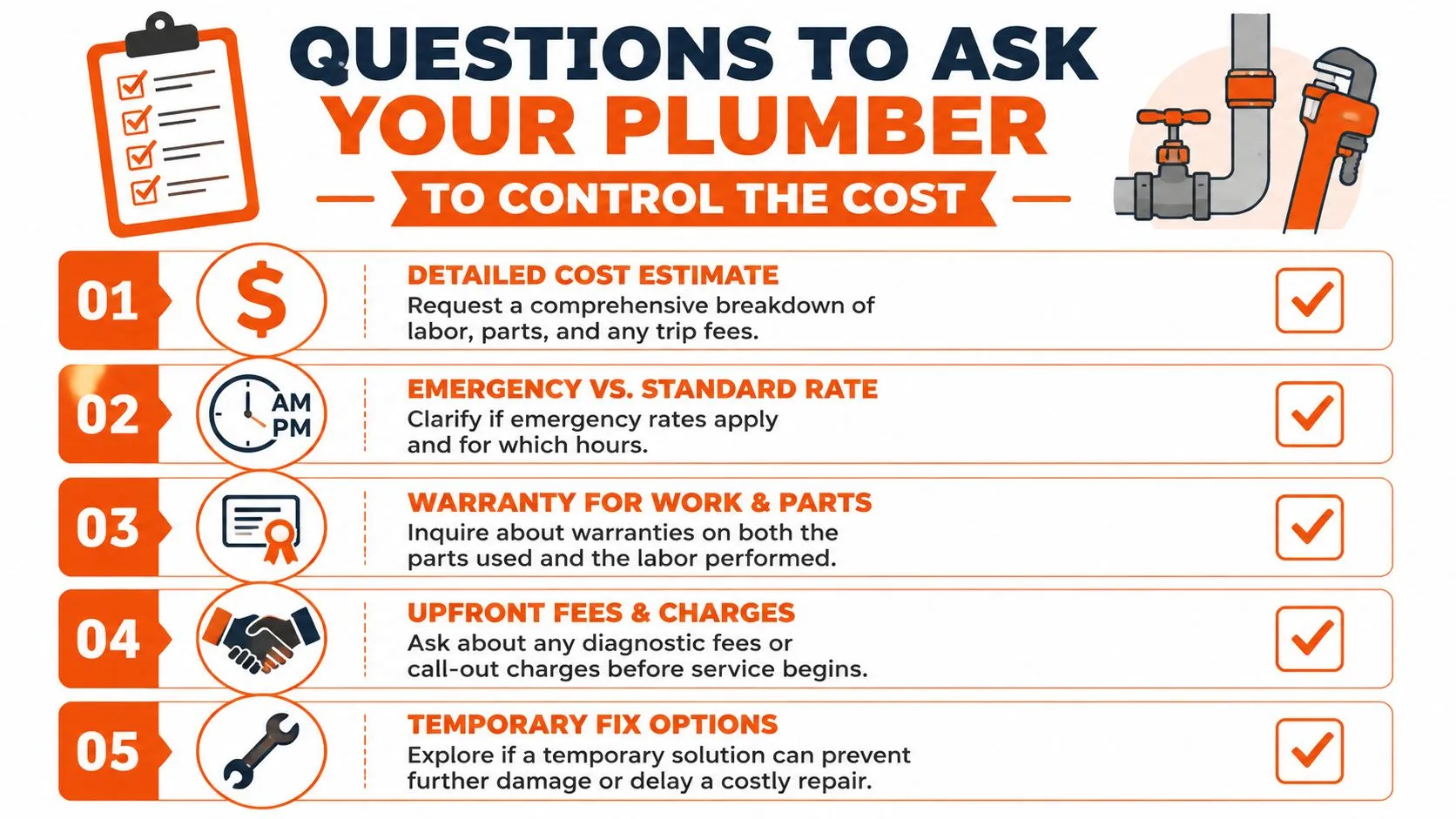
One more question matters a lot. Ask whether they can do a temporary stabilization if the full repair is too expensive or too invasive for the middle of the night. Sometimes capping a line, isolating a fixture, or stopping the immediate leak is enough to move the big repair into standard hours.
For plumbing companies, this kind of clear communication is also part of good marketing and sales operations. Shops that explain pricing well usually convert better and create less friction after the visit. This breakdown of plumbing lead generation gets into that business side.
What to confirm before work starts
Once the plumber arrives and diagnoses the issue, pause for one minute and ask for the work plan in plain English.
Use this script:
- What exactly failed?
- What has to be done tonight?
- What can wait until regular hours, if anything?
- What’s the expected total range before you begin?
- What parts are included in that number?
Then check the invoice before you pay.
Look for the trip charge, labor line, parts, and any separate emergency surcharge. If water escaped into the structure, ask whether the damage side may need separate documentation for your insurer.
Get the plumber to separate “must do now” from “should do later.” That one question can save real money.
What doesn’t work is approving a vague repair at a vague price because the situation feels urgent. Slow the conversation down, even if the job itself needs to move fast.
Making the Right Call When Water Is Everywhere
Emergency plumbing cost is high because the service is high-stakes. You’re paying for speed, access, and the chance to stop damage before it spreads.
That doesn’t mean every late-night problem deserves an emergency visit. Some do. Some don’t. The smart move is to judge the risk, not just the rate.
If the issue is contained, isolated, and stable, waiting for standard hours can save money. If water is still moving, spreading, or backing up, delaying can turn a plumbing bill into a much larger property problem. That’s especially true when cleanup starts crossing into the same kind of urgent response work discussed in storm damage restoration.
The best decision is usually the one that limits total damage, not just tonight’s invoice.
If you run a plumbing or home-service company and want more of the right calls, not just more traffic, FirstMention helps trades get found across search and AI platforms, capture missed opportunities, and turn demand into booked jobs with a system that’s built for how local service businesses operate.